School ended early for Cesare Villari. At the age of 14 he was
already working in a porcelain factory, but he didn’t mind, on
the contrary he was fascinated by that world. Being inquisitive,
he wanted to know everything about creation and production.
He often asked to change place to better understand the molding,
the cooking and every single step in the process.
He was in his 20s and he had already a lot of experience when
a 15 years old girl came into the atelier, her name was Silvia.
She too had a great passion for this job, maybe this brought
them closer. She asked him a lot of questions. They got on so
well that love didn’t take long to come and a few years later
they got married. They felt strong together. Who had the idea?
Who pushed the other to dare? One day they decided to leave
the factory to build a factory on their own. The firm Villari born
on an October morning of 1967. “At the beginning it wasn’t
easy” admits Cesare, but the enthusiasm, supported by an
indomitable will, allowed them to get over all the difficulties.
At the beginning they were only ten, but now about fifty people
work for Villari. Cesare is satisfied, he has had a “great life”:
he built a “great” factory and a “great” family, nowadays his
two daughters Alessandra and Barbara , a son Leone and a son-
in-law Jean Sebastien work for the company. The name Villari
is well known all over the world, there are Villari’s shops in
the most unlikely Countries like Iran, Chechnya, Azerbaijan,
Lithuania and Dagestan but even in the more traditional ones:
Japan, USA, China and, last but not the least, the brand shines
at Harrod’s in London. Every day Silvia and Cesare are at
work, looking for new shapes, trying to improve the technique
and helping their craftsmen to create even more beautiful
objects. The other family members run the administration and
the development of the company. “Is this family work easy?”
Cesare smiles, “It is not always simple, we are in contact every
single day. We must be patient, very patient!” he repeats like if
some recent event had come back to his mind. From the outside
the factory is not outstanding: just some industrial sheds. To
understand you have to enter the atelier where the heart of
the company beats. A very large hall with a profusion of lights
where everything is white, made even more so by a thin layer of
white chalk covering everything. Absolute silence, like in a old
monastery. An incredible amount of objects, similar to the cave
of an alchemist where a strange menagerie might stand out, or
Father Christmas’ workshop who, as an artist, might have given
up producing toys. Here rose petals are shaped, one different
from the other, like in nature, and then they are assembled into
delicate flowers. There, an elephant is being painted in a ugly
green “Don’t worry, it’s gold, but the real colour appears only
after the cooking!”. Over there decorations are applied with
a paintbrush to some goblets. Not far off some little ancient
characters are being dressed. Processions of angels, in ordinate
rows are waiting to be colored, rearing horses do not lose their
balance while waiting to receive their coating of crystals. We
start dreaming. At the end: the big kilns, like supreme altars
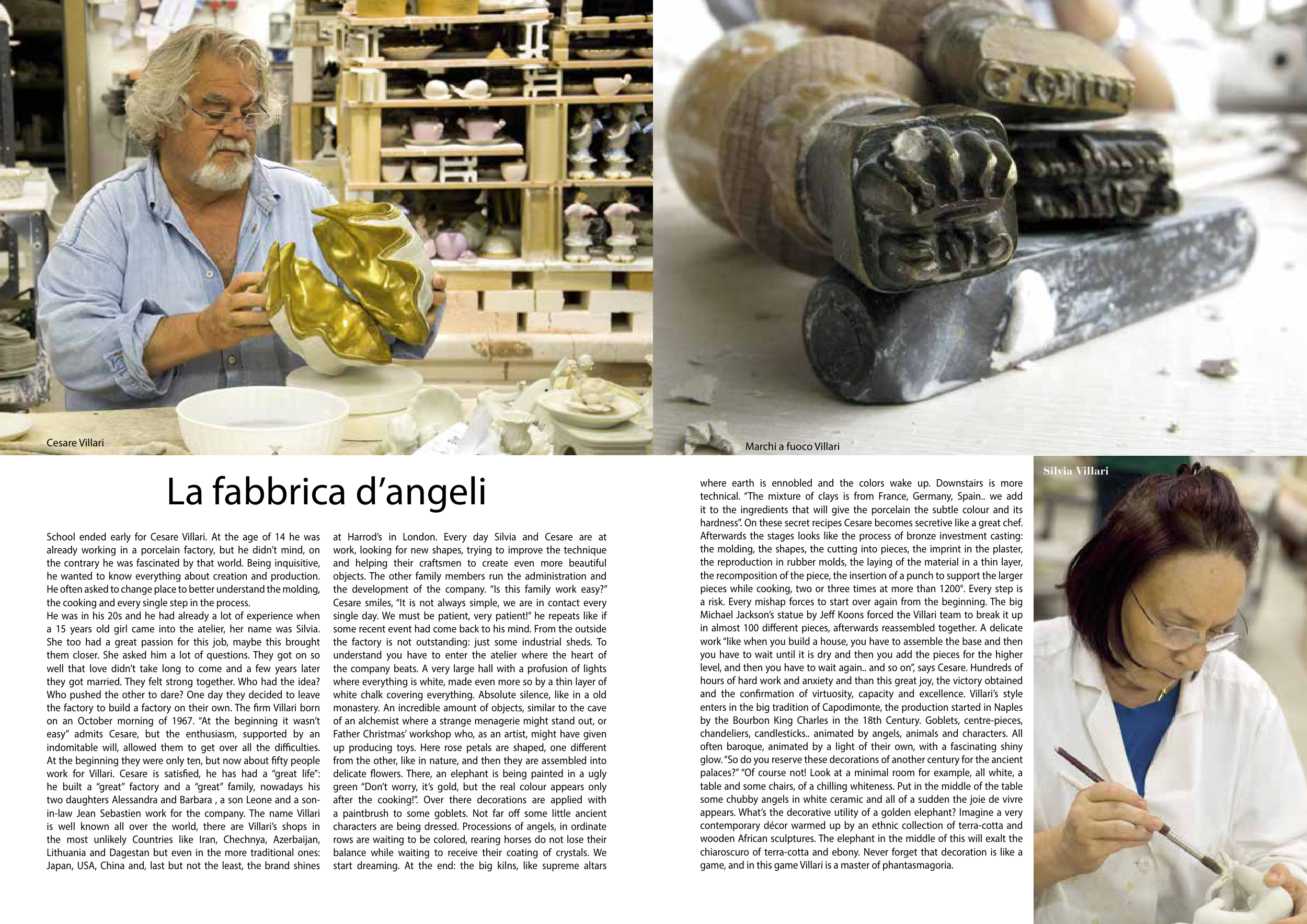
Cesare Villari
La fabbrica d’angeli
where earth is ennobled and the colors wake up. Downstairs is more
technical. “The mixture of clays is from France, Germany, Spain.. we add
it to the ingredients that will give the porcelain the subtle colour and its
hardness”. On these secret recipes Cesare becomes secretive like a great chef.
Afterwards the stages looks like the process of bronze investment casting:
the molding, the shapes, the cutting into pieces, the imprint in the plaster,
the reproduction in rubber molds, the laying of the material in a thin layer,
the recomposition of the piece, the insertion of a punch to support the larger
pieces while cooking, two or three times at more than 1200°. Every step is
a risk. Every mishap forces to start over again from the beginning. The big
Michael Jackson’s statue by Jeff Koons forced the Villari team to break it up
in almost 100 different pieces, afterwards reassembled together. A delicate
work “like when you build a house, you have to assemble the base and then
you have to wait until it is dry and then you add the pieces for the higher
level, and then you have to wait again.. and so on”, says Cesare. Hundreds of
hours of hard work and anxiety and than this great joy, the victory obtained
and the confirmation of virtuosity, capacity and excellence. Villari’s style
enters in the big tradition of Capodimonte, the production started in Naples
by the Bourbon King Charles in the 18th Century. Goblets, centre-pieces,
chandeliers, candlesticks.. animated by angels, animals and characters. All
often baroque, animated by a light of their own, with a fascinating shiny
glow. “So do you reserve these decorations of another century for the ancient
palaces?” “Of course not! Look at a minimal room for example, all white, a
table and some chairs, of a chilling whiteness. Put in the middle of the table
some chubby angels in white ceramic and all of a sudden the joie de vivre
appears. What’s the decorative utility of a golden elephant? Imagine a very
contemporary décor warmed up by an ethnic collection of terra-cotta and
wooden African sculptures. The elephant in the middle of this will exalt the
chiaroscuro of terra-cotta and ebony. Never forget that decoration is like a
game, and in this game Villari is a master of phantasmagoria.
Marchi a fuoco Villari