06 THONET
THONET 07
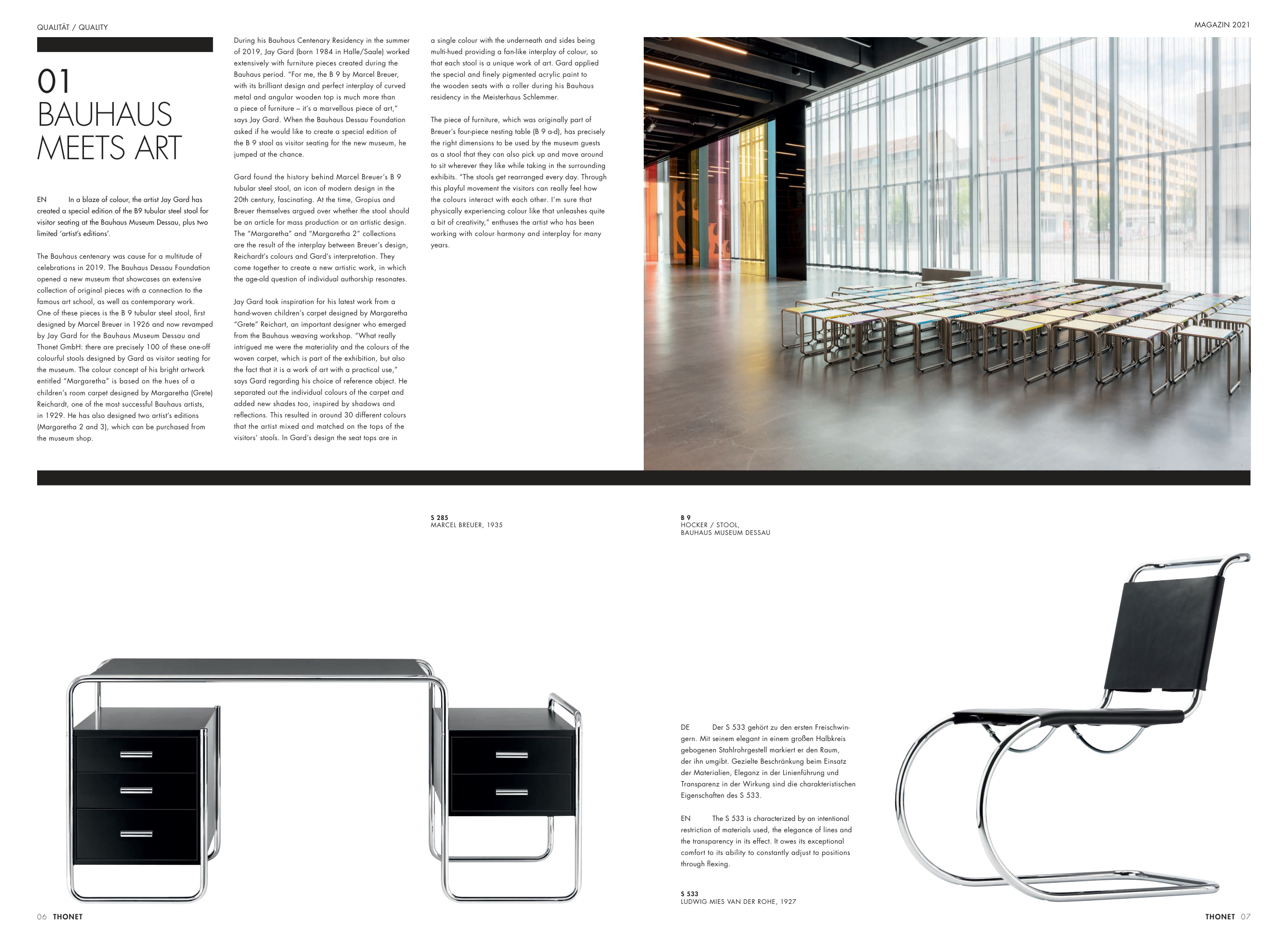
During his Bauhaus Centenary Residency in the summer
of 2019, Jay Gard (born 1984 in Halle/Saale) worked
extensively with furniture pieces created during the
Bauhaus period. “For me, the B 9 by Marcel Breuer,
with its brilliant design and perfect interplay of curved
metal and angular wooden top is much more than
a piece of furniture – it’s a marvellous piece of art,”
says Jay Gard. When the Bauhaus Dessau Foundation
asked if he would like to create a special edition of
the B 9 stool as visitor seating for the new museum, he
jumped at the chance.
Gard found the history behind Marcel Breuer’s B 9
tubular steel stool, an icon of modern design in the
20th century, fascinating. At the time, Gropius and
Breuer themselves argued over whether the stool should
be an article for mass production or an artistic design.
The “Margaretha” and “Margaretha 2” collections
are the result of the interplay between Breuer’s design,
Reichardt’s colours and Gard’s interpretation. They
come together to create a new artistic work, in which
the age-old question of individual authorship resonates.
Jay Gard took inspiration for his latest work from a
hand-woven children’s carpet designed by Margaretha
“Grete” Reichart, an important designer who emerged
from the Bauhaus weaving workshop. “What really
intrigued me were the materiality and the colours of the
woven carpet, which is part of the exhibition, but also
the fact that it is a work of art with a practical use,”
says Gard regarding his choice of reference object. He
separated out the individual colours of the carpet and
added new shades too, inspired by shadows and
reflections. This resulted in around 30 different colours
that the artist mixed and matched on the tops of the
visitors’ stools. In Gard’s design the seat tops are in
QUALITÄT / QUALITY
01
BAUHAUS
MEETS ART
B 9
HOCKER / STOOL,
BAUHAUS MUSEUM DESSAU
MAGAZIN 2021
a single colour with the underneath and sides being
multi-hued providing a fan-like interplay of colour, so
that each stool is a unique work of art. Gard applied
the special and finely pigmented acrylic paint to
the wooden seats with a roller during his Bauhaus
residency in the Meisterhaus Schlemmer.
The piece of furniture, which was originally part of
Breuer’s four-piece nesting table (B 9 a-d), has precisely
the right dimensions to be used by the museum guests
as a stool that they can also pick up and move around
to sit wherever they like while taking in the surrounding
exhibits. “The stools get rearranged every day. Through
this playful movement the visitors can really feel how
the colours interact with each other. I’m sure that
physically experiencing colour like that unleashes quite
a bit of creativity,” enthuses the artist who has been
working with colour harmony and interplay for many
years.
EN
In a blaze of colour, the artist Jay Gard has
created a special edition of the B9 tubular steel stool for
visitor seating at the Bauhaus Museum Dessau, plus two
limited ‘artist’s editions’.
The Bauhaus centenary was cause for a multitude of
celebrations in 2019. The Bauhaus Dessau Foundation
opened a new museum that showcases an extensive
collection of original pieces with a connection to the
famous art school, as well as contemporary work.
One of these pieces is the B 9 tubular steel stool, first
designed by Marcel Breuer in 1926 and now revamped
by Jay Gard for the Bauhaus Museum Dessau and
Thonet GmbH: there are precisely 100 of these one-off
colourful stools designed by Gard as visitor seating for
the museum. The colour concept of his bright artwork
entitled “Margaretha” is based on the hues of a
children’s room carpet designed by Margaretha (Grete)
Reichardt, one of the most successful Bauhaus artists,
in 1929. He has also designed two artist’s editions
(Margaretha 2 and 3), which can be purchased from
the museum shop.
DE
Der S 533 gehört zu den ersten Freischwin-
gern. Mit seinem elegant in einem großen Halbkreis
gebogenen Stahlrohrgestell markiert er den Raum,
der ihn umgibt. Gezielte Beschränkung beim Einsatz
der Materialien, Eleganz in der Linienführung und
Trans parenz in der Wirkung sind die charakteristischen
Eigenschaften des S 533.
EN
The S 533 is characterized by an intentional
restriction of materials used, the elegance of lines and
the transparency in its effect. It owes its exceptional
comfort to its ability to constantly adjust to positions
through flexing.
S 533
LUDWIG MIES VAN DER ROHE, 1927
S 285
MARCEL BREUER, 1935