72
73
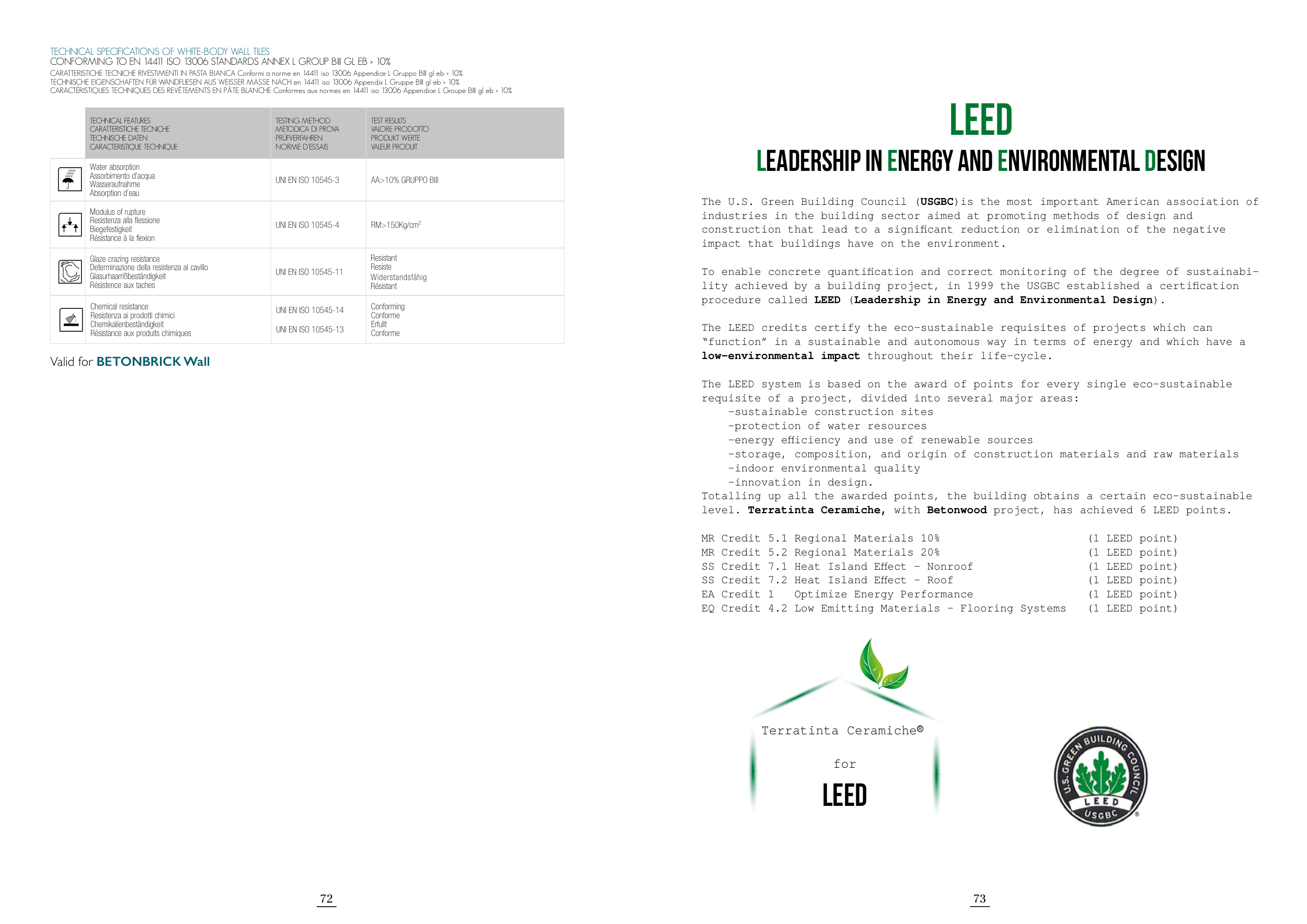
Water absorption
Assorbimento d’acqua
Wasseraufnahme
Absorption d’eau
UNI EN ISO 10545-3
AA>10% GRUPPO BIII
Modulus of rupture
Resistenza alla flessione
Biegefestigkeit
Résistance à la flexion
UNI EN ISO 10545-4
RM>150Kg/cm2
Glaze crazing resistance
Determinazione della resistenza al cavillo
Glasurhaarrißbeständigkeit
Résistence aux taches
UNI EN ISO 10545-11
Resistant
Resiste
Widerstandsfähig
Résistant
Chemical resistance
Resistenza ai prodotti chimici
Chemikalienbeständigkeit
Résistance aux produits chimiques
UNI EN ISO 10545-14
UNI EN ISO 10545-13
Conforming
Conforme
Erfullt
Conforme
TECHNICAL FEATURES
CARATTERISTICHE TECNICHE
TECHNISCHE DATEN
CARACTERISTIQUE TECHNIQUE
TESTING METHOD
METODICA DI PROVA
PRÜFVERFAHREN
NORME D’ESSAIS
TEST RESULTS
VALORE PRODOTTO
PRODUKT WERTE
VALEUR PRODUIT
TECHNICAL SPECIFICATIONS OF WHITE-BODY WALL TILES
CONFORMING TO EN 14411 ISO 13006 STANDARDS ANNEX L GROUP BIII GL EB > 10%
CARATTERISTICHE TECNICHE RIVESTIMENTI IN PASTA BIANCA Conformi a norme en 14411 iso 13006 Appendice L Gruppo BIII gl eb > 10%
TECHNISCHE EIGENSCHAFTEN FÜR WANDFLIESEN AUS WEISSER MASSE NACH en 14411 iso 13006 Appendix L Gruppe BIII gl eb > 10%
CARACTÉRISTIQUES TECHNIQUES DES REVÊTEMENTS EN PÂTE BLANCHE Conformes aux normes en 14411 iso 13006 Appendice L Groupe BIII gl eb > 10%
Valid for BETONBRICK Wall
Terratinta Ceramiche
for
LEED
R
LEED
Leadership in Energy and Environmental Design
The U.S. Green Building Council (USGBC)is the most important American association of
industries in the building sector aimed at promoting methods of design and
construction that lead to a signifcant reduction or elimination of the negative
impact that buildings have on the environment.
To enable concrete quantifcation and correct monitoring of the degree of sustainabi-
lity achieved by a building project, in 1999 the USGBC established a certifcation
procedure called LEED (Leadership in Energy and Environmental Design).
The LEED credits certify the eco-sustainable requisites of projects which can
“function” in a sustainable and autonomous way in terms of energy and which have a
low-environmental impact throughout their life-cycle.
The LEED system is based on the award of points for every single eco-sustainable
requisite of a project, divided into several major areas:
-sustainable construction sites
-protection of water resources
-energy eficiency and use of renewable sources
-storage, composition, and origin of construction materials and raw materials
-indoor environmental quality
-innovation in design.
Totalling up all the awarded points, the building obtains a certain eco-sustainable
level. Terratinta Ceramiche, with Betonwood project, has achieved 6 LEED points.
MR Credit 5.1 Regional Materials 10% (1 LEED point)
MR Credit 5.2 Regional Materials 20% (1 LEED point)
SS Credit 7.1 Heat Island Efect – Nonroof (1 LEED point)
SS Credit 7.2 Heat Island Efect – Roof (1 LEED point)
EA Credit 1 Optimize Energy Performance (1 LEED point)
EQ Credit 4.2 Low Emitting Materials – Flooring Systems (1 LEED point)