Copyright www.qlt.it • qlt@qlt.it
4
Durata di vita del Led - LED lifetime
La durata di vita è uno dei vantaggi dei LED di potenza.
Essi sono dei semiconduttori, quindi potenzialmente hanno una
vita infinita o quasi. In realtà nel fabbricare questi componenti
si utilizzano delle sostanze chimiche che nel tempo perdono di
efficienza.
Come illustrato nel disegno, intorno al chip di silicio viene posta
una gelatina di silicone morbido che permette il passaggio della
luce e protegge il chip dalla rottura dovuta alle differenti dilatazioni
termiche della lente e del supporto metallico di dissipazione.
Tale gelatina, nel tempo, tende a opacizzare diminuendo la resa
luminosa.
La lente di materiale plastico con il passare delle ore tende a
ingiallire cambiando la tonalità della luce. Il riflettore interno si
ossida riflettendo di meno. Il calore ha la proprietà di accelerare
questo processo e i cicli termici di accensione/spegnimento fanno
si che la vita utile sia circa la metà di quella di partenza. Il valore
teorico di vita è di 100.000 ore .
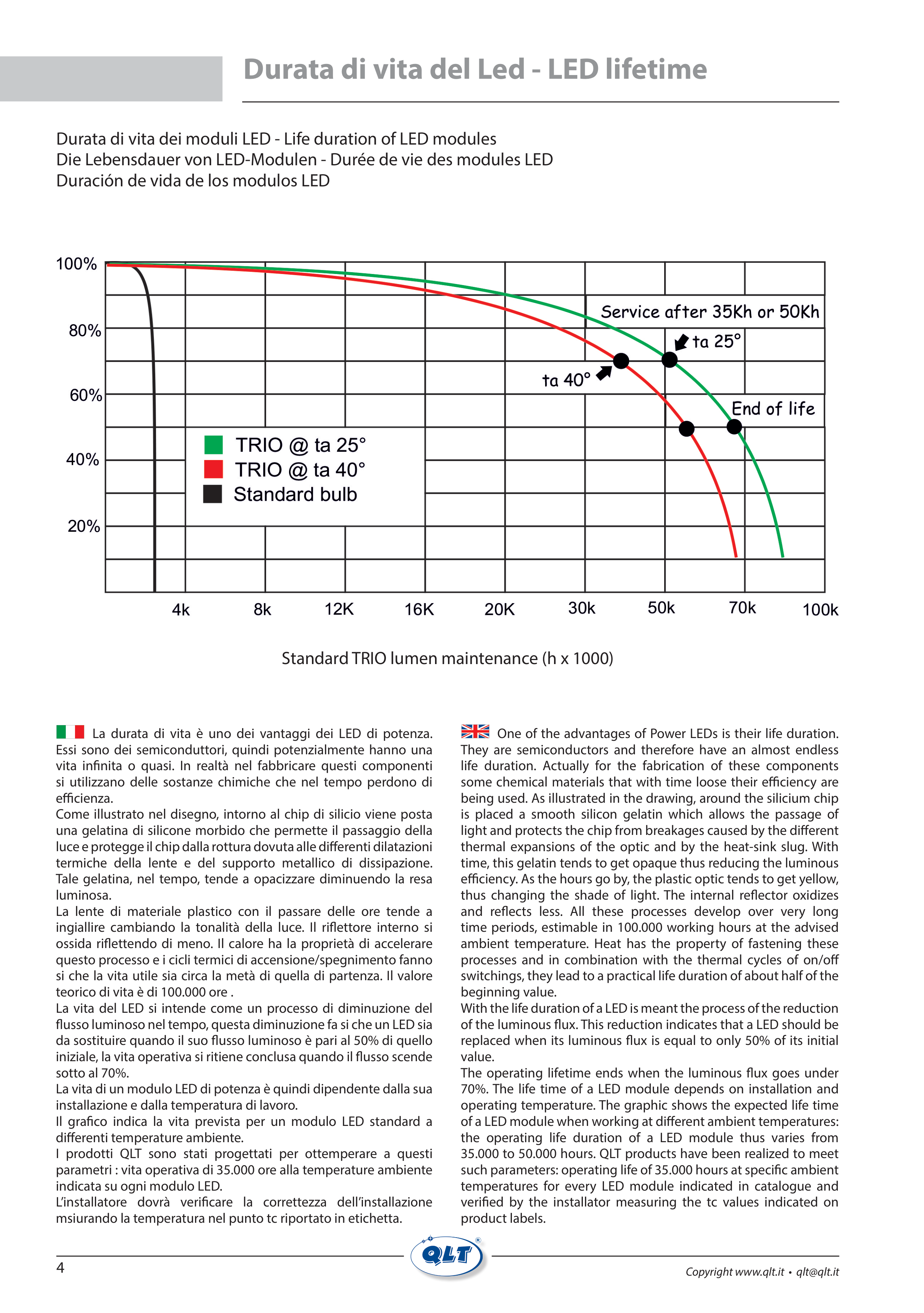
La vita del LED si intende come un processo di diminuzione del
flusso luminoso nel tempo, questa diminuzione fa si che un LED sia
da sostituire quando il suo flusso luminoso è pari al 50% di quello
iniziale, la vita operativa si ritiene conclusa quando il flusso scende
sotto al 70%.
La vita di un modulo LED di potenza è quindi dipendente dalla sua
installazione e dalla temperatura di lavoro.
Il grafico indica la vita prevista per un modulo LED standard a
differenti temperature ambiente.
I prodotti QLT sono stati progettati per ottemperare a questi
parametri : vita operativa di 35.000 ore alla temperature ambiente
indicata su ogni modulo LED.
L’installatore dovrà verificare la correttezza dell’installazione
msiurando la temperatura nel punto tc riportato in etichetta.
One of the advantages of Power LEDs is their life duration.
They are semiconductors and therefore have an almost endless
life duration. Actually for the fabrication of these components
some chemical materials that with time loose their efficiency are
being used. As illustrated in the drawing, around the silicium chip
is placed a smooth silicon gelatin which allows the passage of
light and protects the chip from breakages caused by the different
thermal expansions of the optic and by the heat-sink slug. With
time, this gelatin tends to get opaque thus reducing the luminous
efficiency. As the hours go by, the plastic optic tends to get yellow,
thus changing the shade of light. The internal reflector oxidizes
and reflects less. All these processes develop over very long
time periods, estimable in 100.000 working hours at the advised
ambient temperature. Heat has the property of fastening these
processes and in combination with the thermal cycles of on/off
switchings, they lead to a practical life duration of about half of the
beginning value.
With the life duration of a LED is meant the process of the reduction
of the luminous flux. This reduction indicates that a LED should be
replaced when its luminous flux is equal to only 50% of its initial
value.
The operating lifetime ends when the luminous flux goes under
70%. The life time of a LED module depends on installation and
operating temperature. The graphic shows the expected life time
of a LED module when working at different ambient temperatures:
the operating life duration of a LED module thus varies from
35.000 to 50.000 hours. QLT products have been realized to meet
such parameters: operating life of 35.000 hours at specific ambient
temperatures for every LED module indicated in catalogue and
verified by the installator measuring the tc values indicated on
product labels.
Standard TRIO lumen maintenance (h x 1000)
Durata di vita dei moduli LED - Life duration of LED modules
Die Lebensdauer von LED-Modulen - Durée de vie des modules LED
Duración de vida de los modulos LED