237
Tables, Tables basses, Bureaux
Tische, Tischchen, Schreibtische
Tables, Small Tables, Desks
Tavoli, Tavolini, Scrivanie
La fi nitura in nero, anche questa
recuperata dalla versione originale che
Frattini progettò insieme all’ebanista,
è ottenuta con una verniciatura nera
a poro aperto, applicata sulla struttura
in legno massello di faggio.
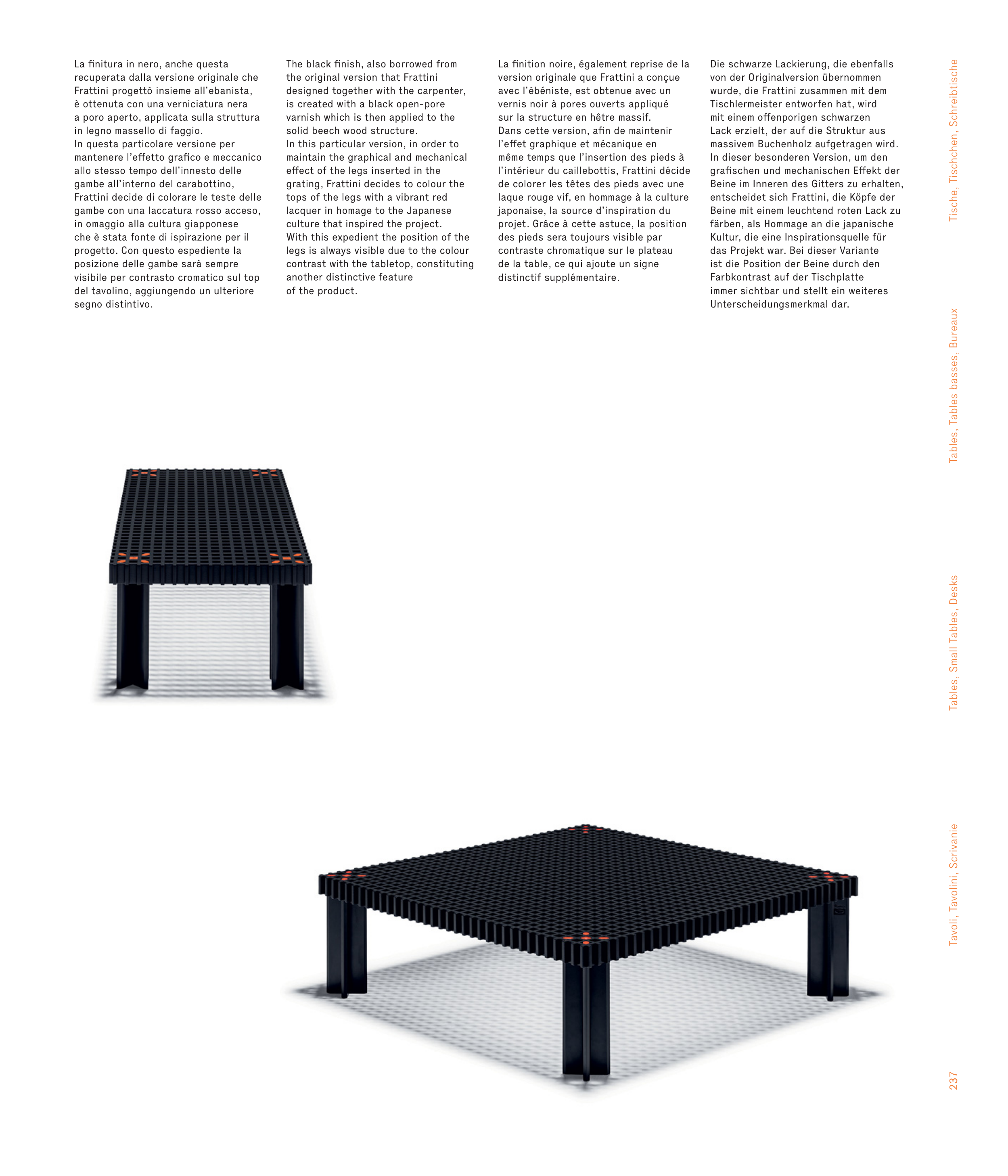
In questa particolare versione per
mantenere l’eff etto grafi co e meccanico
allo stesso tempo dell’innesto delle
gambe all’interno del carabottino,
Frattini decide di colorare le teste delle
gambe con una laccatura rosso acceso,
in omaggio alla cultura giapponese
che è stata fonte di ispirazione per il
progetto. Con questo espediente la
posizione delle gambe sarà sempre
visibile per contrasto cromatico sul top
del tavolino, aggiungendo un ulteriore
segno distintivo.
La fi nition noire, également reprise de la
version originale que Frattini a conçue
avec l’ébéniste, est obtenue avec un
vernis noir à pores ouverts appliqué
sur la structure en hêtre massif.
Dans cette version, afi n de maintenir
l’eff et graphique et mécanique en
même temps que l’insertion des pieds à
l’intérieur du caillebottis, Frattini décide
de colorer les têtes des pieds avec une
laque rouge vif, en hommage à la culture
japonaise, la source d’inspiration du
projet. Grâce à cette astuce, la position
des pieds sera toujours visible par
contraste chromatique sur le plateau
de la table, ce qui ajoute un signe
distinctif supplémentaire.
The black fi nish, also borrowed from
the original version that Frattini
designed together with the carpenter,
is created with a black open-pore
varnish which is then applied to the
solid beech wood structure.
In this particular version, in order to
maintain the graphical and mechanical
eff ect of the legs inserted in the
grating, Frattini decides to colour the
tops of the legs with a vibrant red
lacquer in homage to the Japanese
culture that inspired the project.
With this expedient the position of the
legs is always visible due to the colour
contrast with the tabletop, constituting
another distinctive feature
of the product.
Die schwarze Lackierung, die ebenfalls
von der Originalversion übernommen
wurde, die Frattini zusammen mit dem
Tischlermeister entworfen hat, wird
mit einem off enporigen schwarzen
Lack erzielt, der auf die Struktur aus
massivem Buchenholz aufgetragen wird.
In dieser besonderen Version, um den
grafi schen und mechanischen Eff ekt der
Beine im Inneren des Gitters zu erhalten,
entscheidet sich Frattini, die Köpfe der
Beine mit einem leuchtend roten Lack zu
färben, als Hommage an die japanische
Kultur, die eine Inspirationsquelle für
das Projekt war. Bei dieser Variante
ist die Position der Beine durch den
Farbkontrast auf der Tischplatte
immer sichtbar und stellt ein weiteres
Unterscheidungsmerkmal dar.