329
Complements, Accessoires
Erganzungsmöbel, Zubehore
Complementary Units, Accessories
Complementi, Accessori
328
Poltrona Frau
I Tappeti — Chado
I
P
e
a
r
l
G
r
a
y
S
o
f
t
B
l
u
e
A
n
t
i
q
u
e
Y
e
ll
o
w
C
o
p
p
e
r
E
a
rl
G
r
a
y
La serie Chado racconta tecniche di
lavorazione che appartengono da sempre
alla cultura del tappeto. Delicati fili
di seta di bambù e corposi fili di lino,
lavorati secondo l’antico procedimento
dell’annodatura, compongono tappeti di
valore tridimensionale.
Nelle civiltà nomadi, infatti, i tappeti
definivano spazi da abitare e dovevano
avere un loro spessore per isolare dal
suolo, in una sorta di coibentazione
tessile. Nei tappeti Chado i minuscoli
nodi vengono poi tagliati uno per uno
secondo una lavorazione chiamata
cut. L’effetto è un manto vellutato,
continuamente cangiante, dove la
lucentezza della seta si alterna
all’opacità del lino, che ha anche la
funzione di dare pienezza alla texture.
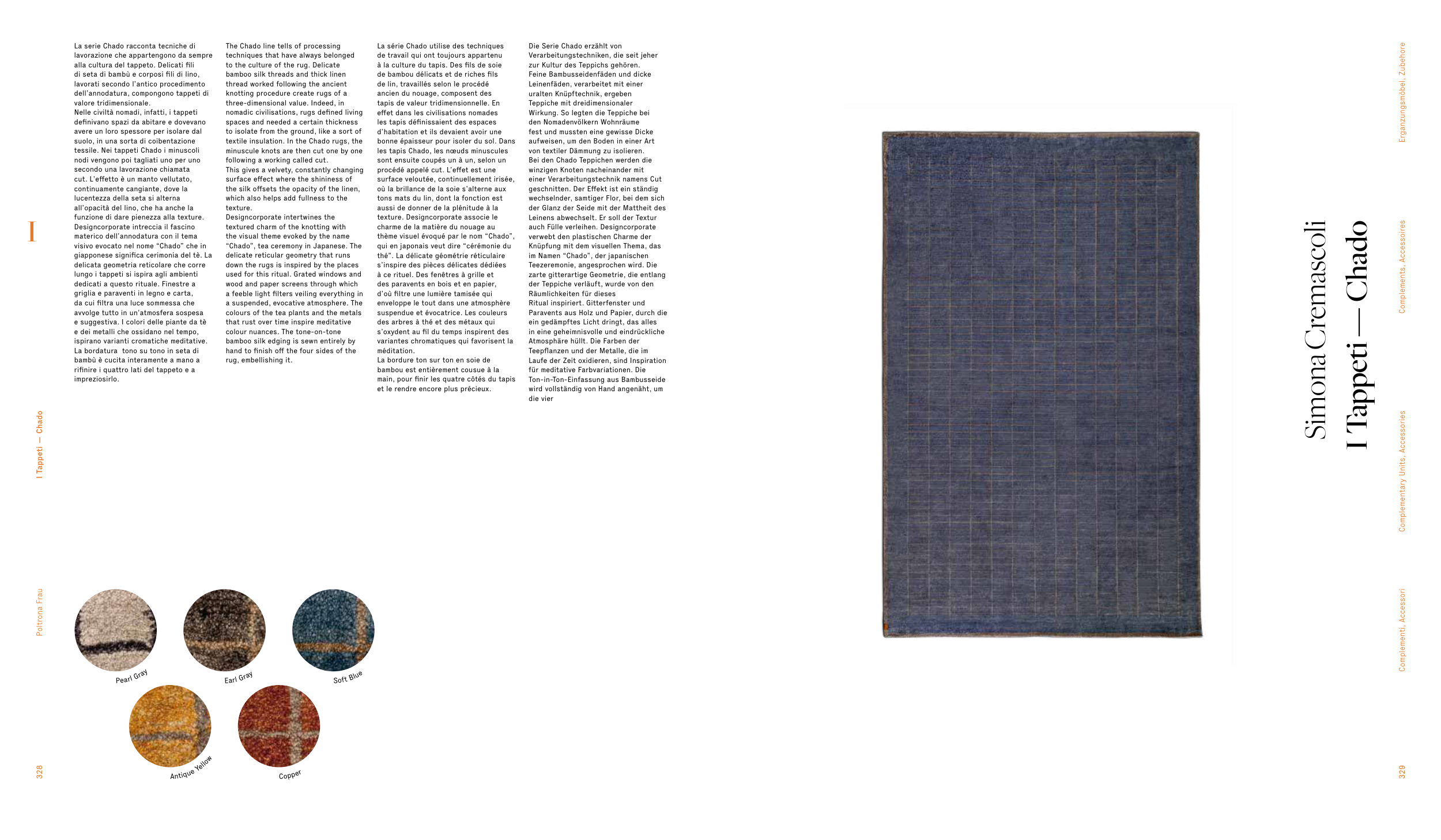
Designcorporate intreccia il fascino
materico dell’annodatura con il tema
visivo evocato nel nome “Chado” che in
giapponese significa cerimonia del tè. La
delicata geometria reticolare che corre
lungo i tappeti si ispira agli ambienti
dedicati a questo rituale. Finestre a
griglia e paraventi in legno e carta,
da cui filtra una luce sommessa che
avvolge tutto in un’atmosfera sospesa
e suggestiva. I colori delle piante da tè
e dei metalli che ossidano nel tempo,
ispirano varianti cromatiche meditative.
La bordatura tono su tono in seta di
bambù è cucita interamente a mano a
rifinire i quattro lati del tappeto e a
impreziosirlo.
The Chado line tells of processing
techniques that have always belonged
to the culture of the rug. Delicate
bamboo silk threads and thick linen
thread worked following the ancient
knotting procedure create rugs of a
three-dimensional value. Indeed, in
nomadic civilisations, rugs defined living
spaces and needed a certain thickness
to isolate from the ground, like a sort of
textile insulation. In the Chado rugs, the
minuscule knots are then cut one by one
following a working called cut.
This gives a velvety, constantly changing
surface effect where the shininess of
the silk offsets the opacity of the linen,
which also helps add fullness to the
texture.
Designcorporate intertwines the
textured charm of the knotting with
the visual theme evoked by the name
“Chado”, tea ceremony in Japanese. The
delicate reticular geometry that runs
down the rugs is inspired by the places
used for this ritual. Grated windows and
wood and paper screens through which
a feeble light filters veiling everything in
a suspended, evocative atmosphere. The
colours of the tea plants and the metals
that rust over time inspire meditative
colour nuances. The tone-on-tone
bamboo silk edging is sewn entirely by
hand to finish off the four sides of the
rug, embellishing it.
La série Chado utilise des techniques
de travail qui ont toujours appartenu
à la culture du tapis. Des fils de soie
de bambou délicats et de riches fils
de lin, travaillés selon le procédé
ancien du nouage, composent des
tapis de valeur tridimensionnelle. En
effet dans les civilisations nomades
les tapis définissaient des espaces
d’habitation et ils devaient avoir une
bonne épaisseur pour isoler du sol. Dans
les tapis Chado, les nœuds minuscules
sont ensuite coupés un à un, selon un
procédé appelé cut. L’effet est une
surface veloutée, continuellement irisée,
où la brillance de la soie s’alterne aux
tons mats du lin, dont la fonction est
aussi de donner de la plénitude à la
texture. Designcorporate associe le
charme de la matière du nouage au
thème visuel évoqué par le nom “Chado”,
qui en japonais veut dire “cérémonie du
thé”. La délicate géométrie réticulaire
s’inspire des pièces délicates dédiées
à ce rituel. Des fenêtres à grille et
des paravents en bois et en papier,
d’où filtre une lumière tamisée qui
enveloppe le tout dans une atmosphère
suspendue et évocatrice. Les couleurs
des arbres à thé et des métaux qui
s’oxydent au fil du temps inspirent des
variantes chromatiques qui favorisent la
méditation.
La bordure ton sur ton en soie de
bambou est entièrement cousue à la
main, pour finir les quatre côtés du tapis
et le rendre encore plus précieux.
Die Serie Chado erzählt von
Verarbeitungstechniken, die seit jeher
zur Kultur des Teppichs gehören.
Feine Bambusseidenfäden und dicke
Leinenfäden, verarbeitet mit einer
uralten Knüpftechnik, ergeben
Teppiche mit dreidimensionaler
Wirkung. So legten die Teppiche bei
den Nomadenvölkern Wohnräume
fest und mussten eine gewisse Dicke
aufweisen, um den Boden in einer Art
von textiler Dämmung zu isolieren.
Bei den Chado Teppichen werden die
winzigen Knoten nacheinander mit
einer Verarbeitungstechnik namens Cut
geschnitten. Der Effekt ist ein ständig
wechselnder, samtiger Flor, bei dem sich
der Glanz der Seide mit der Mattheit des
Leinens abwechselt. Er soll der Textur
auch Fülle verleihen. Designcorporate
verwebt den plastischen Charme der
Knüpfung mit dem visuellen Thema, das
im Namen “Chado”, der japanischen
Teezeremonie, angesprochen wird. Die
zarte gitterartige Geometrie, die entlang
der Teppiche verläuft, wurde von den
Räumlichkeiten für dieses
Ritual inspiriert. Gitterfenster und
Paravents aus Holz und Papier, durch die
ein gedämpftes Licht dringt, das alles
in eine geheimnisvolle und eindrückliche
Atmosphäre hüllt. Die Farben der
Teepflanzen und der Metalle, die im
Laufe der Zeit oxidieren, sind Inspiration
für meditative Farbvariationen. Die
Ton-in-Ton-Einfassung aus Bambusseide
wird vollständig von Hand angenäht, um
die vier
I Tappeti — Chado
Simona Cremascoli