Photometric laboratory
Quality, tests, certifications
To illuminate with led –
photo-biological risk
With the coming onto the market of high power LED technology, usable
both as common and signaling lighting, a confused marketing of poorly
performing and unsafe products from a photo-biological viewpoint has taken
place.
Therefore the Group chose to use high power LED from leading brands only.
On an international level a now standard has been fixed: EN62471 (IEC62471).
This standard deals in a transversal way with the photo-biological risks of
lighting sources and especially of LED devices and products using specific
types of discharge lamps and LED light sources.
A classification of GROUPS OF PHOTO-BIOLOGICAL RISKS under which
luminaires may fall has been drawn.
The Groups of risks are defined as follows:
Group of Risk Nil:
The luminaires do not pose any photo-biological risks.
Group of Risk 1:
The luminaires do not cause photo-biological damage for the risk is cancelled
by the common behavioral reaction of a person to the exposure to a light
source.
Group of Risk 2:
The luminaires cannot cause photo-biological damage for the risk is cancelled
by instinctive reaction of looking away from a very bright and strong light or
from a thermal suffering.
Group of Risk 3:
The luminaires may cause photo-biological damage; risk is high even for a
short or instant exposure. It is strongly advised to not use the luminaires for
general lighting.
Production checks
PRODUCTION CHECKS
All products are subject to a vast number of accurate checks directly in the
production line. Checks are done with control instruments that are checked
and managed by the quality system procedure jointly with the indications
reported on the “Minimum Values for Electrical Tests” List of the IEC/EN 60598-
1 – Luminaires standard. This ensures the reliability and the compliance with
security and performance of the product the Client expects.
Training of technical department
By constantly attending upgrade courses proposed by the industry
associations and different certifying bodies, a fundamental importance is
given to the specific training of the technical department.
The company attends the meetings of the industry association (ASSIL) and
is present in the 34D and 34A subcommittee of CEI (Italian Electro-technical
Committee).
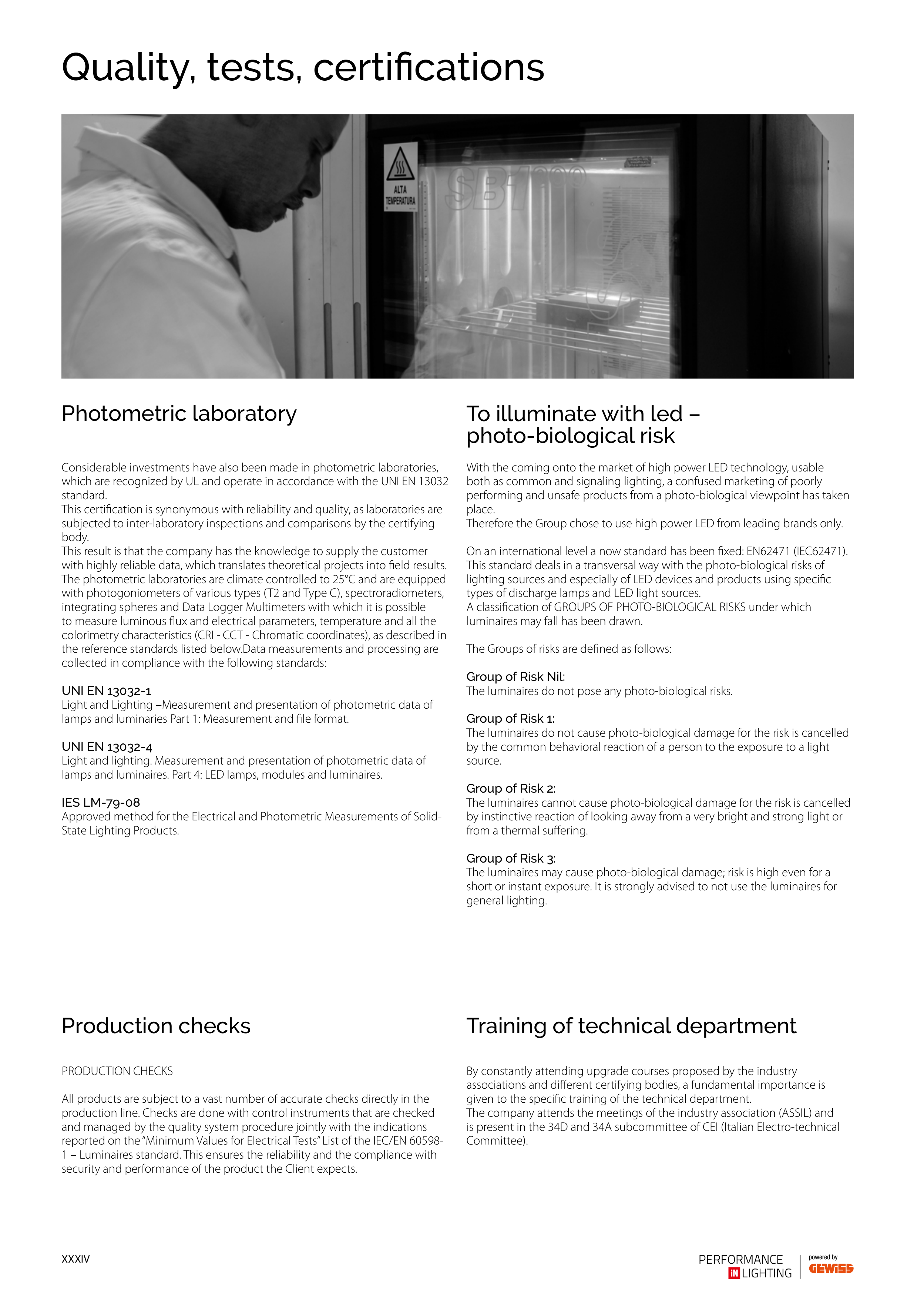
Considerable investments have also been made in photometric laboratories,
which are recognized by UL and operate in accordance with the UNI EN 13032
standard.
This certification is synonymous with reliability and quality, as laboratories are
subjected to inter-laboratory inspections and comparisons by the certifying
body.
This result is that the company has the knowledge to supply the customer
with highly reliable data, which translates theoretical projects into field results.
The photometric laboratories are climate controlled to 25°C and are equipped
with photogoniometers of various types (T2 and Type C), spectroradiometers,
integrating spheres and Data Logger Multimeters with which it is possible
to measure luminous flux and electrical parameters, temperature and all the
colorimetry characteristics (CRI - CCT - Chromatic coordinates), as described in
the reference standards listed below.Data measurements and processing are
collected in compliance with the following standards:
UNI EN 13032-1
Light and Lighting –Measurement and presentation of photometric data of
lamps and luminaries Part 1: Measurement and file format.
UNI EN 13032-4
Light and lighting. Measurement and presentation of photometric data of
lamps and luminaires. Part 4: LED lamps, modules and luminaires.
IES LM-79-08
Approved method for the Electrical and Photometric Measurements of Solid-
State Lighting Products.
XXXIV