E R E S
L O S P I R I T O D E L L A N A T U R A
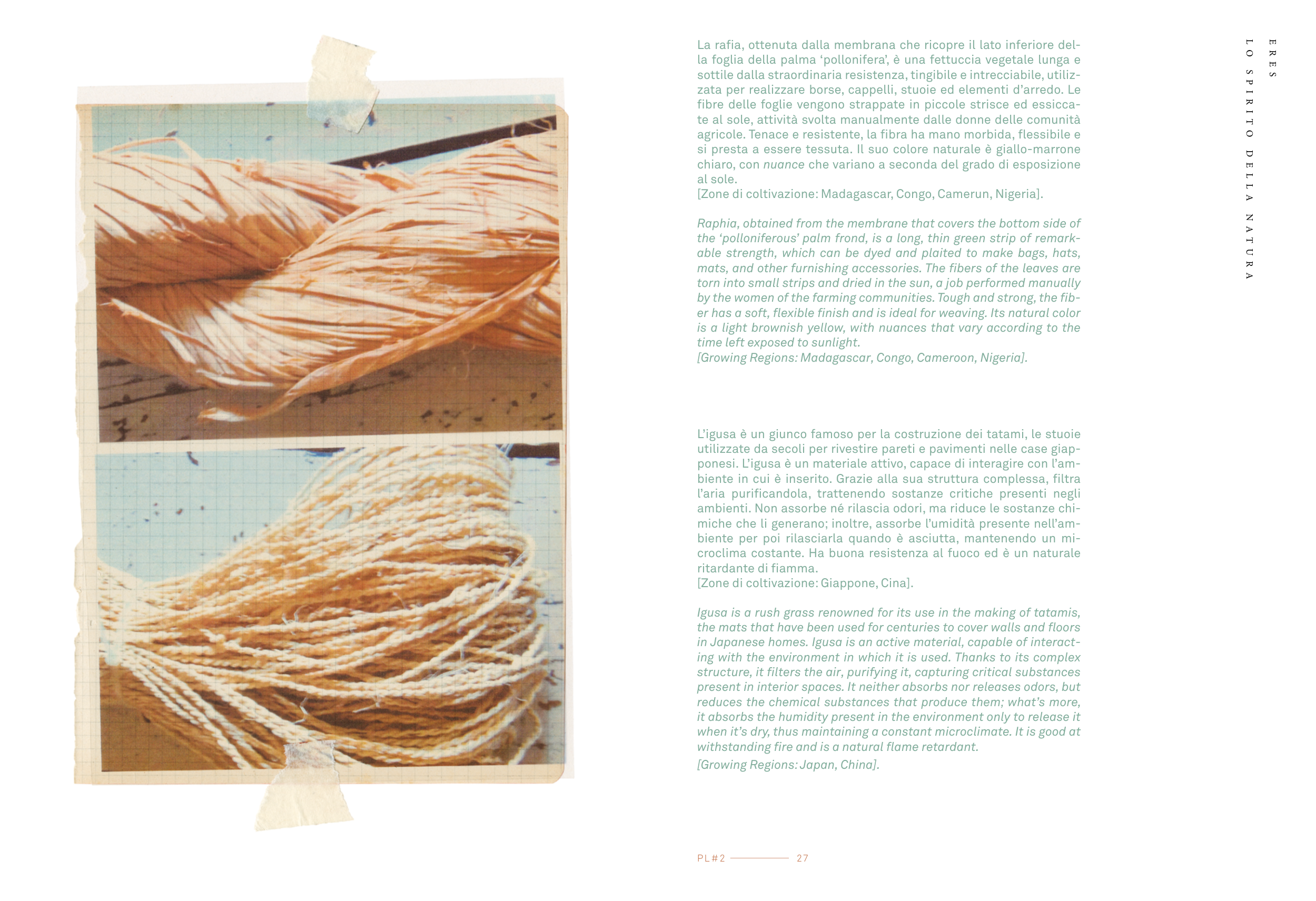
La rafia, ottenuta dalla membrana che ricopre il lato inferiore del-
la foglia della palma ‘pollonifera’, è una fettuccia vegetale lunga e
sottile dalla straordinaria resistenza, tingibile e intrecciabile, utiliz-
zata per realizzare borse, cappelli, stuoie ed elementi d’arredo. Le
fibre delle foglie vengono strappate in piccole strisce ed essicca-
te al sole, attività svolta manualmente dalle donne delle comunità
agricole. Tenace e resistente, la fibra ha mano morbida, flessibile e
si presta a essere tessuta. Il suo colore naturale è giallo-marrone
chiaro, con nuance che variano a seconda del grado di esposizione
al sole.
[Zone di coltivazione: Madagascar, Congo, Camerun, Nigeria].
Raphia, obtained from the membrane that covers the bottom side of
the ‘polloniferous’ palm frond, is a long, thin green strip of remark-
able strength, which can be dyed and plaited to make bags, hats,
mats, and other furnishing accessories. The fibers of the leaves are
torn into small strips and dried in the sun, a job performed manually
by the women of the farming communities. Tough and strong, the fib-
er has a soft, flexible finish and is ideal for weaving. Its natural color
is a light brownish yellow, with nuances that vary according to the
time left exposed to sunlight.
[Growing Regions: Madagascar, Congo, Cameroon, Nigeria].
L’igusa è un giunco famoso per la costruzione dei tatami, le stuoie
utilizzate da secoli per rivestire pareti e pavimenti nelle case giap-
ponesi. L’igusa è un materiale attivo, capace di interagire con l’am-
biente in cui è inserito. Grazie alla sua struttura complessa, filtra
l’aria purificandola, trattenendo sostanze critiche presenti negli
ambienti. Non assorbe né rilascia odori, ma riduce le sostanze chi-
miche che li generano; inoltre, assorbe l’umidità presente nell’am-
biente per poi rilasciarla quando è asciutta, mantenendo un mi-
croclima costante. Ha buona resistenza al fuoco ed è un naturale
ritardante di fiamma.
[Zone di coltivazione: Giappone, Cina].
Igusa is a rush grass renowned for its use in the making of tatamis,
the mats that have been used for centuries to cover walls and floors
in Japanese homes. Igusa is an active material, capable of interact-
ing with the environment in which it is used. Thanks to its complex
structure, it filters the air, purifying it, capturing critical substances
present in interior spaces. It neither absorbs nor releases odors, but
reduces the chemical substances that produce them; what’s more,
it absorbs the humidity present in the environment only to release it
when it’s dry, thus maintaining a constant microclimate. It is good at
withstanding fire and is a natural flame retardant.
[Growing Regions: Japan, China].
pl#2
27