169
tic. He has consolidated his excavation prac-
tices. He knows the rhetorical power of the
media and the historian, and by cannibalizing
knows an image or artifact can still be full of
meaning. He uses as a starting point the vast
repertoire of the collective unconscious, to-
day so saturated with assaults, trauma, and
shock, that it has become repressed almost
in real time.
We list a few examples: Bam, is a series of
1950s stamps from Afghanistan that in 2016
were meticulously “revised” by the artist, ma-
king a simple iconoclastic gesture. With a ra-
zor, he carefully deleted the Buddha statues,
making this historical lapse almost physical
and newly visible.
The black frames produced by Serretta an-
nounce – Coming soon. The language of cine-
matic trailers is clearly noted here. Only after
having read a translation in Russian, Arabic,
and other languages, does the game unfold.
Maybe this time it won’t tell of yet another di-
verting thriller. What these flags announce,
the symbol of contemporary jihadism, is that
the worst is yet to come – A Venir!
In the series, Landscape – the labyrinth of
references reaches its maximum effective-
ness. We all know that desert landscape. It
is tied to all the iconography of the exotic
Western – but more recently it has become
a representation of the other, of the un-
known, and of lurking danger. Two square
monochromes, one black and one orange,
harmoniously occupy the central part of the
landscape. They remind us of the Guanta-
namo detention center, but also the specta-
cular recent beheadings of Westerners, where
this color iconology is overturned. Here the
relationship between the torturer and the
victim never becomes clearly defined. The
formal equilibrium of the composition beco-
mes a sort of perpetual motor. The change
of roles remains locked up in the work as an
ominous potential.
The Rodchenko style table, shown under the
photos, follows the same chromatic logic. The
measure of the table becomes here a di-
stance, but also a possible proximity between
the two parts, the two others. They invite a
comparison, a dialogue, a sportive game that
has its own rulebook (As Soon as Possible).
Previous work extracted elements from po-
pular culture, such as Hollywood cinema,
with truisms that seem almost prophetic: “Ei-
ther die a hero, or live long enough to become
the villain.” A direct quote from Batman, The
Dark Knight – translated into Arabic – beco-
mes a provocative slogan of a society of bo-
redom and fatigue.
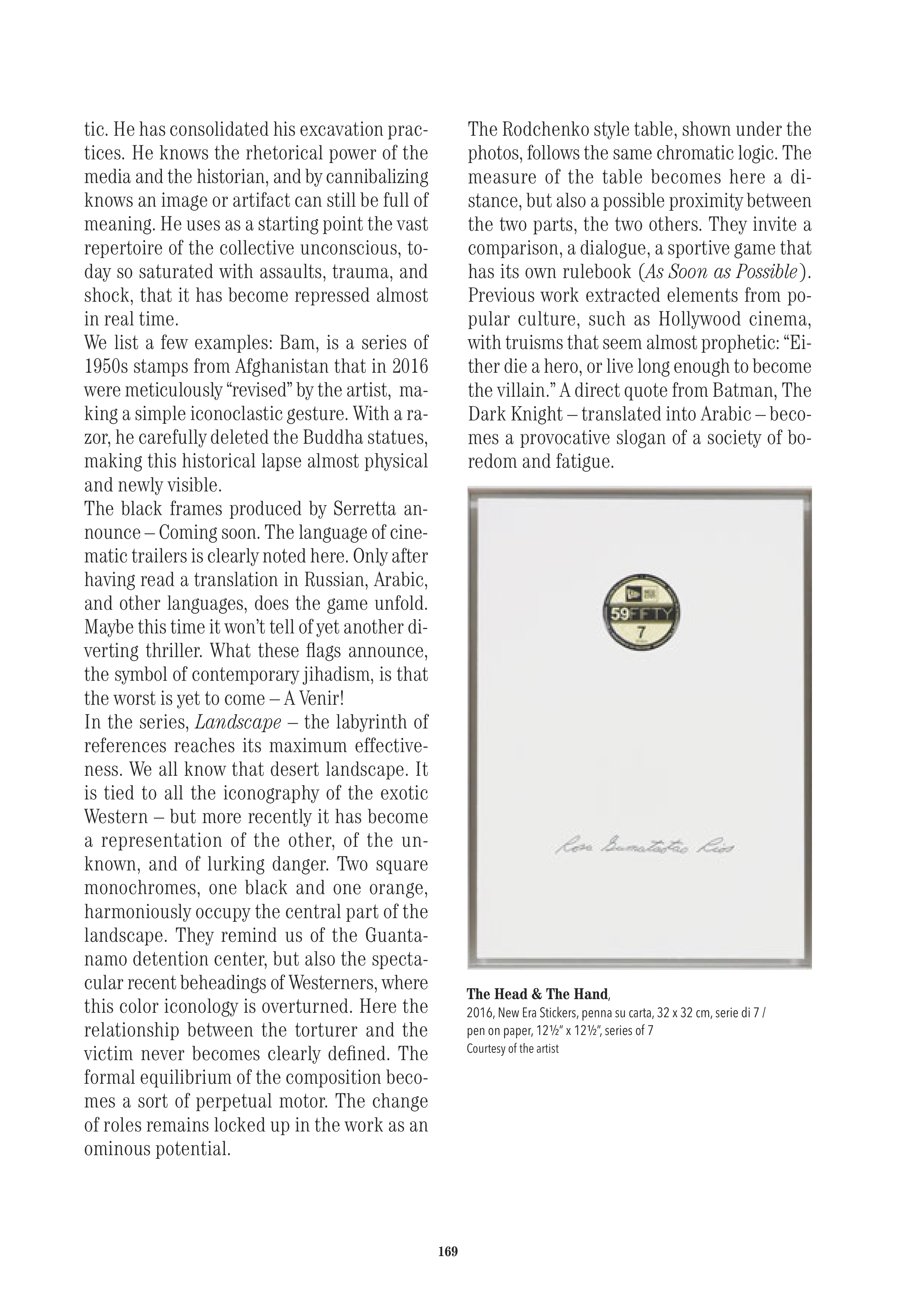
The Head & The Hand,
2016, New Era Stickers, penna su carta, 32 x 32 cm, serie di 7 /
pen on paper, 12½” x 12½”, series of 7
Courtesy of the artist