trolled way, I thought, a new aesthetic
might arise without actually altering the
material itself. The goal was to deepen
the existing material spectrum, not to
find new ones.
Can you describe your technique?
rt: I start with galvanized steel chicken
wire. My technique involves forming the
mesh into cylinders, which are then
secured over a mould. By pulling on one
side, the material simultaneously
stretches and suctions itself to the mould
and ‘sets’. It’s a bit like taking a sock off
your foot. If you pull at one end, the sock
grabs your foot. This means I can control
the shape extremely well. Through the
process of stretching, tension is trapped
in the material, reinforcing it.
Moooi translated my artisanal
process into an industrial one. Where I
stopped, they took over. Now I get to see
all the machines I dreamed of in action,
with clever features and moulds I
couldn’t possibly afford. It’s a nice step
in the process: to see your products
grow up.
How did you come into
contact with Moooi?
rt: It was a couple of years ago, and only
by chance. I met one of Moooi’s manufac-
turers – the company making the
Raimond lamp. I was visiting as part of a
group of people working with LEDs. One
day I decided to bring in a prototype of
my Filigree floor lamp to make the
conversation more concrete. The owner
of the company saw potential and wanted
to carry it through to manufacture.
Development began but we ran into some
issues, so he suggested showing it to
Moooi.
Just before Filigree was launched in
Milan [2016], I was exhibiting the lamp
along with the Meshmatics chandelier at
a fair in Dubai. The next booth over just
happened to belong to Marcel Wanders. I
hadn’t met him yet, but had been
developing a product together with his
company for almost three years, so I
plucked up the courage to introduce
myself. He then asked who had designed
the Meshmatics chandelier – and why I
hadn’t shown it to him. I guess I was just
in the right place at the right time.
Were you actively looking for a
brand to take on your products?
rt: I invested everything I had in
graduating, leaving me completely broke
afterwards. People approached me
during my show, asking if I could make a
lamp for their homes. It was such a huge
compliment – and saying yes was a way
to buy groceries. It was nice to immedi-
ately get to work and make a living, but
things quickly got out of hand. More
orders came in, and I began selling to
stores and architects. The idea of trying
to collaborate with a brand came up after
about a year. If you have your own studio
that also manufactures its own products,
you might design for a tiny percentage of
your time. I got a bit sick of that. I was
only producing, going to fairs, dealing
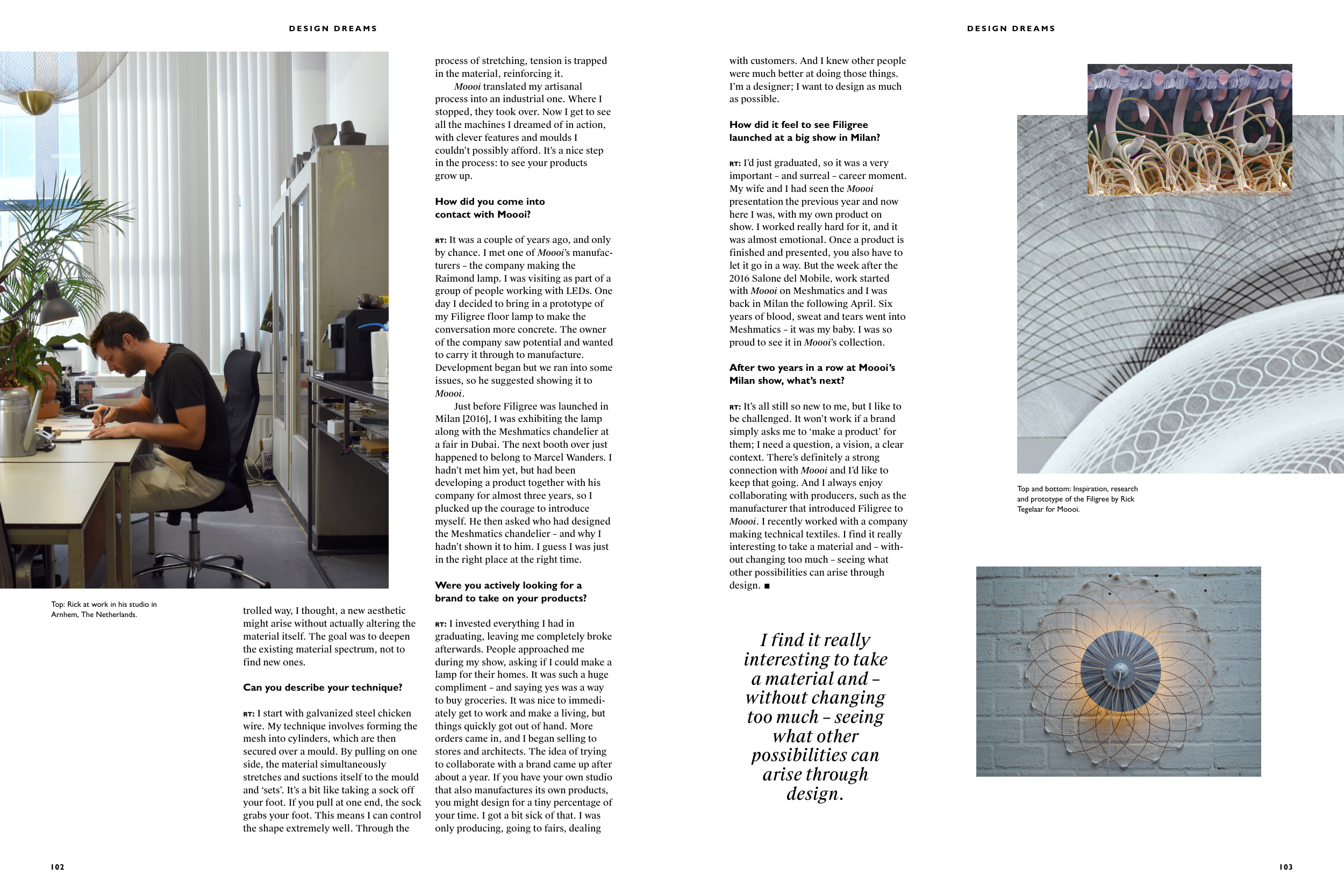
Top: Rick at work in his studio in
Arnhem, The Netherlands.
D E S I G N D R E A M S
with customers. And I knew other people
were much better at doing those things.
I’m a designer; I want to design as much
as possible.
How did it feel to see Filigree
launched at a big show in Milan?
rt: I’d just graduated, so it was a very
important – and surreal – career moment.
My wife and I had seen the Moooi
presentation the previous year and now
here I was, with my own product on
show. I worked really hard for it, and it
was almost emotional. Once a product is
finished and presented, you also have to
let it go in a way. But the week after the
2016 Salone del Mobile, work started
with Moooi on Meshmatics and I was
back in Milan the following April. Six
years of blood, sweat and tears went into
Meshmatics – it was my baby. I was so
proud to see it in Moooi’s collection.
After two years in a row at Moooi’s
Milan show, what’s next?
rt: It’s all still so new to me, but I like to
be challenged. It won’t work if a brand
simply asks me to ‘make a product’ for
them; I need a question, a vision, a clear
context. There’s definitely a strong
connection with Moooi and I’d like to
keep that going. And I always enjoy
collaborating with producers, such as the
manufacturer that introduced Filigree to
Moooi. I recently worked with a company
making technical textiles. I find it really
interesting to take a material and – with-
out changing too much – seeing what
other possibilities can arise through
design. ■
Top and bottom: Inspiration, research
and prototype of the Filigree by Rick
Tegelaar for Moooi.
D E S I G N D R E A M S
I find it really
interesting to take
a material and –
without changing
too much – seeing
what other
possibilities can
arise through
design.
102
103