INTERVIEW BY TRACEY INGRAM
How did you start out as a designer?
rick tegelaar: Much of my youth was
spent in our garage, dismantling broken
appliances and machines. I was always
working with my hands, and became
interested in engineering and technology.
After starting in one of the top classes at
high school, I eventually trickled down
the ranks, just barely getting my
diploma. In the Netherlands that
situation forces graduates into a more
practical education path, so I studied
engineering. I really enjoyed harnessing
my technical skills and working with
metal – I still do. It’s no coincidence that
Filigree and Meshmatics – two of my
products manufactured by Moooi – incor-
porate a lot of metal.
After studying engineering for a
year I decided to move on. The discipline
is all about making a goal, setting
calculations, and then achieving that
goal. I wanted to explore a bit more, to
have some flexibility, and ended up in the
product design department of ArtEZ in
Arnhem. In 2011 I graduated with the
Meshmatics technique.
You developed the
technique yourself?
rt: When you want to graduate you’re
prompted to discover yourself – to find
out what you’re good at and then apply
that to a design context. I’m skilled with
machines and materials, and wanted to
find a way of working with those
elements to really add value to the design
industry. I began by looking into simple
materials, one of which was wire mesh. If
I could find a way to form it in a con-
D E S I G N D R E A M S
Rick Tegelaar
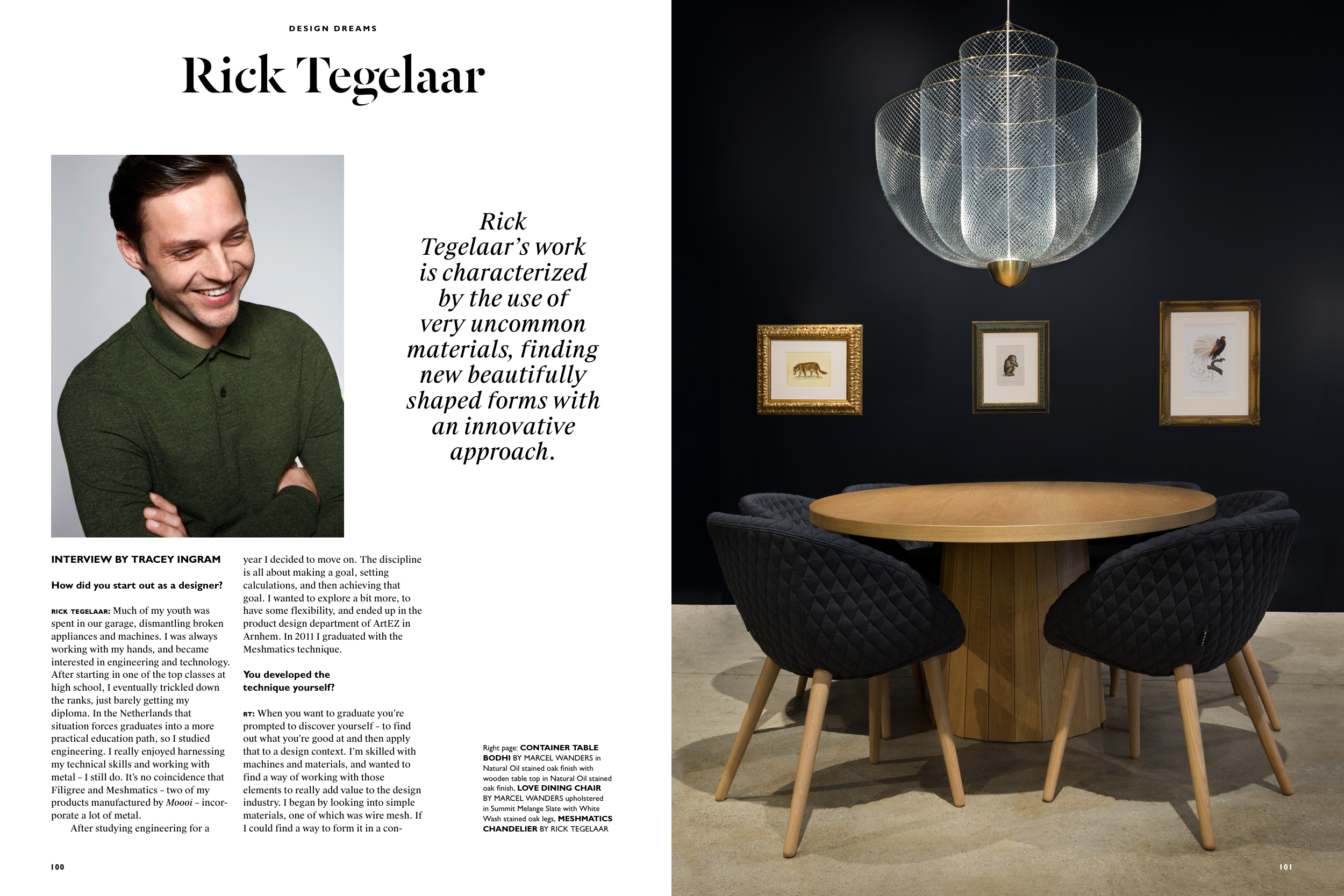
Right page: CONTAINER TABLE
BODHI BY MARCEL WANDERS in
Natural Oil stained oak fi nish with
wooden table top in Natural Oil stained
oak fi nish, LOVE DINING CHAIR
BY MARCEL WANDERS upholstered
in Summit Melange Slate with White
Wash stained oak legs, MESHMATICS
CHANDELIER BY RICK TEGELAAR
Rick
Tegelaar’s work
is characterized
by the use of
very uncommon
materials, finding
new beautifully
shaped forms with
an innovative
approach.
100
101