result was the Von Trapp Dining Room.
What was the response in Milan?
jk: Priveekollektie gallery saw the chairs
and wanted a whole series. The catch was
that they needed them within a few
months for an exhibition. That experi-
ence was the real test for us as a duo: can
we work together creatively when a client
is involved? Luckily it was a huge success
and we managed to make seven chair
variations. From then on Kranen/Gille
felt like an official company.
jg: The chairs’ backrests were laser-cut
from layers of aluminium, allowing us to
make theatrical ornamentation. First we
created a kitschy Austrian autumnal
view, but we also explored our combined
passions: New York Art Deco, Victorian
England, the Ruhrgebiet, Industrial
Revolution.
jk: We used the chairs to make a sample
chart of our fascinations as a duo.
So your initial work was largely
for galleries, not brands?
jk: Yes, but we were more interested in
making our work accessible to a larger
public, which meant producing in greater
numbers.
jg: We began to rediscover our love for
industrial design – it was written on our
diplomas, after all. It’s fun to make a
product so intelligently that it’s suitable
for mass manufacture. A brand like
Moooi takes that challenge extremely far.
They make results like no other, but they
dare to do it with edgy artistic work.
jk: And they put the designer at the
centre. You’re involved in every stage of
development.
Your fi rst product for Moooi is
the Plant Chandelier. How did
the product come about?
jk: It’s part of a larger Plant series, which
is based on industry imitating nature.
After successfully showing our seven
chairs at Priveekollektie, we wondered
what to do next. We retreated to Tuscany,
locking ourselves in a house to draw and
drink wine. Eventually we came back to
the concept of translating circuit boards
into objects – something I’d explored
during my graduation project at DAE. We
thought we could expand on the idea.
The first ‘sprout’ was a small table, but
we saw the potential for lamps and other
furniture pieces, too. The table was about
form; adding electricity to the series
came second. First we made a large lamp
with a cord. When we started developing
D E S I G N D R E A M S
We were more
interested in making
our work accessible to
a larger public, which
meant producing in
greater numbers.
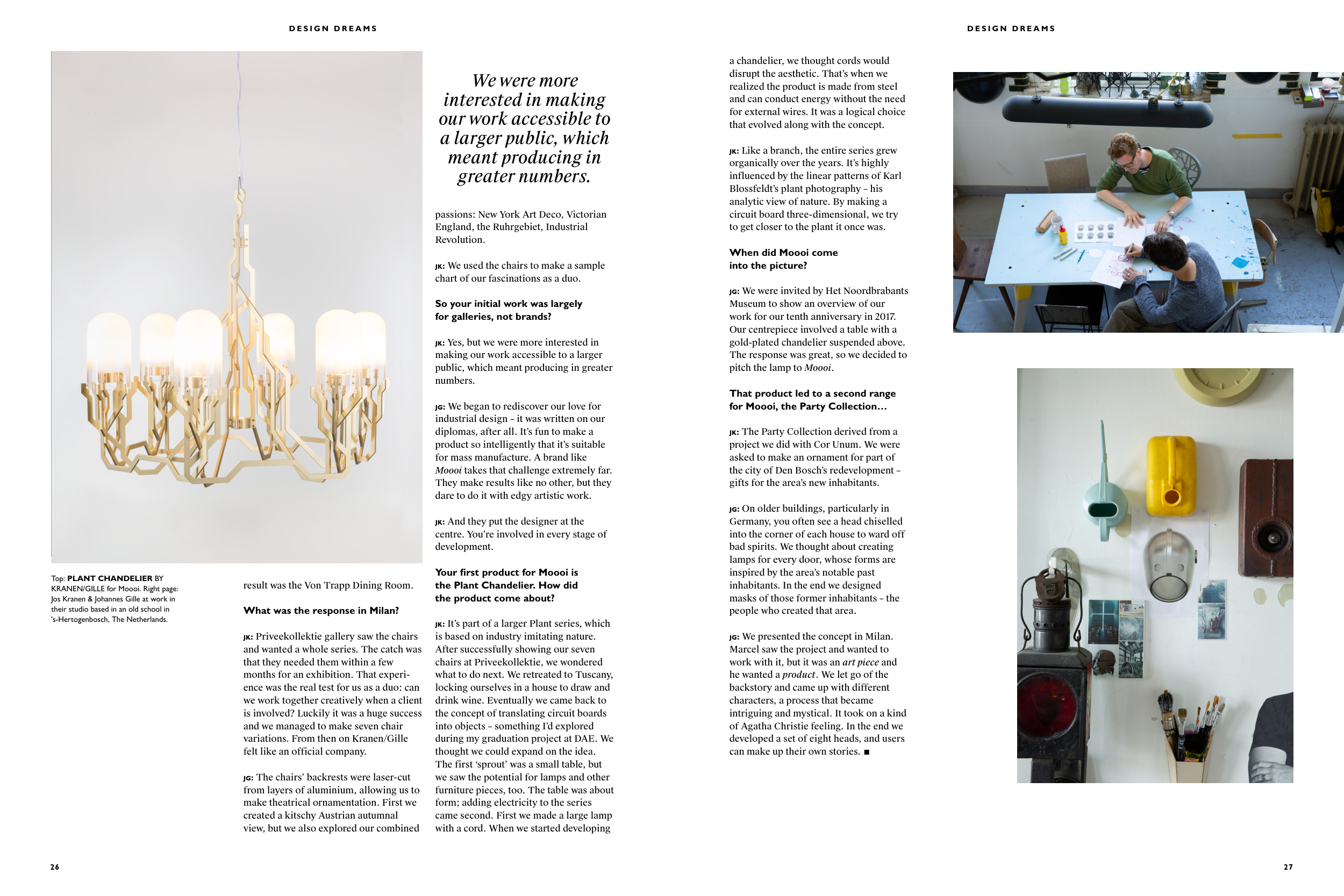
Top: PLANT CHANDELIER BY
KRANEN/GILLE for Moooi. Right page:
Jos Kranen & Johannes Gille at work in
their studio based in an old school in
's-Hertogenbosch, The Netherlands.
a chandelier, we thought cords would
disrupt the aesthetic. That’s when we
realized the product is made from steel
and can conduct energy without the need
for external wires. It was a logical choice
that evolved along with the concept.
jk: Like a branch, the entire series grew
organically over the years. It’s highly
influenced by the linear patterns of Karl
Blossfeldt’s plant photography – his
analytic view of nature. By making a
circuit board three-dimensional, we try
to get closer to the plant it once was.
When did Moooi come
into the picture?
jg: We were invited by Het Noordbrabants
Museum to show an overview of our
work for our tenth anniversary in 2017.
Our centrepiece involved a table with a
gold-plated chandelier suspended above.
The response was great, so we decided to
pitch the lamp to Moooi.
That product led to a second range
for Moooi, the Party Collection…
jk: The Party Collection derived from a
project we did with Cor Unum. We were
asked to make an ornament for part of
the city of Den Bosch’s redevelopment –
gifts for the area’s new inhabitants.
jg: On older buildings, particularly in
Germany, you often see a head chiselled
into the corner of each house to ward off
bad spirits. We thought about creating
lamps for every door, whose forms are
inspired by the area’s notable past
inhabitants. In the end we designed
masks of those former inhabitants – the
people who created that area.
jg: We presented the concept in Milan.
Marcel saw the project and wanted to
work with it, but it was an art piece and
he wanted a product. We let go of the
backstory and came up with different
characters, a process that became
intriguing and mystical. It took on a kind
of Agatha Christie feeling. In the end we
developed a set of eight heads, and users
can make up their own stories. ■
D E S I G N D R E A M S
26
27