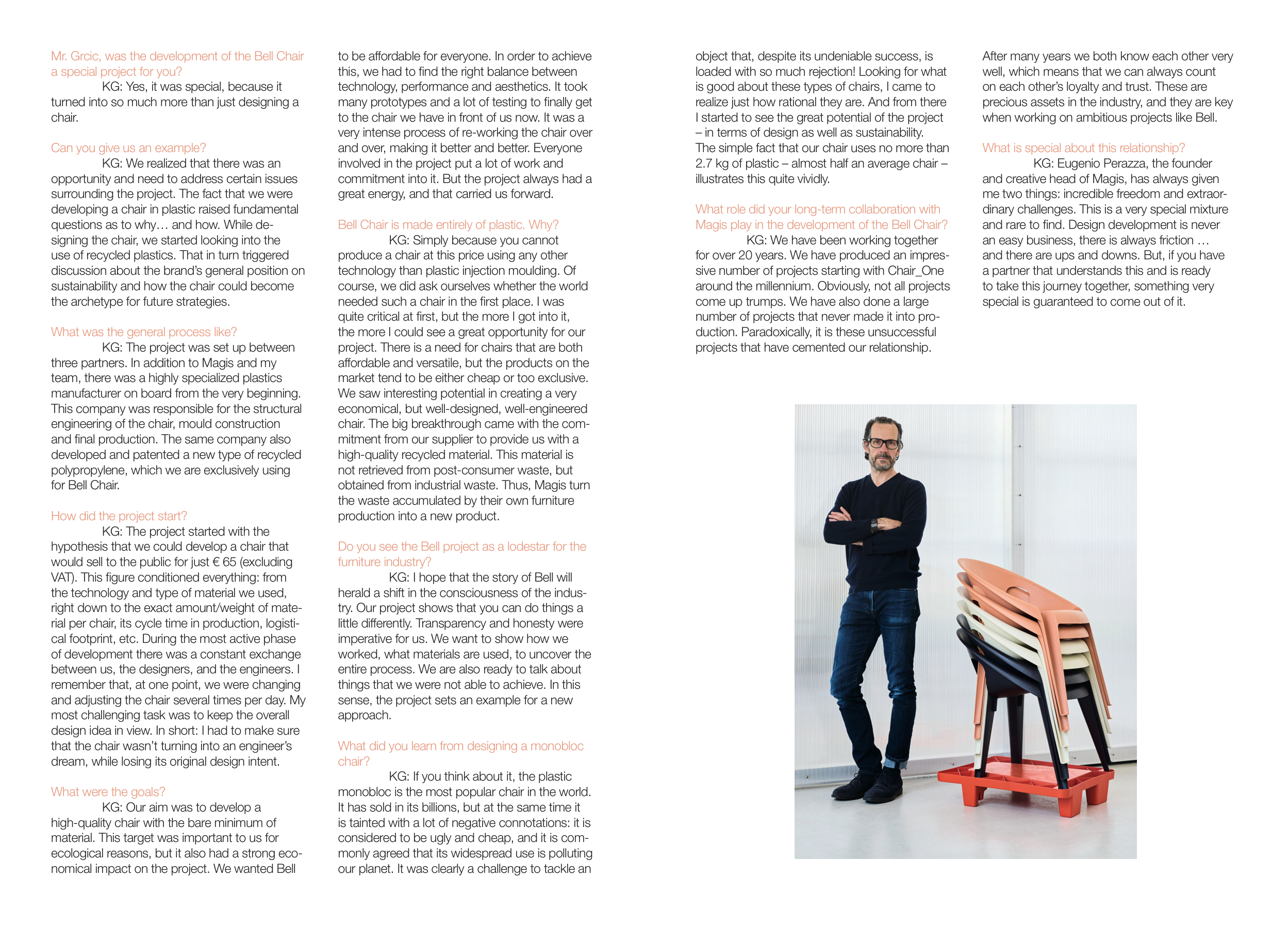
Mr. Grcic, was the development of the Bell Chair
a special project for you?
KG: Yes, it was special, because it
turned into so much more than just designing a
chair.
Can you give us an example?
KG: We realized that there was an
opportunity and need to address certain issues
surrounding the project. The fact that we were
developing a chair in plastic raised fundamental
questions as to why… and how. While de-
signing the chair, we started looking into the
use of recycled plastics. That in turn triggered
discussion about the brand’s general position on
sustainability and how the chair could become
the archetype for future strategies.
What was the general process like?
KG: The project was set up between
three partners. In addition to Magis and my
team, there was a highly specialized plastics
manufacturer on board from the very beginning.
This company was responsible for the structural
engineering of the chair, mould construction
and final production. The same company also
developed and patented a new type of recycled
polypropylene, which we are exclusively using
for Bell Chair.
How did the project start?
KG: The project started with the
hypothesis that we could develop a chair that
would sell to the public for just € 65 (excluding
VAT). This figure conditioned everything: from
the technology and type of material we used,
right down to the exact amount/weight of mate-
rial per chair, its cycle time in production, logisti-
cal footprint, etc. During the most active phase
of development there was a constant exchange
between us, the designers, and the engineers. I
remember that, at one point, we were changing
and adjusting the chair several times per day. My
most challenging task was to keep the overall
design idea in view. In short: I had to make sure
that the chair wasn’t turning into an engineer’s
dream, while losing its original design intent.
What were the goals?
KG: Our aim was to develop a
high-quality chair with the bare minimum of
material. This target was important to us for
ecological reasons, but it also had a strong eco-
nomical impact on the project. We wanted Bell
object that, despite its undeniable success, is
loaded with so much rejection! Looking for what
is good about these types of chairs, I came to
realize just how rational they are. And from there
I started to see the great potential of the project
– in terms of design as well as sustainability.
The simple fact that our chair uses no more than
2.7 kg of plastic – almost half an average chair –
illustrates this quite vividly.
What role did your long-term collaboration with
Magis play in the development of the Bell Chair?
KG: We have been working together
for over 20 years. We have produced an impres-
sive number of projects starting with Chair_One
around the millennium. Obviously, not all projects
come up trumps. We have also done a large
number of projects that never made it into pro-
duction. Paradoxically, it is these unsuccessful
projects that have cemented our relationship.
to be affordable for everyone. In order to achieve
this, we had to find the right balance between
technology, performance and aesthetics. It took
many prototypes and a lot of testing to finally get
to the chair we have in front of us now. It was a
very intense process of re-working the chair over
and over, making it better and better. Everyone
involved in the project put a lot of work and
commitment into it. But the project always had a
great energy, and that carried us forward.
Bell Chair is made entirely of plastic. Why?
KG: Simply because you cannot
produce a chair at this price using any other
technology than plastic injection moulding. Of
course, we did ask ourselves whether the world
needed such a chair in the first place. I was
quite critical at first, but the more I got into it,
the more I could see a great opportunity for our
project. There is a need for chairs that are both
affordable and versatile, but the products on the
market tend to be either cheap or too exclusive.
We saw interesting potential in creating a very
economical, but well-designed, well-engineered
chair. The big breakthrough came with the com-
mitment from our supplier to provide us with a
high-quality recycled material. This material is
not retrieved from post-consumer waste, but
obtained from industrial waste. Thus, Magis turn
the waste accumulated by their own furniture
production into a new product.
Do you see the Bell project as a lodestar for the
furniture industry?
KG: I hope that the story of Bell will
herald a shift in the consciousness of the indus-
try. Our project shows that you can do things a
little differently. Transparency and honesty were
imperative for us. We want to show how we
worked, what materials are used, to uncover the
entire process. We are also ready to talk about
things that we were not able to achieve. In this
sense, the project sets an example for a new
approach.
What did you learn from designing a monobloc
chair?
KG: If you think about it, the plastic
monobloc is the most popular chair in the world.
It has sold in its billions, but at the same time it
is tainted with a lot of negative connotations: it is
considered to be ugly and cheap, and it is com-
monly agreed that its widespread use is polluting
our planet. It was clearly a challenge to tackle an
After many years we both know each other very
well, which means that we can always count
on each other’s loyalty and trust. These are
precious assets in the industry, and they are key
when working on ambitious projects like Bell.
What is special about this relationship?
KG: Eugenio Perazza, the founder
and creative head of Magis, has always given
me two things: incredible freedom and extraor-
dinary challenges. This is a very special mixture
and rare to find. Design development is never
an easy business, there is always friction …
and there are ups and downs. But, if you have
a partner that understands this and is ready
to take this journey together, something very
special is guaranteed to come out of it.