French 18TH
century
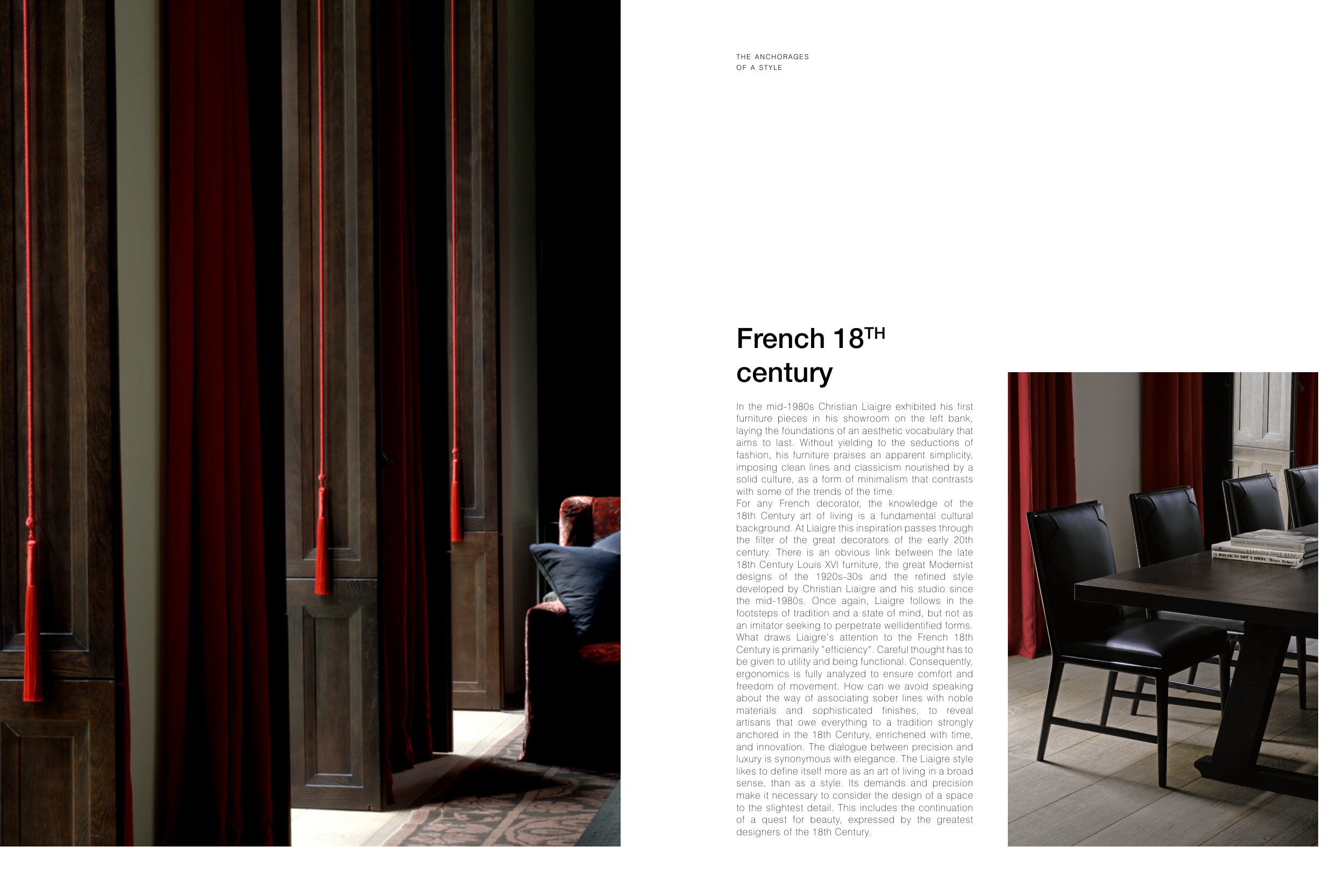
In the mid-1980s Christian Liaigre exhibited his first
furniture pieces in his showroom on the left bank,
laying the foundations of an aesthetic vocabulary that
aims to last. Without yielding to the seductions of
fashion, his furniture praises an apparent simplicity,
imposing clean lines and classicism nourished by a
solid culture, as a form of minimalism that contrasts
with some of the trends of the time.
For any French decorator, the knowledge of the
18th Century art of living is a fundamental cultural
background. At Liaigre this inspiration passes through
the filter of the great decorators of the early 20th
century. There is an obvious link between the late
18th Century Louis XVI furniture, the great Modernist
designs of the 1920s-30s and the refined style
developed by Christian Liaigre and his studio since
the mid-1980s. Once again, Liaigre follows in the
footsteps of tradition and a state of mind, but not as
an imitator seeking to perpetrate wellidentified forms.
What draws Liaigre’s attention to the French 18th
Century is primarily “efficiency”. Careful thought has to
be given to utility and being functional. Consequently,
ergonomics is fully analyzed to ensure comfort and
freedom of movement. How can we avoid speaking
about the way of associating sober lines with noble
materials and sophisticated finishes, to reveal
artisans that owe everything to a tradition strongly
anchored in the 18th Century, enrichened with time,
and innovation. The dialogue between precision and
luxury is synonymous with elegance. The Liaigre style
likes to define itself more as an art of living in a broad
sense, than as a style. Its demands and precision
make it necessary to consider the design of a space
to the slightest detail. This includes the continuation
of a quest for beauty, expressed by the greatest
designers of the 18th Century.
the anchorages
of a style