Historical Buildings & Cultural Venues
056
057
L&L Luce&Light
Hypogeum of Santa Maria in Stelle
Hypogeum of Santa Maria in Stelle
The hypogeum of Santa Maria in Stelle, located below the church of
Santa Maria Assunta, in the heart of the Valpantena valley just east
of Verona, is a very special archaeological site. It started as a Roman
aqueduct built to capture the water from the spring that flows in
that area. It has undergone many changes over the centuries, from a
pagan sanctuary dedicated to water nymphs in the 3rd century AD
to an early Christian place of worship and a mediaeval pilgrimage
destination. In the 9th century, the hypogeum was consecrated by
Pope Urban III and made suitable for liturgical celebrations.
In 2020, in the final stage of a lengthy restoration project, the new
lighting system was designed by Lucearchitettura of Verona, lighting
designers Cinzia Todeschini and Lorella Marconi. The project’s initial
study and development was made possible by the collaboration of
Ing. Luigi Antolini as a historical consultant for the site. The lighting
system was designed to take visitors – a maximum of four at a time
to keep CO2 levels under control – on an experiential journey. The
lights, activated by the guide with an app, illuminate one scenario at
a time, magically revealing the story.
A flight of stairs connects the entrance to the subterranean complex.
At the foot of the stairs, a statue of Publius Pomponius Cornelius,
the location’s creator, is fully illuminated thanks to the 13°x52°
elliptical optics of the Ginko 2.0 projector. In the passage, an indirect,
diffuse light, dimmed to 30% and directed downwards, creates a
contemplative environment that prepares visitors for the frescoed
scenes. A single Ginko 1.0 projector (3.5W, 36°) shines a grazing
light on a precise point on the wall halfway along the route, revealing
the first important evidence of the hypogeum's transformation from
a pagan place to a sacred one: an engraving made by Bishop Zeno
depicting the Chi Rho, the early Christian monogram cross While
you continue along the conduit towards the atrium, the latter is
shrouded in darkness to emphasise the tunnel’s visual continuation
on the other side, where it is lit with a blue light to evoke the water
that still flows, but whose only sign now is a gurgling sound. As
you step into the atrium, the lights come up on the magnificently
frescoed vault.
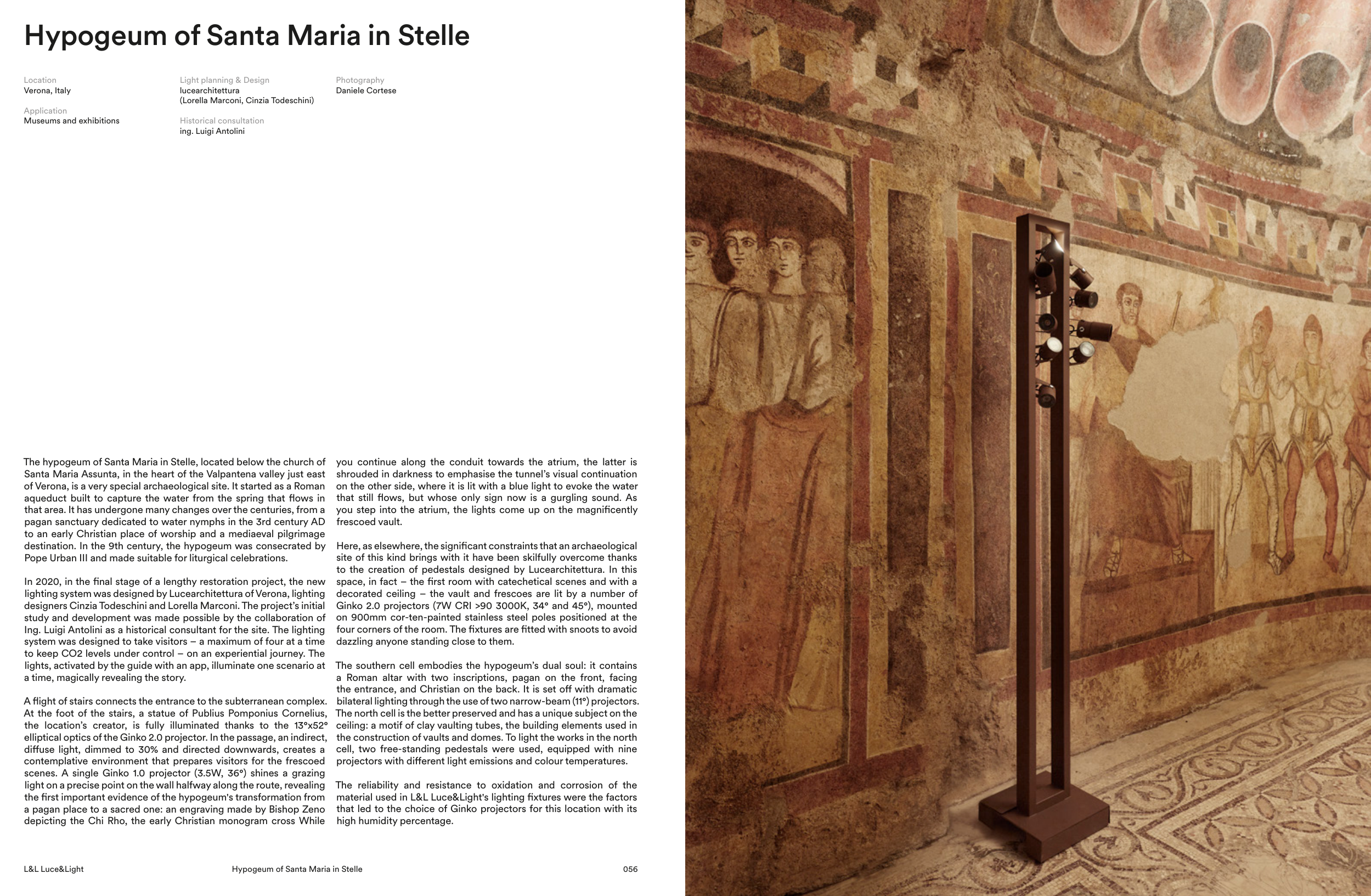
Here, as elsewhere, the significant constraints that an archaeological
site of this kind brings with it have been skilfully overcome thanks
to the creation of pedestals designed by Lucearchitettura. In this
space, in fact – the first room with catechetical scenes and with a
decorated ceiling – the vault and frescoes are lit by a number of
Ginko 2.0 projectors (7W CRI >90 3000K, 34° and 45°), mounted
on 900mm cor-ten-painted stainless steel poles positioned at the
four corners of the room. The fixtures are fitted with snoots to avoid
dazzling anyone standing close to them.
The southern cell embodies the hypogeum’s dual soul: it contains
a Roman altar with two inscriptions, pagan on the front, facing
the entrance, and Christian on the back. It is set off with dramatic
bilateral lighting through the use of two narrow-beam (11°) projectors.
The north cell is the better preserved and has a unique subject on the
ceiling: a motif of clay vaulting tubes, the building elements used in
the construction of vaults and domes. To light the works in the north
cell, two free-standing pedestals were used, equipped with nine
projectors with different light emissions and colour temperatures.
The reliability and resistance to oxidation and corrosion of the
material used in L&L Luce&Light's lighting fixtures were the factors
that led to the choice of Ginko projectors for this location with its
high humidity percentage.
Location
Verona, Italy
Application
Museums and exhibitions
Light planning & Design
lucearchitettura
(Lorella Marconi, Cinzia Todeschini)
Historical consultation
ing. Luigi Antolini
Photography
Daniele Cortese