10
11
Workplace
Sustainability
Environmental aspects
The most significant environmental aspects in the
furniture sector are related to the consumption
of raw materials, specifically fuel, paint and wood
used in furniture manufacturing. With this in mind,
we implement continuous measures to minimise any
negative impacts on the environment. For example,
Kettal carries out product research to improve
processes and assess the possible external impact
of its products.
True to its philosophy of respect for the environment,
Kettal ensures that its main materials, such as paint
and wood, are both high-quality and environmentally
sustainable. As a result, almost 100% of the paint it uses
is recyclable and environmentally friendly. Its main
supplier of paint used in the manufacture of furniture
has both quality certifications (Qualicoat, GSB, IKS,
Quali Steel Coat) and environmental certifications for
its products (verified by AENOR in accordance with its
Global EPD type III ecolabel system, ISO standards, etc.).
As regards wood, Kettal uses teak certified by the
agency SUCOFINDO, which guarantees environmental
requirements, commitment to quality, occupational
health and safety and social responsibility.
Likewise, following its commitment to offer the best
design and the highest product quality, for each
new design it draws up an Environmental Product
Declaration (EPD) for the purpose of assessing the
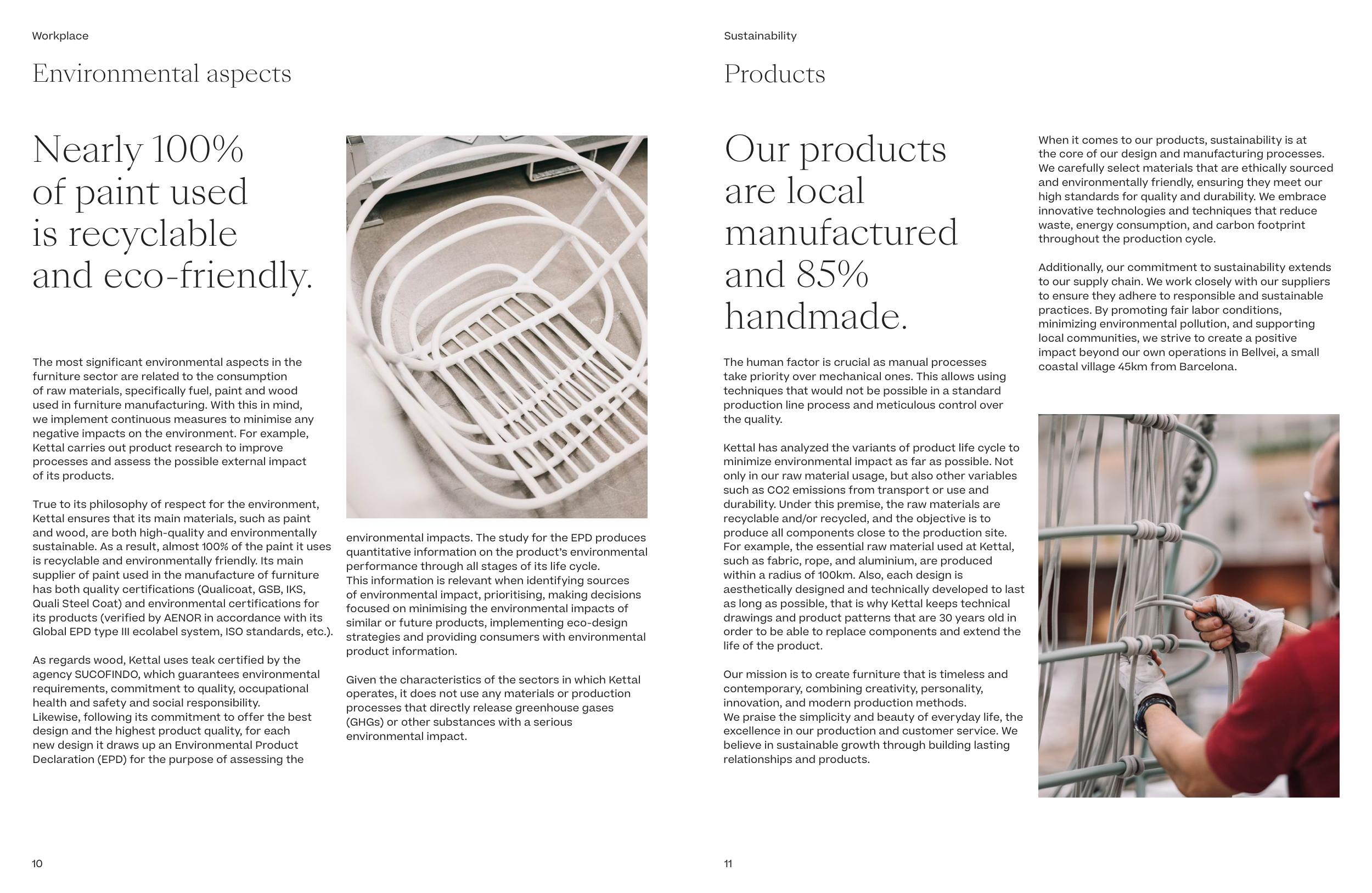
Nearly 100%
of paint used
is recyclable
and eco-friendly.
Our products
are local
manufactured
and 85%
handmade.
The human factor is crucial as manual processes
take priority over mechanical ones. This allows using
techniques that would not be possible in a standard
production line process and meticulous control over
the quality.
Kettal has analyzed the variants of product life cycle to
minimize environmental impact as far as possible. Not
only in our raw material usage, but also other variables
such as CO2 emissions from transport or use and
durability. Under this premise, the raw materials are
recyclable and/or recycled, and the objective is to
produce all components close to the production site.
For example, the essential raw material used at Kettal,
such as fabric, rope, and aluminium, are produced
within a radius of 100km. Also, each design is
aesthetically designed and technically developed to last
as long as possible, that is why Kettal keeps technical
drawings and product patterns that are 30 years old in
order to be able to replace components and extend the
life of the product.
Our mission is to create furniture that is timeless and
contemporary, combining creativity, personality,
innovation, and modern production methods.
We praise the simplicity and beauty of everyday life, the
excellence in our production and customer service. We
believe in sustainable growth through building lasting
relationships and products.
Products
environmental impacts. The study for the EPD produces
quantitative information on the product’s environmental
performance through all stages of its life cycle.
This information is relevant when identifying sources
of environmental impact, prioritising, making decisions
focused on minimising the environmental impacts of
similar or future products, implementing eco-design
strategies and providing consumers with environmental
product information.
Given the characteristics of the sectors in which Kettal
operates, it does not use any materials or production
processes that directly release greenhouse gases
(GHGs) or other substances with a serious
environmental impact.
When it comes to our products, sustainability is at
the core of our design and manufacturing processes.
We carefully select materials that are ethically sourced
and environmentally friendly, ensuring they meet our
high standards for quality and durability. We embrace
innovative technologies and techniques that reduce
waste, energy consumption, and carbon footprint
throughout the production cycle.
Additionally, our commitment to sustainability extends
to our supply chain. We work closely with our suppliers
to ensure they adhere to responsible and sustainable
practices. By promoting fair labor conditions,
minimizing environmental pollution, and supporting
local communities, we strive to create a positive
impact beyond our own operations in Bellvei, a small
coastal village 45km from Barcelona.