135
COCÒ
COCÒ 2000
Aldo Cibic
The name betrays the impish and playful
figurative reference which inspired
Aldo Cibic. With his usual approach, the
designer attempts to “humanize” the
object, softening it and smoothing all
the rough edges. He simultaneously
explores the potential of glass and the
kind of light which a table lamp must
provide. Various technical adaptations
have changed the continuous and closed
configuration which initially
characterized the shade. To obtain glass
of that shape blown into a still mold,
particular attention was paid to
controlling the thickness and the
consistency of the material to avoid
creating annoying shadows on the
surface when the lamp was switched on,
in the areas where the material might be
thicker or could include air bubbles in
the vitreous material. Another problem
to be explored was the location of the
area to attach the blowpipe, which was
located on the bottom of the shade in
the only possible area allowed by the
shape of the glass, so that the opening
could be covered with the lens-shaped
element on which the foot of the fixture
was attached. The large circular hole on
the contrary was the answer to the
requirement of exhausting the heat
produced by the source, a 100 watt
incandescent bulb, and ensuring the
normal maintenance of the product.
The dimension and position along the
inclined axis of the shade are functional
to the correct conveyance of the
luminous flux onto the working surface.
The result is a double lighting effect:
warm and diffused through the glass,
white on the inside and white or ruby red
on the outside, and directed through the
round opening. In addition, to avoid
fingerprints on the surface the shade is
given a satin finish by processing it in
acid. The design of the base of the
support, in relation to the zoomorphic
solution conceived by the designer, was
regularized during the development
phase, becoming a sort of webbed “foot”
with five lobes made of die-cast
aluminum and supplied with non-
scratch pads. The support is a thin
metal tube painted aluminum. Pushing
the technical possibilities of shaping
new forms in Murano glass one step
further, in 2003 Cibic designed the
Lampoon “ball” with soft bumps blown
into a still mold.
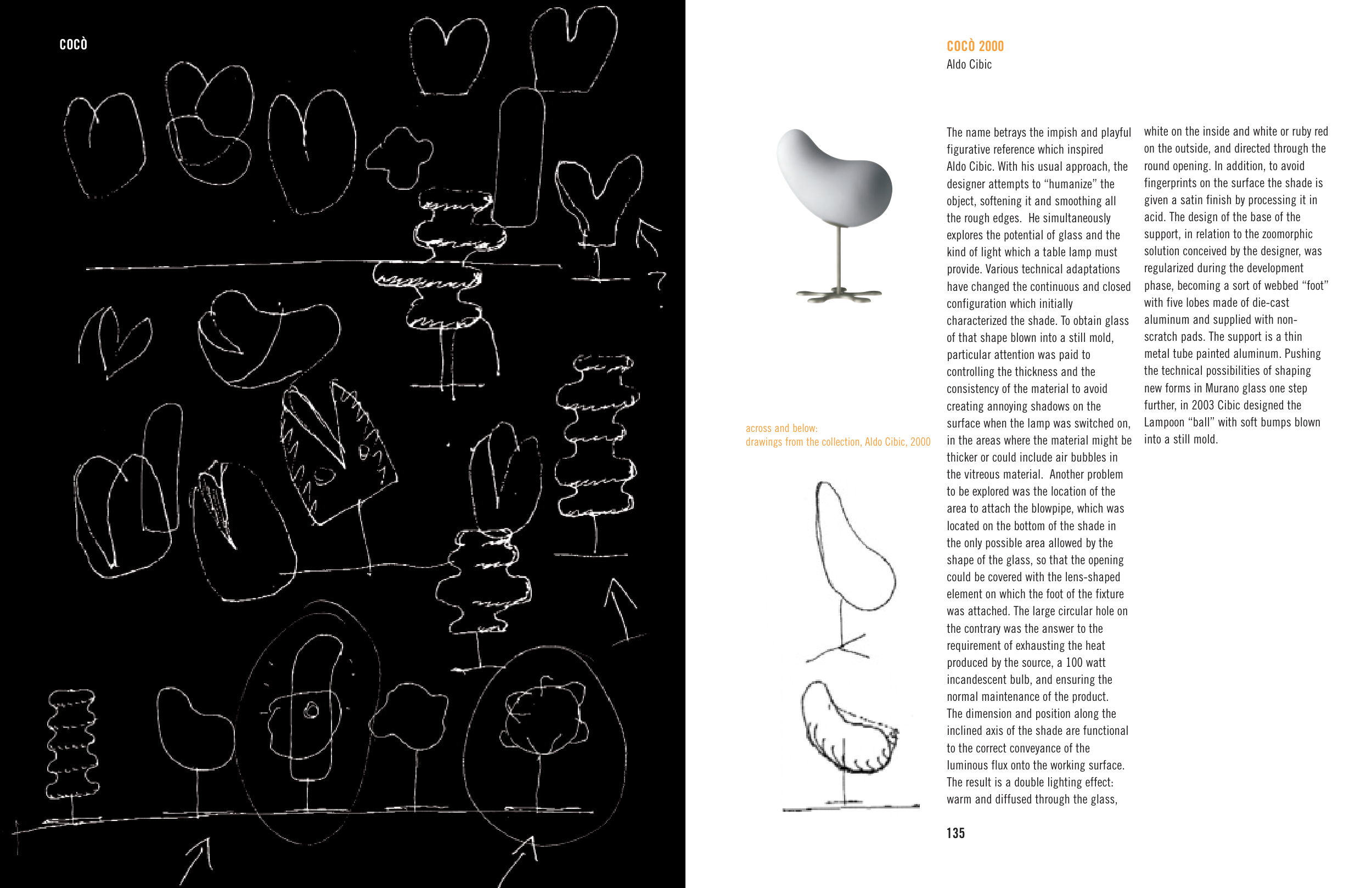
across and below:
drawings from the collection, Aldo Cibic, 2000