Nel 1978 c’è aria di cambiamento anche sul
fronte dell’architettura, del design e
dell’arredamento. L’interesse per il recupero del
patrimonio storico è sempre vivo.
Ma si inizia anche a parlare dei primi loft in
edifici industriali. Il design esplora nuovi
territori, la produzione industriale è attenta a
seguire i progettisti in queste sperimentazioni.
E qualche volta le stimola, in un circuito
virtuoso. Oggetti d’autore entrano nelle vite
di un pubblico sempre più ampio.
Ed è del 1978 anche un progetto provocatorio,
simbolo di un nuovo pensiero estetico che si sta
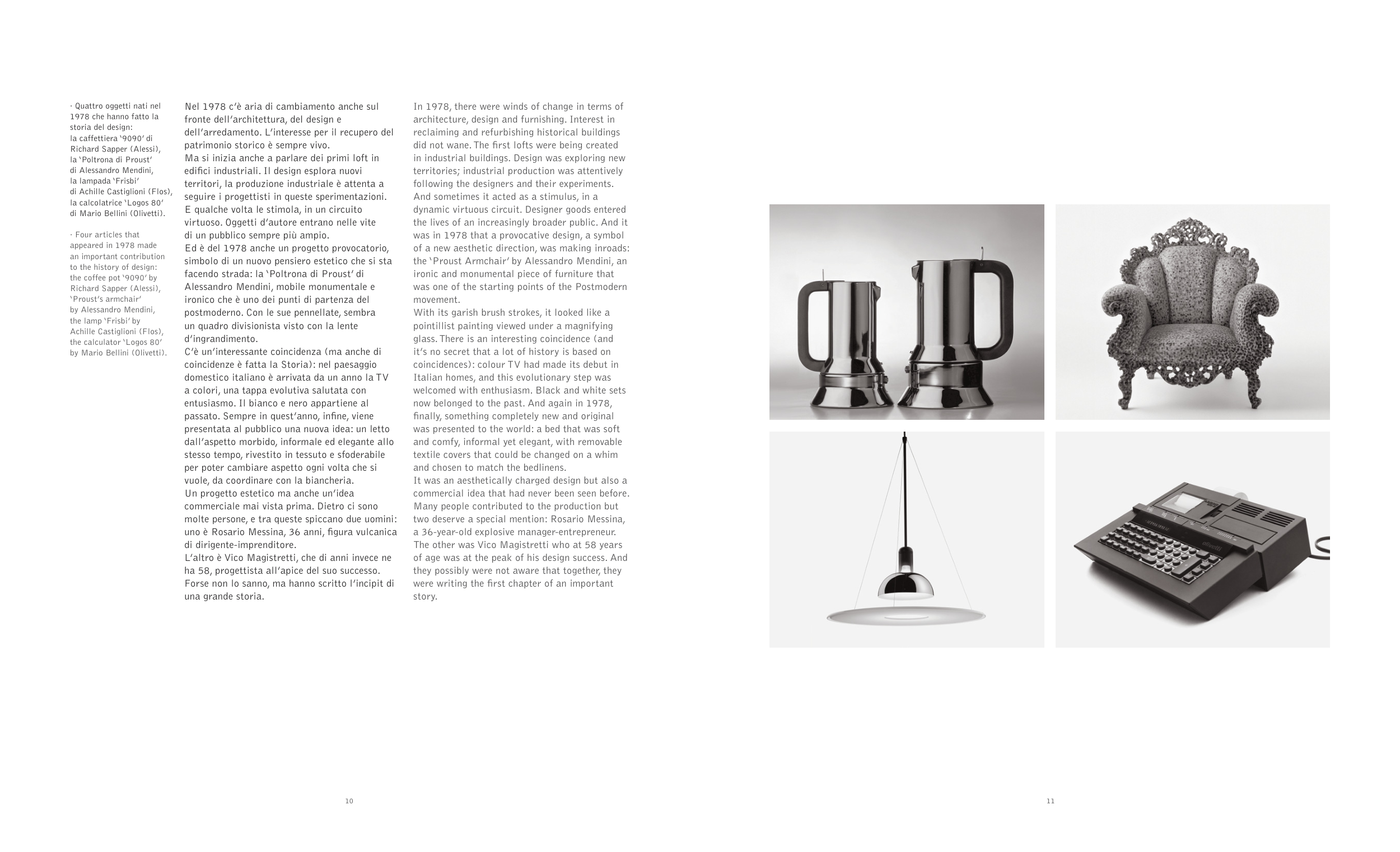
facendo strada: la ‘Poltrona di Proust’ di
Alessandro Mendini, mobile monumentale e
ironico che è uno dei punti di partenza del
postmoderno. Con le sue pennellate, sembra
un quadro divisionista visto con la lente
d’ingrandimento.
C’è un’interessante coincidenza (ma anche di
coincidenze è fatta la Storia): nel paesaggio
domestico italiano è arrivata da un anno la TV
a colori, una tappa evolutiva salutata con
entusiasmo. Il bianco e nero appartiene al
passato. Sempre in quest’anno, infine, viene
presentata al pubblico una nuova idea: un letto
dall’aspetto morbido, informale ed elegante allo
stesso tempo, rivestito in tessuto e sfoderabile
per poter cambiare aspetto ogni volta che si
vuole, da coordinare con la biancheria.
Un progetto estetico ma anche un’idea
commerciale mai vista prima. Dietro ci sono
molte persone, e tra queste spiccano due uomini:
uno è Rosario Messina, 36 anni, figura vulcanica
di dirigente-imprenditore.
L’altro è Vico Magistretti, che di anni invece ne
ha 58, progettista all’apice del suo successo.
Forse non lo sanno, ma hanno scritto l’incipit di
una grande storia.
In 1978, there were winds of change in terms of
architecture, design and furnishing. Interest in
reclaiming and refurbishing historical buildings
did not wane. The first lofts were being created
in industrial buildings. Design was exploring new
territories; industrial production was attentively
following the designers and their experiments.
And sometimes it acted as a stimulus, in a
dynamic virtuous circuit. Designer goods entered
the lives of an increasingly broader public. And it
was in 1978 that a provocative design, a symbol
of a new aesthetic direction, was making inroads:
the ‘Proust Armchair’ by Alessandro Mendini, an
ironic and monumental piece of furniture that
was one of the starting points of the Postmodern
movement.
With its garish brush strokes, it looked like a
pointillist painting viewed under a magnifying
glass. There is an interesting coincidence (and
it’s no secret that a lot of history is based on
coincidences): colour TV had made its debut in
Italian homes, and this evolutionary step was
welcomed with enthusiasm. Black and white sets
now belonged to the past. And again in 1978,
finally, something completely new and original
was presented to the world: a bed that was soft
and comfy, informal yet elegant, with removable
textile covers that could be changed on a whim
and chosen to match the bedlinens.
It was an aesthetically charged design but also a
commercial idea that had never been seen before.
Many people contributed to the production but
two deserve a special mention: Rosario Messina,
a 36-year-old explosive manager-entrepreneur.
The other was Vico Magistretti who at 58 years
of age was at the peak of his design success. And
they possibly were not aware that together, they
were writing the first chapter of an important
story.
· Quattro oggetti nati nel
1978 che hanno fatto la
storia del design:
la caffettiera ‘9090’ di
Richard Sapper (Alessi),
la ‘Poltrona di Proust’
di Alessandro Mendini,
la lampada ‘Frisbi’
di Achille Castiglioni (Flos),
la calcolatrice ‘Logos 80’
di Mario Bellini (Olivetti).
· Four articles that
appeared in 1978 made
an important contribution
to the history of design:
the coffee pot ‘9090’ by
Richard Sapper (Alessi),
‘Proust’s armchair’
by Alessandro Mendini,
the lamp ‘Frisbi’ by
Achille Castiglioni (Flos),
the calculator ‘Logos 80’
by Mario Bellini (Olivetti).
10
11