Il 1978 era anche l’anno in cui veniva approvato
dalla CEE il Sistema Monetario Europeo, che
porterà alla moneta unica.
E quello in cui nasceva la prima ‘bambina in
provetta’, da fecondazione in vitro: un evento
senza precedenti e di portata enorme, e per
questo accompagnato da dibattiti profondi.
Era la nascita della bioetica. In Italia è il
periodo che verrà ricordato come ‘anni di
piombo’: scontri di piazza, terrorismo.
Il rapimento Moro e le dimissioni del Presidente
della Repubblica, Giovanni Leone, sono due
shock: la risposta è l’elezione di Sandro Pertini,
l’8 luglio, con la più larga maggioranza fino ad
allora nella storia repubblicana (sarà uno dei
capi di Stato più amati di sempre). Sono anche
anni, per reazione, di leggerezza: si iniziano a
vedere i primi segni di quella spinta edonistica
del decennio che sta per arrivare. Al grigio si
risponde col colore, con un’esuberanza culturale
straordinaria. La sensazione è quella di un
orizzonte in continua espansione, di confini che si
fanno sempre più permeabili.
Si fa teatro ovunque, per esempio: appartamenti
privati, ex hangar, stadi.
Il desiderio di crescita culturale è percepibile
dappertutto, il concetto di ‘tempo libero’ non
viene più visto come semplice occasione di svago
ma come momento per fare esperienze.
In 1978, the EEC (European Economic
Community) approved the European Monetary
System, that eventually led to the single
currency. The first ‘test-tube baby’ was born: an
unprecedented event of enormous importance,
surrounded by lengthy depth debates. This
scientific event marked the birth of bioethics.
In Italy, this period will be remembered as the
‘anni di piombo’ (years of lead): riots, protests,
turmoil, terrorism. Then two momentous events
sent shock waves across the country - Aldo Moro,
a prominent Christian Democratic statesman
was kidnapped and murdered, and the Italian
Republic’s President, Giovanni Leone, stepped
down from office. The country responded with
the election of Sandro Pertini on July 8th, with
the biggest majority ever witnessed in the Italian
Republic’s history (he was the country’s
best-loved head of State of all time).
However, these were also ‘easy’ years, and the
first hedonistic signs appeared marking the new
decade that was about to begin. The darkness of
the immediate past was replaced with colour and
an extraordinary cultural exuberance.
The general feeling was one of a continually
expanding horizon, with boundaries that were
becoming increasingly permeable. Theatre was
performed anywhere and everywhere: in private
apartments, ex-hangars, in stadiums. The desire
for cultural development and growth was
perceptible everywhere; the idea of ‘free time’
was no longer viewed simply as an opportunity
to relax but was now considered to be an
opportunity for new experiences.
L’espressione ‘vacanze intelligenti’, coniata dal
settimanale ‘L’Espresso’ (che al tema dedica una
serie di supplementi speciali), entra nel
linguaggio comune – e stimola anche la parodia,
come nell’omonimo episodio diretto da
Alberto Sordi del film ‘Dove vai in vacanza?’,
uscito il 21 dicembre. Fa notizia ‘Il flauto
magico’ di Emanuele Luzzati, cartone animato
di grande suggestione visiva basato
sull’omonima opera di Mozart. E poi arriva una
pellicola destinata a imprimere alla società una
svolta: ‘La febbre del sabato sera’, con un ancora
sconosciuto John Travolta, che nello stesso anno
esce anche con ‘Grease’.
È una rivoluzione: la cultura del ballo esce
dall’ombra, nella classifica mondiale dei dischi
più venduti i primi cinque titoli sono tutti
dance. Le grandi discoteche di New York, con in
testa il celeberrimo Studio 54, fanno notizia.
Nel panorama internazionale si sta affermando
la moda italiana. Anche in questo ambito il 1978
è un anno importante, quello della prima sfilata
(il 28 marzo, al Palazzo della Permanente di
Milano) di un giovane talento.
È Gianni Versace.
The expression of ‘intelligent vacations’ - a phrase
coined by the weekly magazine ‘L’Espresso’ (that
dedicated a series of special supplements to the
subject) – joined the vernacular – and also gave
rise to parodies such as the episode directed by
Alberto Sordi in the film ‘Where are you going
on holiday?’, in cinemas on December 21st.
The Magic Flute (‘Il flauto magico’) by Emanuele
Luzzati, was a highly visually suggestive cartoon
based on the music by Mozart. Then a film that
changed society appeared on the screens:
‘Saturday Night Fever’ starring the then unknown
actor, John Travolta, who also starred, in the
same year, in the evergreen ‘Grease’. A revolution
was taking place: dance culture was emerging
from the shadows, a claim supported by the fact
that the top five all-time best-selling disks listed
in the world charts were all dance music. The
trendiest New York discotheques - with the
famous Studio 54 leading the charge - were
hitting the headlines. Italian design and fashion
were monopolizing the international panorama.
And staying on theme, 1978 was an important
year that showcased a young fashion design
talent - the date was March 28th 1978, the
venue was Milan’s Palazzo della Permanente,
the fashion designer was none other than Gianni
Versace.
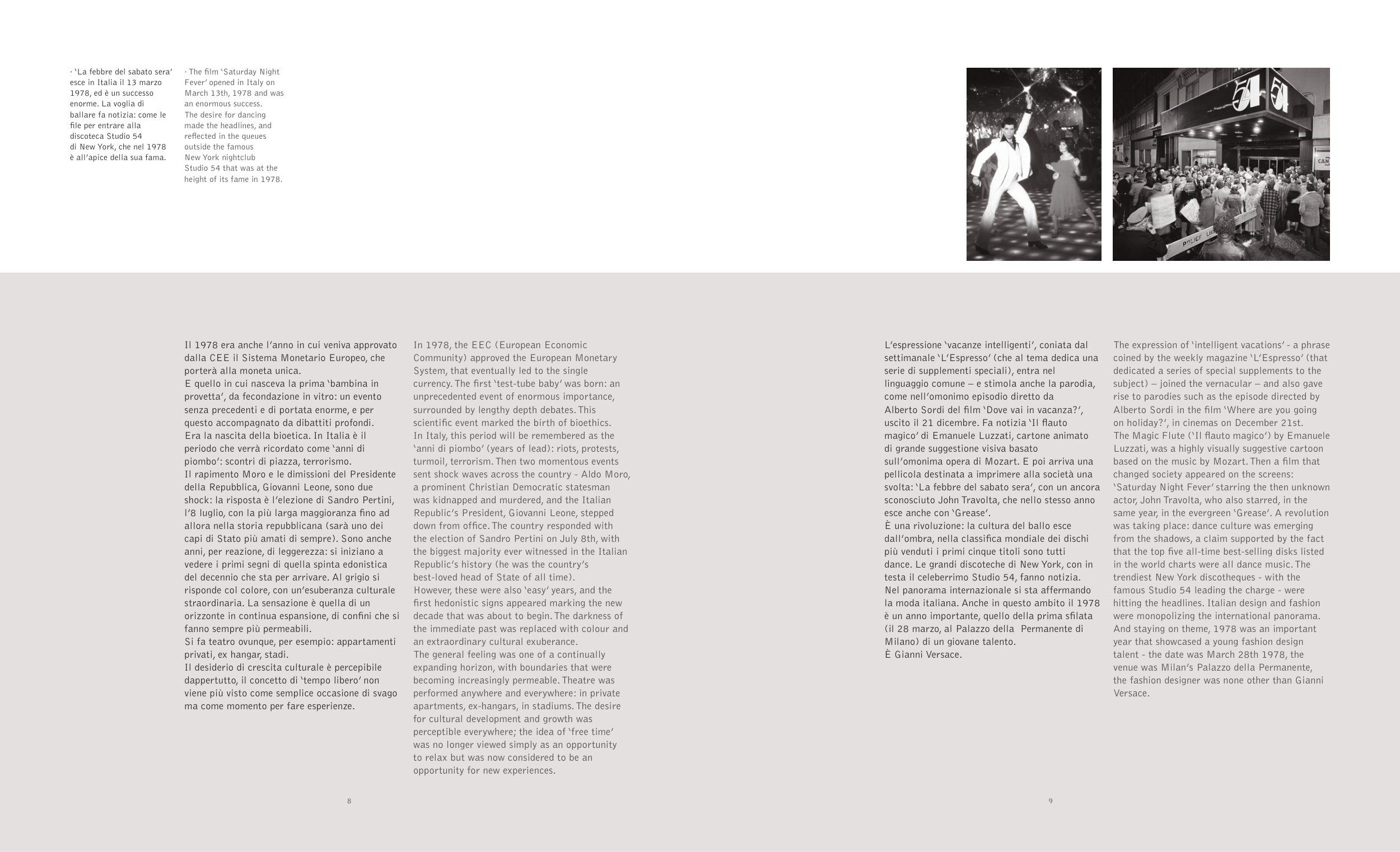
· ‘La febbre del sabato sera’
esce in Italia il 13 marzo
1978, ed è un successo
enorme. La voglia di
ballare fa notizia: come le
file per entrare alla
discoteca Studio 54
di New York, che nel 1978
è all’apice della sua fama.
· The film ‘Saturday Night
Fever’ opened in Italy on
March 13th, 1978 and was
an enormous success.
The desire for dancing
made the headlines, and
reflected in the queues
outside the famous
New York nightclub
Studio 54 that was at the
height of its fame in 1978.
8
9