Lavorare con Magistretti è così, una cosa
fatta di intuizioni rapidissime, di pareri dati
e ricevuti, di scambi. Seguire la creazione
di un oggetto insieme a lui è anche entrare
nel suo pensiero per riuscire a capire tutte le
implicazioni di un gesto o di una battuta.
«Per lui era importante stabilire un’intesa con
chi aveva davanti. E da parte sua c’era sempre
la massima disponibilità», racconta
Pinuccio Borgonovo, designer e storico
collaboratore dell’azienda.
«Si partiva magari da cose ludiche, senza seguire
le mode. È anche per questo che ha creato cose
senza tempo. Partiva da un’idea, non da una
forma: la sella, il mantello da cavalli. La forma
era una conseguenza».
Su questo progetto Magistretti opera in stretto
contatto con Vittorio Prato, designer proveniente
da Cassina, a cui Messina affida il ruolo di
coordinatore tecnico. È Prato quello che mette in
pratica, nei dettagli, l’idea.
Prende forma così un progetto articolato: un
letto semplice e mai visto prima, senza rete,
solido, realmente comodo (a questo proposito
Magistretti si fa consigliare da un ortopedico),
sfoderabile per poter cambiare aspetto pur
rimanendo lo stesso oggetto.
L’imbottitura posata sulla testata, e fermata dai
fiocchi di cui sopra, permette di nasconderci
sotto i cuscini, così rifare il letto è davvero
questione di un attimo; i materiali sono gli stessi
utilizzati per il Piumone. La coordinabilità è
totale. Anni dopo, il progettista lo commentava
così: «Il segreto del successo di questo letto sta
in un’innovazione basilare, in seguito molto
copiata: l’utilizzo in forma rigida del piumone,
che fino ad allora era stato sempre sfruttato
soltanto come coperta mentre qui diventa una
morbida testata alla quale appoggiarsi».
Tra gli elementi su cui Magistretti ha facoltà di
decidere c’è anche la scelta del nome. Durante
l’estate rilegge ‘Guerra e Pace’ di Tolstoj, tra i
cui personaggi spicca la giovane Natalja Rostova:
per il progettista non ci sono dubbi, il nuovo letto
si chiamerà come lei. Magari con una grafia più
internazionale: Nathalie.
Si decide anche di dare un nome a questa nuova
divisione della Bassetti.
Un letto così morbido fa pensare a una nuvola, a
qualcosa di indefinito, a un effetto sfocato. Che in
francese si dice ‘flou’. E la storia inizia.
Being part of his creative team involved
connecting to his mindset to understand every
implication of a gesture or a comment. According
to Pinuccio Borgonovo, one of the company’s
designers and long-term collaborator «It was
important for Magistretti to create a bond with
the people he worked with. And for his part, he
was always available and would take time to
discuss the project in hand. The starting point
would often be something ludic, free from
fashionable trends. And for this reason his
creations are still timeless. He would begin with
an idea, not a shape: for example, a horse saddle
or rug. The shape was a consequential result».
With this project, Magistretti worked closely
with Vittorio Prato, a designer from Cassina;
Messina appointed him as technical coordinator.
Prato was responsible for the finer details of the
idea. The project would take shape and in this
case, it was a fairly simple bed but one that had
never been seen before. It had no mattress
support, it was robust yet extremely comfortable
(and on the issue of comfort, Magistretti asked
an orthopaedic specialist doctor for advice). The
removable textile covers could be easily replaced
to change the aesthetic appearance without
modifying the substance. The padding that
covered the headboard was anchored with bows
as mentioned above and this also created storage
for the pillows to be tidily hidden from view. The
time necessary for daily bed-making really had
decreased. The materials used on the bedhead
and for the duvet were the same. The whole
ensemble matched perfectly. Years later, the
designer commented: «The secret behind the
success was that it was unquestionably innovative,
and it has been widely copied: the idea of using
the duvet as a ‘fixture’ was revolutionary; until
then, the duvet had only been used as a blanket/
cover but in this case, it was transformed into
a soft comfy headboard providing support for
people sitting up in bed». Magistretti also had
the honor of deciding what name he would give
his creation. During the Summer, he had re-re-
ad Tolstoy’s ‘War and Peace’. One of the main
characters in the book was a young lady called
Natalja Rostova: the designer was inspired and
called his new bed a more international version
of her name - Nathalie. The new department of
Bassetti was also given a new name. Such a soft
bed suggested a cloud - something blurred, with
an almost amorphous shape. ‘Flou’ is the French
word for ‘blur’. The rest is history!
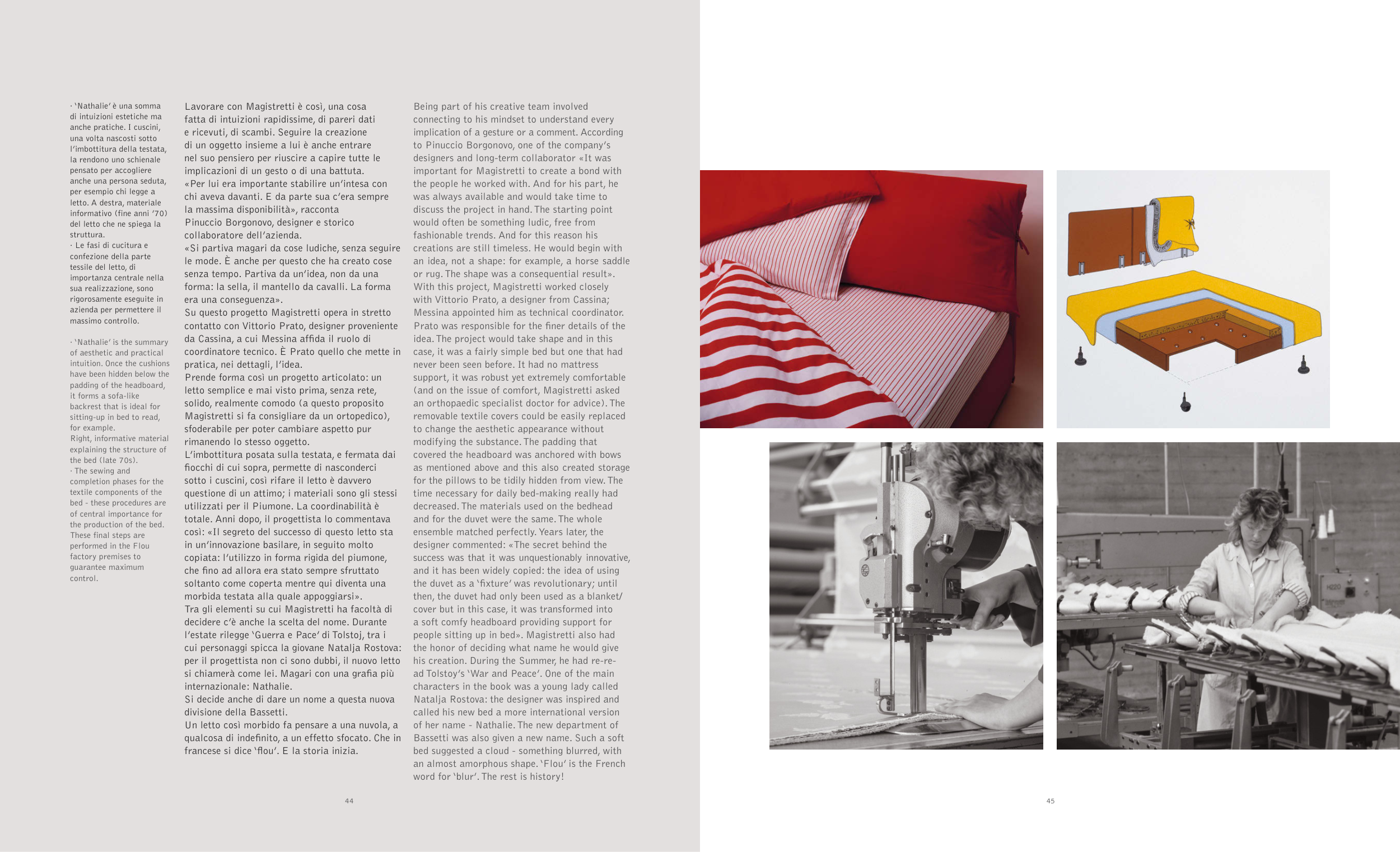
· ‘Nathalie’ è una somma
di intuizioni estetiche ma
anche pratiche. I cuscini,
una volta nascosti sotto
l’imbottitura della testata,
la rendono uno schienale
pensato per accogliere
anche una persona seduta,
per esempio chi legge a
letto. A destra, materiale
informativo (fine anni ’70)
del letto che ne spiega la
struttura.
· Le fasi di cucitura e
confezione della parte
tessile del letto, di
importanza centrale nella
sua realizzazione, sono
rigorosamente eseguite in
azienda per permettere il
massimo controllo.
· ‘Nathalie’ is the summary
of aesthetic and practical
intuition. Once the cushions
have been hidden below the
padding of the headboard,
it forms a sofa-like
backrest that is ideal for
sitting-up in bed to read,
for example.
Right, informative material
explaining the structure of
the bed (late 70s).
· The sewing and
completion phases for the
textile components of the
bed - these procedures are
of central importance for
the production of the bed.
These final steps are
performed in the Flou
factory premises to
guarantee maximum
control.
44
45