ATLANTE DI
UN MONDO
IMMAGINATO
ATLAS OF AN
IMAGINED WORLD
la natura cOME linguaggiO, rElaziOnE E
paEsaggiO sEnsOrialE
naturE as languagE, rElatiOn and
sEnsOry landscapE
N
el 1970, Michel Foucault apriva Le parole
e le cose citando un celebre brano di
Borges, in cui un’ipotetica enciclopedia
cinese classificava gli animali in categorie
paradossali e immaginifiche: “appartenenti
all’Imperatore”, “che si agitano follemente”, “che da lontano
sembrano mosche”. Una tassonomia assurda, certo, ma non
meno arbitraria di qualunque
sistema classificatorio che, per
esistere, deve sempre passare
attraverso uno sguardo, una
lingua, una griglia concettuale.
E forse anche attraverso un
desiderio: quello di trovare un
ordine tra le cose, un senso
tra le forme.
Nel design contemporaneo,
il desiderio di riconnettersi
con la natura ha generato
e
trasferito
negli
interni
domestici un intero universo di
bestiari, erbari e lapidari: ibrido,
imprevedibile,
metamorfico.
In questa pulsione a riportare
nello spazio dell’abitare la
naturalità perduta, il lavoro
di Edra si staglia come un
atlante sensuale e visionario in
cui ogni oggetto appare come
l’eco tangibile di una natura
altra, remota, potente, talvolta
mitologica. Natura non come
idillio o modello da imitare,
ma come forza da evocare e ritrovare. Già nel 2007, in uno
studio sul design italiano e l’animalità dei Fratelli Campana, si
notava come molti dei loro oggetti zoomorfi siano allusivi non
solo nelle forme, ma anche nel nome: Boa, Kaiman Jacaré,
Corallo, Aster Papposus. Non si tratta di vezzi nominalistici,
ma di tentativi di fondare una relazione semantica e affettiva
tra forma e significato, di risemantizzare lo spazio domestico
I
n 1970, in the opening to Words and Things Michel
Foucault quotes a famous passage by Borges
in which a hypothetical Chinese encyclopaedia
classifies animals into fantastical and paradoxical
categories such as “belonging to the Emperor”,
“madly agitating” or “from afar they look like flies”. Certainly,
it is an absurd taxonomy, but no less arbitrary than other
systems of classification that
in order to exist must pass
through a gaze, a language
or a conceptual grid. Perhaps
also through a desire: of finding
order among things, and of
finding meaning among forms.
In contemporary design the
desire to reconnect with nature
has generated an entire universe
of bestiaries, herbariums and
lapidaries - hybrid, unpredictable,
metamorphic - and transferred
them into home interiors. In
this pulsation of returning a lost
naturalness to the places we
inhabit, Edra’s work stands out
like a sensual and visionary atlas
where each object appears as
a tangible echo of a nature that
is other, remote and powerful,
sometimes mythological. This is
not nature as idyll, or model to
imitate, but a force to be evoked
and rediscovered.
In 2007, a study on Italian design
and the Campana Brothers’ animality noted that many of
their zoomorphic objects are allusive not only in form but
in name, for example Boa, Kaiman Jacaré, Corallo and
Aster Papposus. This are not simply an affectation but an
attempt to establish a semantic, affective relation between
form and meaning, to re-semanticize domestic spaces
as environments that welcome back what modernity had
Boa, Flap Diamond CristallizedTM with Swarovski®.
Nelle pagine seguenti il divano in velluto rosso adagiato sulla versione di Flap con il
prezioso tessuto ricoperto da 750.000 cristalli.
On the following pages, the red velvet sofa rests on the Flap version with the
precious fabric covered in 750,000 crystals.
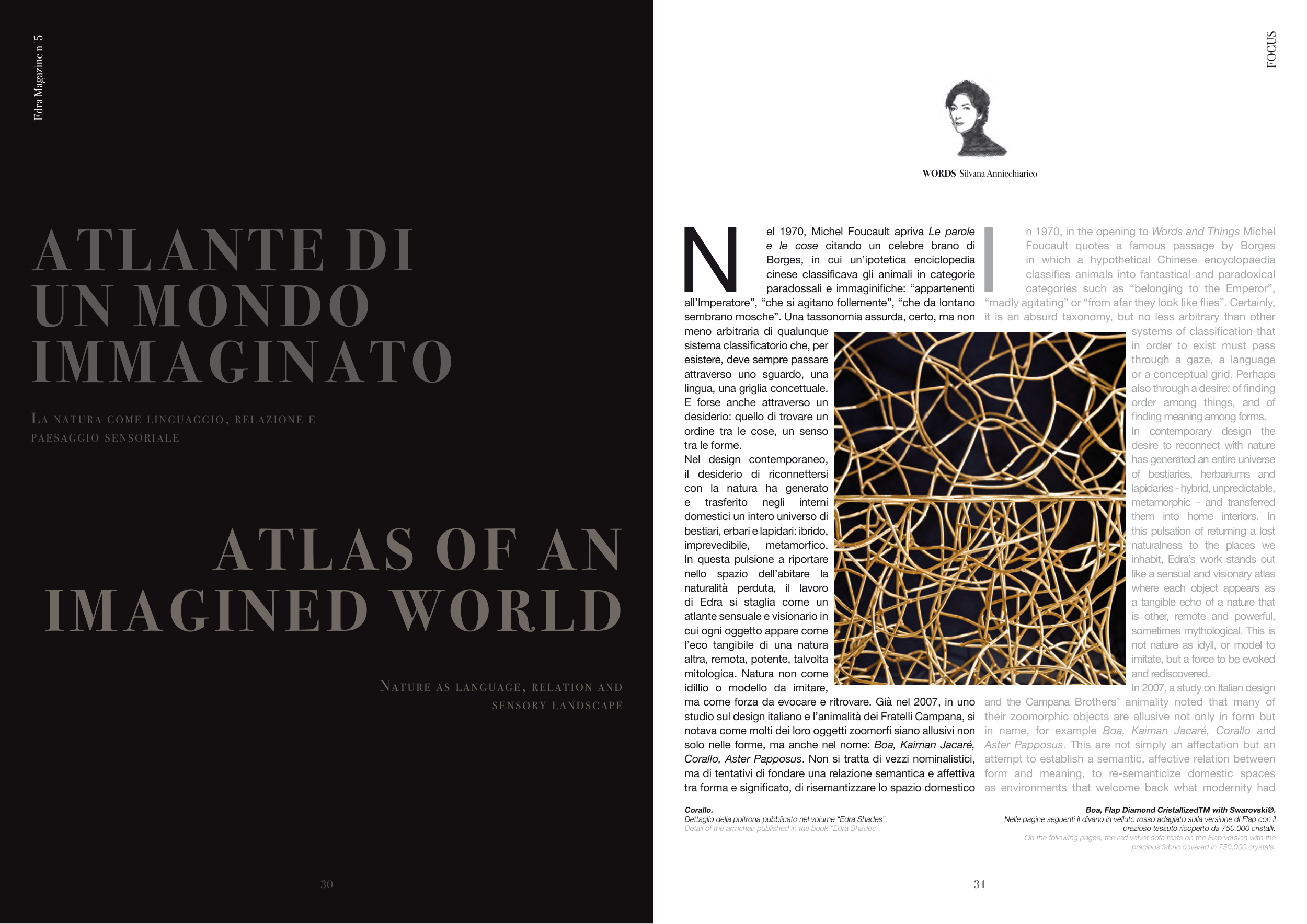
Corallo.
Dettaglio della poltrona pubblicato nel volume “Edra Shades”.
Detail of the armchair published in the book “Edra Shades”.
WORDS Silvana Annicchiarico
Edra Magazine n°5
30
31
FOCUS