EDRA AMENDOLA
Estratto del saggio critico di Bruno Corà
pubblicato nel volume Edra Amendola edito da Treccani.
A
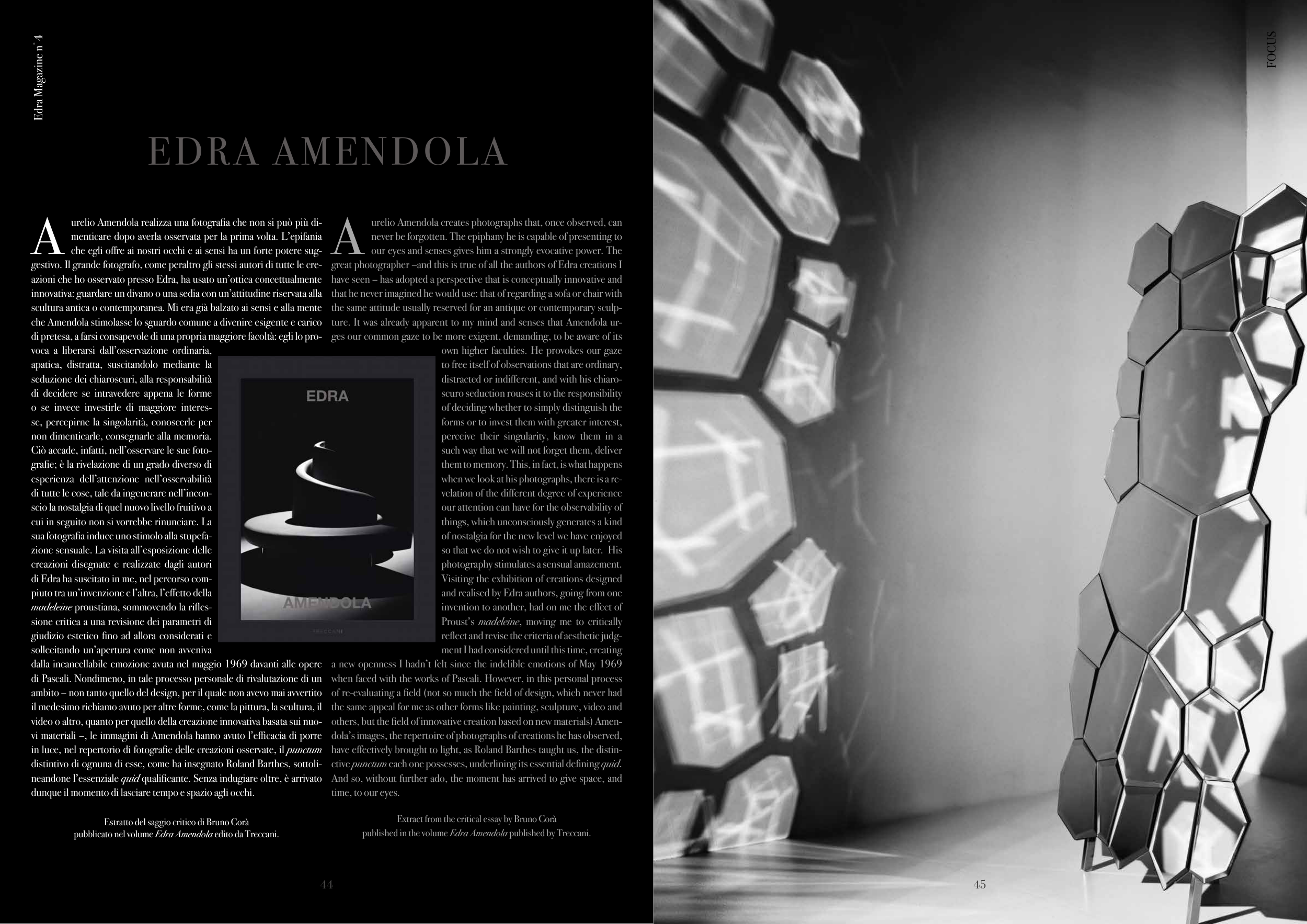
urelio Amendola realizza una fotografia che non si può più di-
menticare dopo averla osservata per la prima volta. L’epifania
che egli offre ai nostri occhi e ai sensi ha un forte potere sug-
gestivo. Il grande fotografo, come peraltro gli stessi autori di tutte le cre-
azioni che ho osservato presso Edra, ha usato un’ottica concettualmente
innovativa: guardare un divano o una sedia con un’attitudine riservata alla
scultura antica o contemporanea. Mi era già balzato ai sensi e alla mente
che Amendola stimolasse lo sguardo comune a divenire esigente e carico
di pretesa, a farsi consapevole di una propria maggiore facoltà: egli lo pro-
voca a liberarsi dall’osservazione ordinaria,
apatica, distratta, suscitandolo mediante la
seduzione dei chiaroscuri, alla responsabilità
di decidere se intravedere appena le forme
o se invece investirle di maggiore interes-
se, percepirne la singolarità, conoscerle per
non dimenticarle, consegnarle alla memoria.
Ciò accade, infatti, nell’osservare le sue foto-
grafie; è la rivelazione di un grado diverso di
esperienza dell’attenzione nell’osservabilità
di tutte le cose, tale da ingenerare nell’incon-
scio la nostalgia di quel nuovo livello fruitivo a
cui in seguito non si vorrebbe rinunciare. La
sua fotografia induce uno stimolo alla stupefa-
zione sensuale. La visita all’esposizione delle
creazioni disegnate e realizzate dagli autori
di Edra ha suscitato in me, nel percorso com-
piuto tra un’invenzione e l’altra, l’effetto della
madeleine proustiana, sommovendo la rifles-
sione critica a una revisione dei parametri di
giudizio estetico fino ad allora considerati e
sollecitando un’apertura come non avveniva
dalla incancellabile emozione avuta nel maggio 1969 davanti alle opere
di Pascali. Nondimeno, in tale processo personale di rivalutazione di un
ambito – non tanto quello del design, per il quale non avevo mai avvertito
il medesimo richiamo avuto per altre forme, come la pittura, la scultura, il
video o altro, quanto per quello della creazione innovativa basata sui nuo-
vi materiali –, le immagini di Amendola hanno avuto l’efficacia di porre
in luce, nel repertorio di fotografie delle creazioni osservate, il punctum
distintivo di ognuna di esse, come ha insegnato Roland Barthes, sottoli-
neandone l’essenziale quid qualificante. Senza indugiare oltre, è arrivato
dunque il momento di lasciare tempo e spazio agli occhi.
A
urelio Amendola creates photographs that, once observed, can
never be forgotten. The epiphany he is capable of presenting to
our eyes and senses gives him a strongly evocative power. The
great photographer –and this is true of all the authors of Edra creations I
have seen – has adopted a perspective that is conceptually innovative and
that he never imagined he would use: that of regarding a sofa or chair with
the same attitude usually reserved for an antique or contemporary sculp-
ture. It was already apparent to my mind and senses that Amendola ur-
ges our common gaze to be more exigent, demanding, to be aware of its
own higher faculties. He provokes our gaze
to free itself of observations that are ordinary,
distracted or indifferent, and with his chiaro-
scuro seduction rouses it to the responsibility
of deciding whether to simply distinguish the
forms or to invest them with greater interest,
perceive their singularity, know them in a
such way that we will not forget them, deliver
them to memory. This, in fact, is what happens
when we look at his photographs, there is a re-
velation of the different degree of experience
our attention can have for the observability of
things, which unconsciously generates a kind
of nostalgia for the new level we have enjoyed
so that we do not wish to give it up later. His
photography stimulates a sensual amazement.
Visiting the exhibition of creations designed
and realised by Edra authors, going from one
invention to another, had on me the effect of
Proust’s madeleine, moving me to critically
reflect and revise the criteria of aesthetic judg-
ment I had considered until this time, creating
a new openness I hadn’t felt since the indelible emotions of May 1969
when faced with the works of Pascali. However, in this personal process
of re-evaluating a field (not so much the field of design, which never had
the same appeal for me as other forms like painting, sculpture, video and
others, but the field of innovative creation based on new materials) Amen-
dola’s images, the repertoire of photographs of creations he has observed,
have effectively brought to light, as Roland Barthes taught us, the distin-
ctive punctum each one possesses, underlining its essential defining quid.
And so, without further ado, the moment has arrived to give space, and
time, to our eyes.
Extract from the critical essay by Bruno Corà
published in the volume Edra Amendola published by Treccani.
Edra Magazine n°4
44
45
FOCUS