78
79
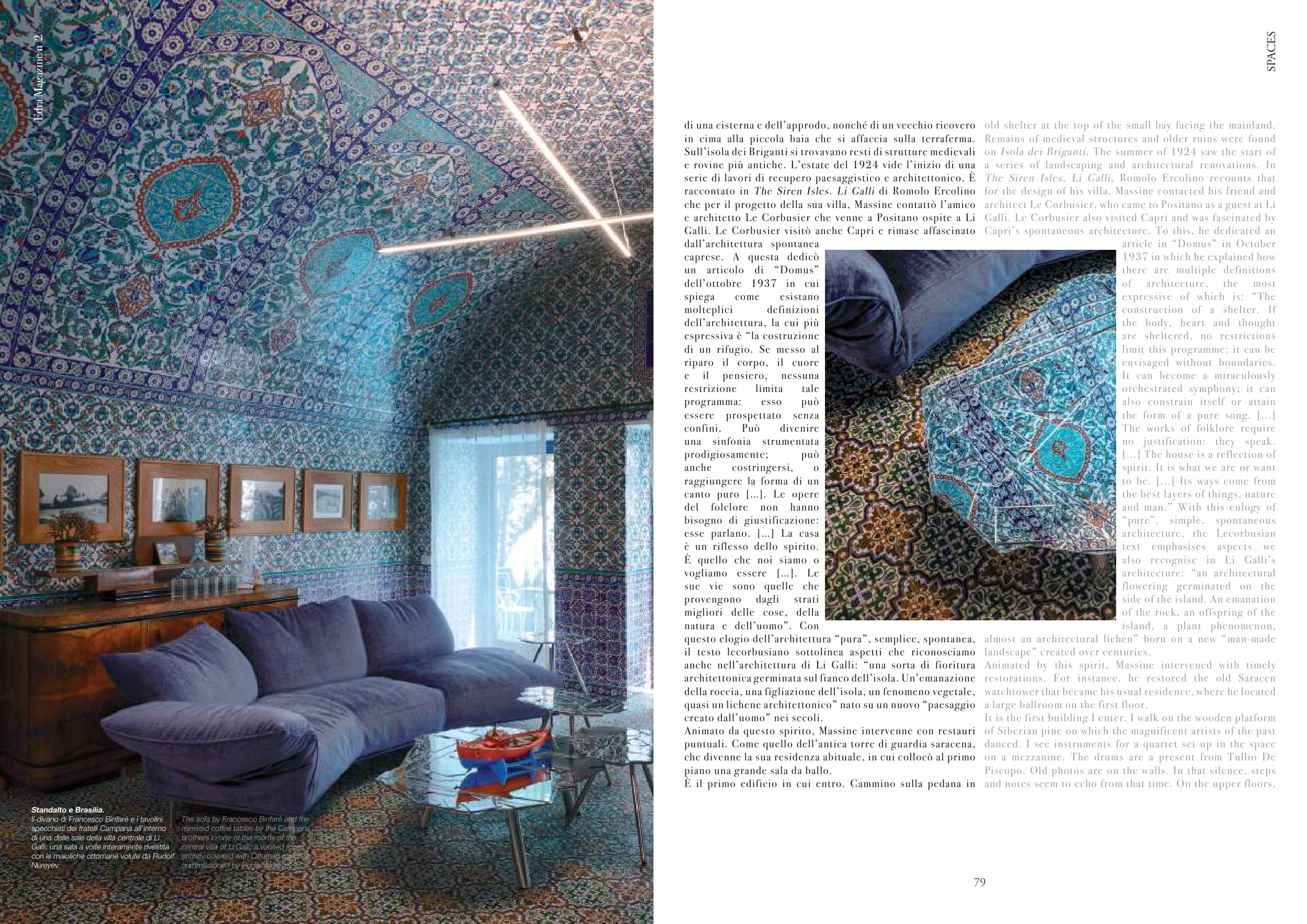
Standalto e Brasilia.
Il divano di Francesco Binfaré e i tavolini
specchiati dei fratelli Campana all’interno
di una delle sale della villa centrale di Li
Galli: una sala a volte interamente rivestita
con le maioliche ottomane volute da Rudolf
Nureyev.
The sofa by Francesco Binfaré and the
mirrored coffee tables by the Campana
brothers in one of the rooms of the
central villa of Li Galli: a vaulted room
entirely covered with Ottoman majolica,
commissioned by Rudolf Nureyev.
di una cisterna e dell’approdo, nonché di un vecchio ricovero
in cima alla piccola baia che si affaccia sulla terraferma.
Sull’isola dei Briganti si trovavano resti di strutture medievali
e rovine più antiche. L’estate del 1924 vide l’inizio di una
serie di lavori di recupero paesaggistico e architettonico. È
raccontato in The Siren Isles. Li Galli di Romolo Ercolino
che per il progetto della sua villa, Massine contattò l’amico
e architetto Le Corbusier che venne a Positano ospite a Li
Galli. Le Corbusier visitò anche Capri e rimase affascinato
dall’architettura spontanea
caprese. A questa dedicò
un articolo di “Domus”
dell’ottobre 1937 in cui
spiega
come
esistano
molteplici
definizioni
dell’architettura, la cui più
espressiva è “la costruzione
di un rifugio. Se messo al
riparo il corpo, il cuore
e
il
pensiero,
nessuna
restrizione
limita
tale
programma:
esso
può
essere
prospettato
senza
confini.
Può
divenire
una
sinfonia
strumentata
prodigiosamente;
può
anche
costringersi,
o
raggiungere la forma di un
canto puro […]. Le opere
del
folclore
non
hanno
bisogno di giustificazione:
esse parlano. […] La casa
è un riflesso dello spirito.
È quello che noi siamo o
vogliamo essere […]. Le
sue vie sono quelle che
provengono
dagli
strati
migliori delle cose, della
natura e dell’uomo”. Con
questo elogio dell’architettura “pura”, semplice, spontanea,
il testo lecorbusiano sottolinea aspetti che riconosciamo
anche nell’architettura di Li Galli: “una sorta di fioritura
architettonica germinata sul fianco dell’isola. Un’emanazione
della roccia, una figliazione dell’isola, un fenomeno vegetale,
quasi un lichene architettonico” nato su un nuovo “paesaggio
creato dall’uomo” nei secoli.
Animato da questo spirito, Massine intervenne con restauri
puntuali. Come quello dell’antica torre di guardia saracena,
che divenne la sua residenza abituale, in cui collocò al primo
piano una grande sala da ballo.
È il primo edificio in cui entro. Cammino sulla pedana in
old shelter at the top of the small bay facing the mainland.
Remains of medieval structures and older ruins were found
on Isola dei Briganti. The summer of 1924 saw the start of
a series of landscaping and architectural renovations. In
The Siren Isles, Li Galli, Romolo Ercolino recounts that
for the design of his villa, Massine contacted his friend and
architect Le Corbusier, who came to Positano as a guest at Li
Galli. Le Corbusier also visited Capri and was fascinated by
Capri’s spontaneous architecture. To this, he dedicated an
article in “Domus” in October
1937 in which he explained how
there are multiple definitions
of
architecture,
the
most
expressive of which is: “The
construction of a shelter. If
the body, heart and thought
are sheltered, no restrictions
limit this programme: it can be
envisaged without boundaries.
It can become a miraculously
orchestrated symphony; it can
also constrain itself or attain
the form of a pure song. [...]
The works of folklore require
no justification: they speak.
[...] The house is a reflection of
spirit. It is what we are or want
to be. [...] Its ways come from
the best layers of things, nature
and man.” With this eulogy of
“pure”, simple, spontaneous
architecture, the Lecorbusian
text
emphasises
aspects
we
also recognise in Li Galli’s
architecture: “an architectural
flowering germinated on the
side of the island. An emanation
of the rock, an offspring of the
island, a plant phenomenon,
almost an architectural lichen” born on a new “man-made
landscape” created over centuries.
Animated by this spirit, Massine intervened with timely
restorations. For instance, he restored the old Saracen
watchtower that became his usual residence, where he located
a large ballroom on the first floor.
It is the first building I enter. I walk on the wooden platform
of Siberian pine on which the magnificent artists of the past
danced. I see instruments for a quartet set up in the space
on a mezzanine. The drums are a present from Tullio De
Piscopo. Old photos are on the walls. In that silence, steps
and notes seem to echo from that time. On the upper floors,
Edra Magazine n°2
SPACES