58
59
La parola materiali deriva da materia, ha la stessa radice
fisica, solida, concreta. Grave. Ma è termine più specifico,
differenziato, il plurale indica che siamo già in presenza di
molte varianti, di un mondo studiato e classificato ancor
prima di Linneo. Istintivamente, a parlare di materiali,
attiviamo nel nostro cervello una divisione netta che ci porta
a distinguere le cose materiali dalle cose immateriali, le cose
concrete da quelle astratte; le cose umane, terrene, da quelle
divine, filosofiche, speculative. Un dualismo che separa la
sfera dei sensi da quella del pensiero. Le cose materiali sono
pratiche e funzionali, fatte per essere adoperate. Le altre si
raggiungono con la mente. Nel caso delle arti visive, però, si
passa da uno dei sensi – come ci indica il nome stesso.
La funzione dell’arte è estetica; l’estetica dell’arredamento
è funzionale. Penso che ai tempi del Magnifico le cose non
fossero così nette e che nella sua
visione di letterato, prima ancora
che di Signore di Firenze, l’arte e
l’arredamento, come la letteratura
e la musica, potessero concorrere,
insieme, a creare un clima di piacevole
appagamento per l’Uomo evoluto.
Per chi, cioè, voleva elevarsi da una
condizione di pura materialità e incamminarsi sulla via dello
spirito. La contemplazione estetica da una parte, e la funzione
d’uso quotidiano dall’altra, rispondevano allo stesso bisogno
di armonia e bellezza. Erano parti di un unico disegno, senza
connotazioni nette di valore: senza essere, cioè, incasellate
nella cultura alta e in quella bassa, che a volte viene definita,
appunto, cultura materiale.
Il passaggio dalla sfera dell’arte a quella dell’arredamento
ha una linea di confine marcata, espressa in particolare da
uno dei nostri sensi: il tatto. L’arte non si tocca con mano, si
ammira e basta. Gli oggetti di design si toccano e si usano. Al
primo approccio ci avvaliamo della vista per leggere forma
e colore; ma è subito dopo, toccandolo, che cerchiamo di
capire come quel mobile, divano, lampada, tavolo o letto, è
stato lavorato e quali sensazioni ci trasmette. Ettore Sottsass
raccontava in un’intervista che “toccare una superficie di
laminato è un tale brivido sensoriale che comincia a diventare
interessante”. E si riferiva appunto al laminato, elemento
innaturale ma piatto, senza asperità, senza matericità.
Di fronte alla trama di un tessuto o alla lavorazione di un
mobile i brividi possono solo moltiplicarsi. Oltre al tatto,
infine, ci sono oggetti su cui possiamo sederci o sdraiarci,
registrando le oscillazioni del benessere, prendendoci il
Tessuto collezione Rinascimento.
Le delicate fiammature della texture in ciniglia
creano linee irregolari che muovono leggermente la superficie,
alternandosi con la struttura di ordito,
valorizzando la palette cromatica.
The delicate flames of the chenille texture create
irregular lines that slightly move the surface,
alternating with the warp structure,
enhancing the color palette.
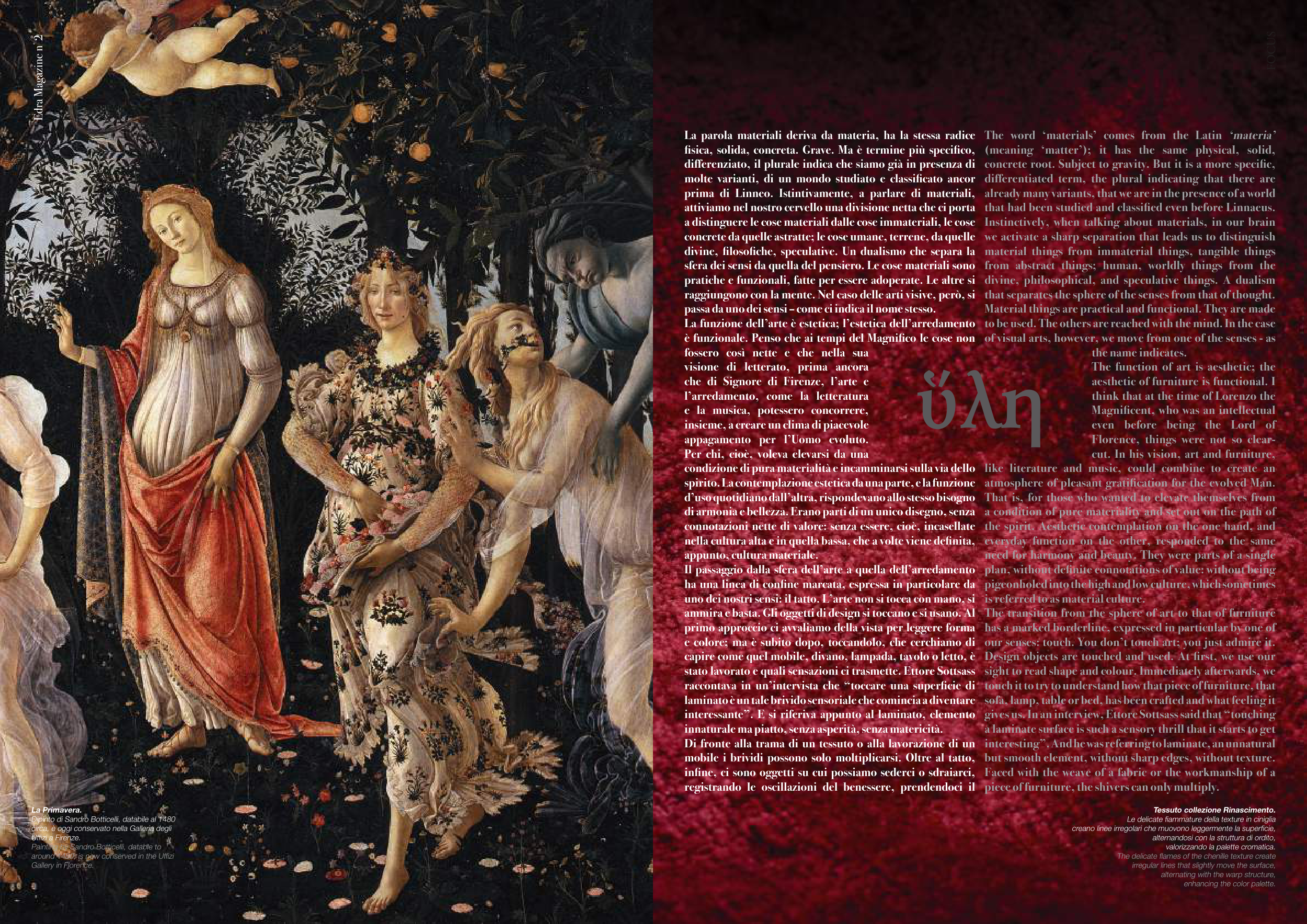
La Primavera.
Dipinto di Sandro Botticelli, databile al 1480
circa, è oggi conservato nella Galleria degli
Uffizi a Firenze.
Painting by Sandro Botticelli, datable to
around 1480, is now conserved in the Uffizi
Gallery in Florence.
ὕλη
The word ‘materials’ comes from the Latin ‘materia’
(meaning ‘matter’); it has the same physical, solid,
concrete root. Subject to gravity. But it is a more specific,
differentiated term, the plural indicating that there are
already many variants, that we are in the presence of a world
that had been studied and classified even before Linnaeus.
Instinctively, when talking about materials, in our brain
we activate a sharp separation that leads us to distinguish
material things from immaterial things, tangible things
from abstract things; human, worldly things from the
divine, philosophical, and speculative things. A dualism
that separates the sphere of the senses from that of thought.
Material things are practical and functional. They are made
to be used. The others are reached with the mind. In the case
of visual arts, however, we move from one of the senses - as
the name indicates.
The function of art is aesthetic; the
aesthetic of furniture is functional. I
think that at the time of Lorenzo the
Magnificent, who was an intellectual
even before being the Lord of
Florence, things were not so clear-
cut. In his vision, art and furniture,
like literature and music, could combine to create an
atmosphere of pleasant gratification for the evolved Man.
That is, for those who wanted to elevate themselves from
a condition of pure materiality and set out on the path of
the spirit. Aesthetic contemplation on the one hand, and
everyday function on the other, responded to the same
need for harmony and beauty. They were parts of a single
plan, without definite connotations of value: without being
pigeonholed into the high and low culture, which sometimes
is referred to as material culture.
The transition from the sphere of art to that of furniture
has a marked borderline, expressed in particular by one of
our senses: touch. You don’t touch art; you just admire it.
Design objects are touched and used. At first, we use our
sight to read shape and colour. Immediately afterwards, we
touch it to try to understand how that piece of furniture, that
sofa, lamp, table or bed, has been crafted and what feeling it
gives us. In an interview, Ettore Sottsass said that “touching
a laminate surface is such a sensory thrill that it starts to get
interesting”. And he was referring to laminate, an unnatural
but smooth element, without sharp edges, without texture.
Faced with the weave of a fabric or the workmanship of a
piece of furniture, the shivers can only multiply.
Edra Magazine n°2
FOCUS