49
Castello Sforzesco di Milano. Il nodo che compare alla cintura
del Vir Niger di Schifanoia a Ferrara, opera di Francesco del
Cossa, enigmatico personaggio studiato da Aby Warburg. Certo,
anche i nodi di un popolo, come quello brasiliano, che sa usare
l’artigianalità al massimo livello partendo da niente. C’è un
mondo di riferimenti in un nodo. E quel nodo nessuno prima lo
aveva fatto diventare divano: nodo d’amore, di complice alleanza,
nodo che intreccia racconti e storie, seduzioni, ricordi.
“Veramente moderno è ciò che è degno di diventare antico…
moderno è lo spirito dei tempi, ma la forma vera non può che
essere classica.”
Ho pensato spesso a questa frase di Dino Gavina: lui amava
ripeterla e ricordo che l’ha pronunciata anche quando l’ho
incontrato l’ultima volta nella sua casa museo di Bologna. E’ una
frase bellissima, generatrice di pensieri, a suo modo profetica:
il moderno e l’antico, la classicità delle forme, il senso della
contemporaneità e del suo divenire, l’eredità di quello che siamo
e che dobbiamo consegnare a chi verrà dopo di noi.
La contemporaneità è la dimensione in cui si muove da sempre
il mercato dell’arredamento: non è nato su queste premesse il
design italiano? Non è cresciuto in opposizione ai modelli del
passato? Non doveva farsi spazio per affermarsi rispetto a ciò che
già esisteva da secoli? Non era arte, non era (solo) artigianato
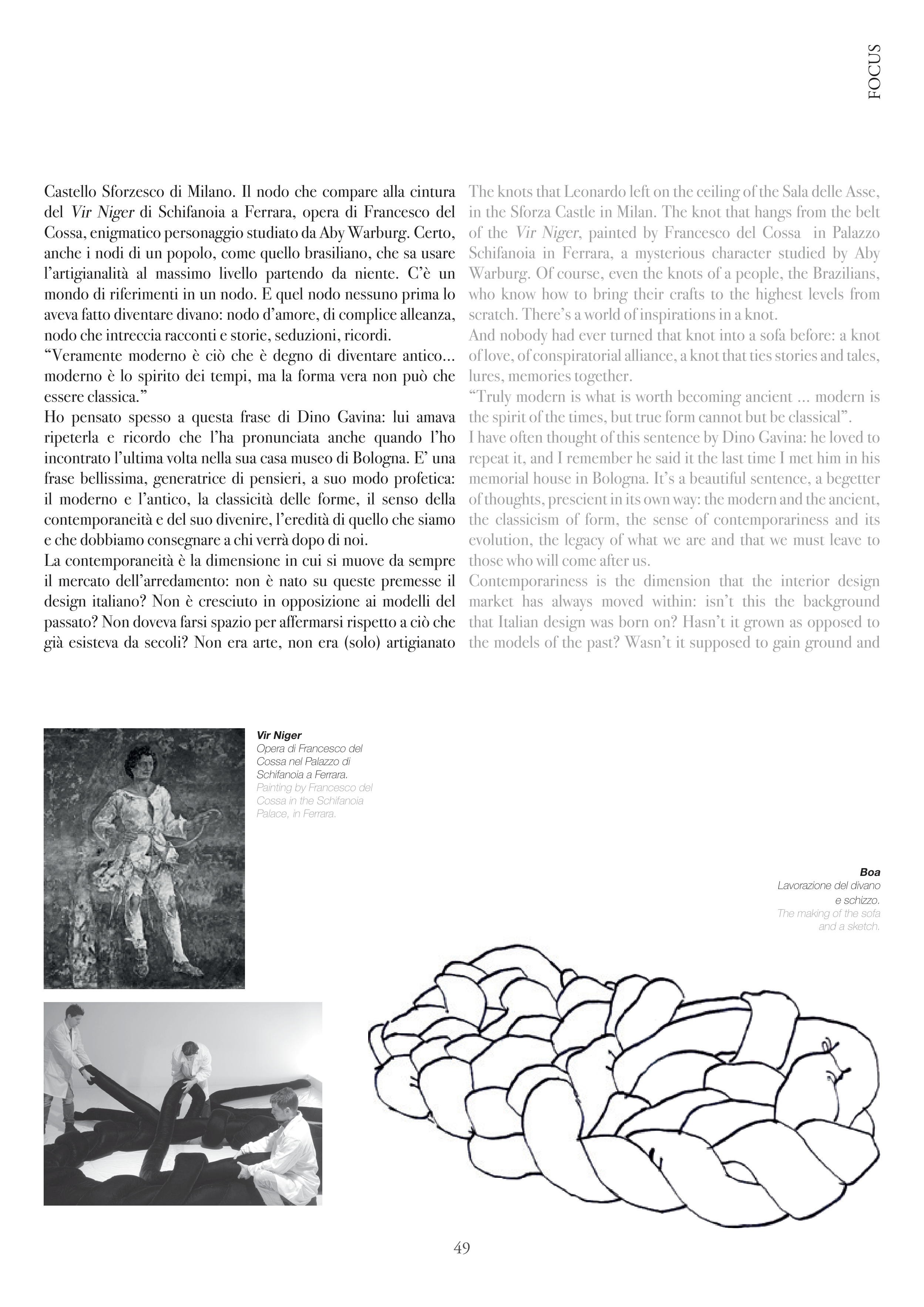
Vir Niger
Opera di Francesco del
Cossa nel Palazzo di
Schifanoia a Ferrara.
Painting by Francesco del
Cossa in the Schifanoia
Palace, in Ferrara.
Boa
Lavorazione del divano
e schizzo.
The making of the sofa
and a sketch.
The knots that Leonardo left on the ceiling of the Sala delle Asse,
in the Sforza Castle in Milan. The knot that hangs from the belt
of the Vir Niger, painted by Francesco del Cossa in Palazzo
Schifanoia in Ferrara, a mysterious character studied by Aby
Warburg. Of course, even the knots of a people, the Brazilians,
who know how to bring their crafts to the highest levels from
scratch. There’s a world of inspirations in a knot.
And nobody had ever turned that knot into a sofa before: a knot
of love, of conspiratorial alliance, a knot that ties stories and tales,
lures, memories together.
“Truly modern is what is worth becoming ancient … modern is
the spirit of the times, but true form cannot but be classical”.
I have often thought of this sentence by Dino Gavina: he loved to
repeat it, and I remember he said it the last time I met him in his
memorial house in Bologna. It’s a beautiful sentence, a begetter
of thoughts, prescient in its own way: the modern and the ancient,
the classicism of form, the sense of contemporariness and its
evolution, the legacy of what we are and that we must leave to
those who will come after us.
Contemporariness is the dimension that the interior design
market has always moved within: isn’t this the background
that Italian design was born on? Hasn’t it grown as opposed to
the models of the past? Wasn’t it supposed to gain ground and
FOCUS