48
Voglio portare un primo esempio che penso possa servire a
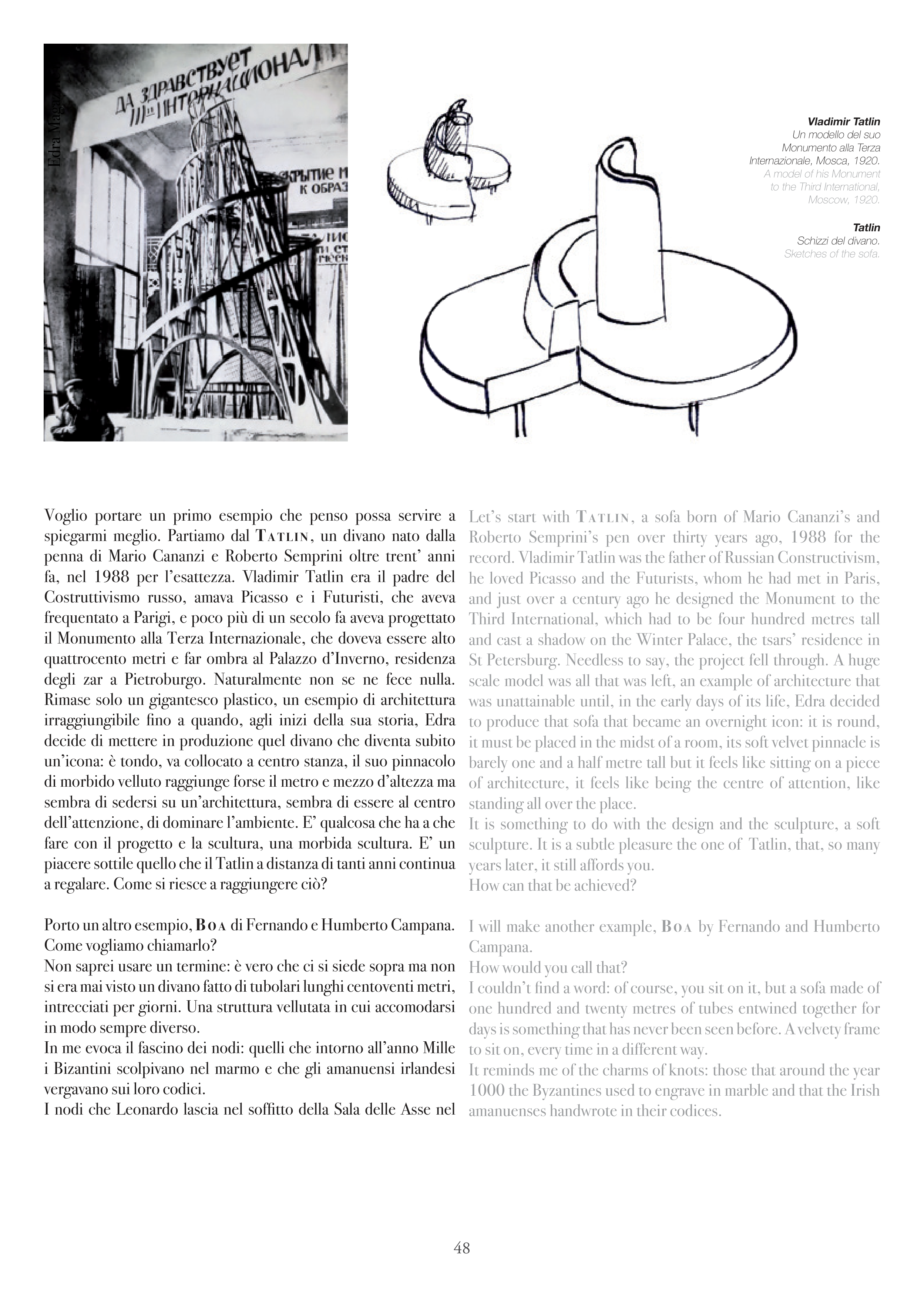
spiegarmi meglio. Partiamo dal tatlin, un divano nato dalla
penna di Mario Cananzi e Roberto Semprini oltre trent’ anni
fa, nel 1988 per l’esattezza. Vladimir Tatlin era il padre del
Costruttivismo russo, amava Picasso e i Futuristi, che aveva
frequentato a Parigi, e poco più di un secolo fa aveva progettato
il Monumento alla Terza Internazionale, che doveva essere alto
quattrocento metri e far ombra al Palazzo d’Inverno, residenza
degli zar a Pietroburgo. Naturalmente non se ne fece nulla.
Rimase solo un gigantesco plastico, un esempio di architettura
irraggiungibile fi no a quando, agli inizi della sua storia, Edra
decide di mettere in produzione quel divano che diventa subito
un’icona: è tondo, va collocato a centro stanza, il suo pinnacolo
di morbido velluto raggiunge forse il metro e mezzo d’altezza ma
sembra di sedersi su un’architettura, sembra di essere al centro
dell’attenzione, di dominare l’ambiente. E’ qualcosa che ha a che
fare con il progetto e la scultura, una morbida scultura. E’ un
piacere sottile quello che il Tatlin a distanza di tanti anni continua
a regalare. Come si riesce a raggiungere ciò?
Porto un altro esempio, boa di Fernando e Humberto Campana.
Come vogliamo chiamarlo?
Non saprei usare un termine: è vero che ci si siede sopra ma non
si era mai visto un divano fatto di tubolari lunghi centoventi metri,
intrecciati per giorni. Una struttura vellutata in cui accomodarsi
in modo sempre diverso.
In me evoca il fascino dei nodi: quelli che intorno all’anno Mille
i Bizantini scolpivano nel marmo e che gli amanuensi irlandesi
vergavano sui loro codici.
I nodi che Leonardo lascia nel soffi tto della Sala delle Asse nel
Vladimir Tatlin
Un modello del suo
Monumento alla Terza
Internazionale, Mosca, 1920.
A model of his Monument
to the Third International,
Moscow, 1920.
Tatlin
Schizzi del divano.
Sketches of the sofa.
Let’s start with tatlin, a sofa born of Mario Cananzi’s and
Roberto Semprini’s pen over thirty years ago, 1988 for the
record. Vladimir Tatlin was the father of Russian Constructivism,
he loved Picasso and the Futurists, whom he had met in Paris,
and just over a century ago he designed the Monument to the
Third International, which had to be four hundred metres tall
and cast a shadow on the Winter Palace, the tsars’ residence in
St Petersburg. Needless to say, the project fell through. A huge
scale model was all that was left, an example of architecture that
was unattainable until, in the early days of its life, Edra decided
to produce that sofa that became an overnight icon: it is round,
it must be placed in the midst of a room, its soft velvet pinnacle is
barely one and a half metre tall but it feels like sitting on a piece
of architecture, it feels like being the centre of attention, like
standing all over the place.
It is something to do with the design and the sculpture, a soft
sculpture. It is a subtle pleasure the one of Tatlin, that, so many
years later, it still affords you.
How can that be achieved?
I will make another example, boa by Fernando and Humberto
Campana.
How would you call that?
I couldn’t fi nd a word: of course, you sit on it, but a sofa made of
one hundred and twenty metres of tubes entwined together for
days is something that has never been seen before. A velvety frame
to sit on, every time in a different way.
It reminds me of the charms of knots: those that around the year
1000 the Byzantines used to engrave in marble and that the Irish
amanuenses handwrote in their codices.
Edra Magazine n°0