N
el cuore della Franciacorta, tra le vigne
della tenuta di famiglia, Valentina Moretti
ha progettato la sua casa come un gesto
radicale di conciliazione con la natura.
Non si tratta solo di architettura, ma di un
modo di vivere e di pensare. Una casa che non cerca di
dominare il paesaggio, ma di farsi paesaggio essa stessa,
aprendosi alla luce, ai suoni, alle stagioni. Una casa come
organismo vivente, dove ogni elemento è pensato per durare,
invecchiare, trasformarsi, come avviene in natura. Un’opera
che fa della bassa definizione – non come mancanza, ma
come spazio essenziale, “vuoto” lasciato all’immaginazione
e alla trasformazione – un punto di forza. Perché, in effetti,
non si tratta della solita architettura patinata, ma traduce
l’idea di casa diffusa in quattro volumi dal sapore brutalista,
I
n the heart of Franciacorta, among the vineyards of
the family estate, Valentina Moretti has designed her
home as a radical gesture of conciliation with nature.
This is not only about architecture, but a way of living
and thinking. It is a house that does not try to dominate
the landscape, but to become landscape itself, open to the
light, sounds, and seasons. It is home as a living organism,
in which every element has been conceived to last, age and
transform as happens in nature. This work makes a strong
point of low definition, considered not as a lack but as an
essential space of “emptiness” left to the imagination and
transformation. In effect this is not the usual highly polished
architecture, but the translation of an idea of home into four
volumes of brutalist flavour, where structure and decorative
apparatus coincide, lying between woods to the north and a
posizionati tra il bosco a nord e il parco a sud, dove struttura
e apparato decorativo coincidono, collegate tra loro da
interspazi. Qui la relazione tra architettura, arredi e natura è
fluida, in continuo movimento, viva. Un micro-ecosistema
come quello di cui parla Luca Molinari nel suo libro Stanze.
Abitare il desiderio. Citando Gio Ponti, l’autore scrive di
stanze come “mondi”, perché sono “il ritratto di chi le abita e
le modifica continuamente lungo l’arco delle stagioni e della
propria vita, ma anche perché raccontano quello che noi
abbiamo preso del mondo e come lo abbiamo modificato”.
Molinari invita a interrogare ogni stanza, entrando in contatto
con le sfumature più piccole della nostra esistenza, che ci
lasciano una sensazione di completezza e ci permettono di
osservare il mondo con occhi diversi. Il privilegio di scoprire
dettagli che ci emozionano, e di farci stupire da essi, è per
On the Rocks, Sherazade, Standard Outdoor.
Nelle pagine precedenti i divani sono accenti di colore che
intrecciano relax e paesaggio nel grande parco immerso fra
bosco e vigneti.
Previous page, the sofas are accents of colour that weave
relaxation with landscape in the large garden immersed in woods
and vineyards.
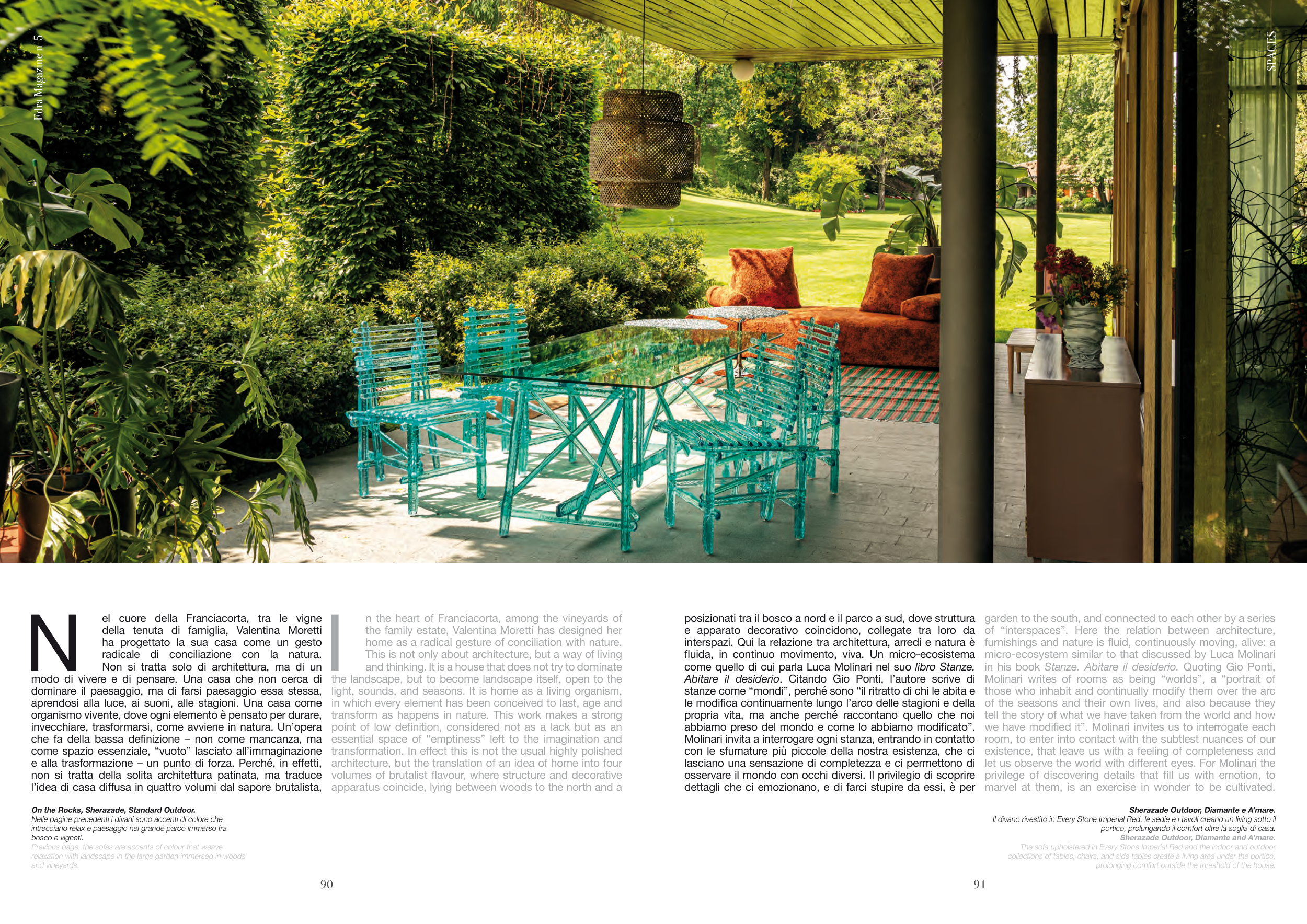
Sherazade Outdoor, Diamante e A’mare.
Il divano rivestito in Every Stone Imperial Red, le sedie e i tavoli creano un living sotto il
portico, prolungando il comfort oltre la soglia di casa.
Sherazade Outdoor, Diamante and A’mare.
The sofa upholstered in Every Stone Imperial Red and the indoor and outdoor
collections of tables, chairs, and side tables create a living area under the portico,
prolonging comfort outside the threshold of the house.
garden to the south, and connected to each other by a series
of “interspaces”. Here the relation between architecture,
furnishings and nature is fluid, continuously moving, alive: a
micro-ecosystem similar to that discussed by Luca Molinari
in his book Stanze. Abitare il desiderio. Quoting Gio Ponti,
Molinari writes of rooms as being “worlds”, a “portrait of
those who inhabit and continually modify them over the arc
of the seasons and their own lives, and also because they
tell the story of what we have taken from the world and how
we have modified it”. Molinari invites us to interrogate each
room, to enter into contact with the subtlest nuances of our
existence, that leave us with a feeling of completeness and
let us observe the world with different eyes. For Molinari the
privilege of discovering details that fill us with emotion, to
marvel at them, is an exercise in wonder to be cultivated.
Edra Magazine n°5
90
91
SPACES