Il primo, le sculture di Davide Rivalta in Campo Santa
Maria Formosa. Due leoni e due leonesse nel cuore di
Venezia, come epifanie dell’“aperto”: soglie che mostrano
la fragilità della nostra pretesa di dominare la distinzione
tra umano e animale, resti di quel confine di cui abbiamo
bisogno per definirci. Sculture, animali inerti, “visibili”
solo come oggetti simbolici. Eppure, la loro presenza è
“aperta”, non parlano ma non smettono di guardare. Sono
il nostro controcampo silenzioso, la materializzazione
dell’animalità inclusa, rappresentata e addomesticata
nell’ordine umano. Eppure restano inquieti, come sul
punto di incrinare la finzione, di restituirci la domanda
sospesa: cosa ci distingue davvero? Siamo ancora capaci di
riconoscere nell’animale un altro da noi? E quale relazione
intratteniamo oggi con quella natura di cui siamo parte,
come cellule di un unico organismo vivente?
Il secondo, Q Spot. Seat, read, think, repeat, progettato
da Martí Guixé, trasforma il logo della Fondazione
in una seduta sociale, invitando a sostare, leggere,
riflettere e condividere, promuovendo la cultura come
pratica quotidiana e allenamento per vivere il mondo.
Un oggetto che abilita, dischiude la socialità come
evento, predisponendo lo spazio per l’interazione
pubblica, occasionale e dinamica. Un’opera come
dispositivo comportamentale, come agente relazionale
che modifica l’ambiente incoraggiando la comunicazione
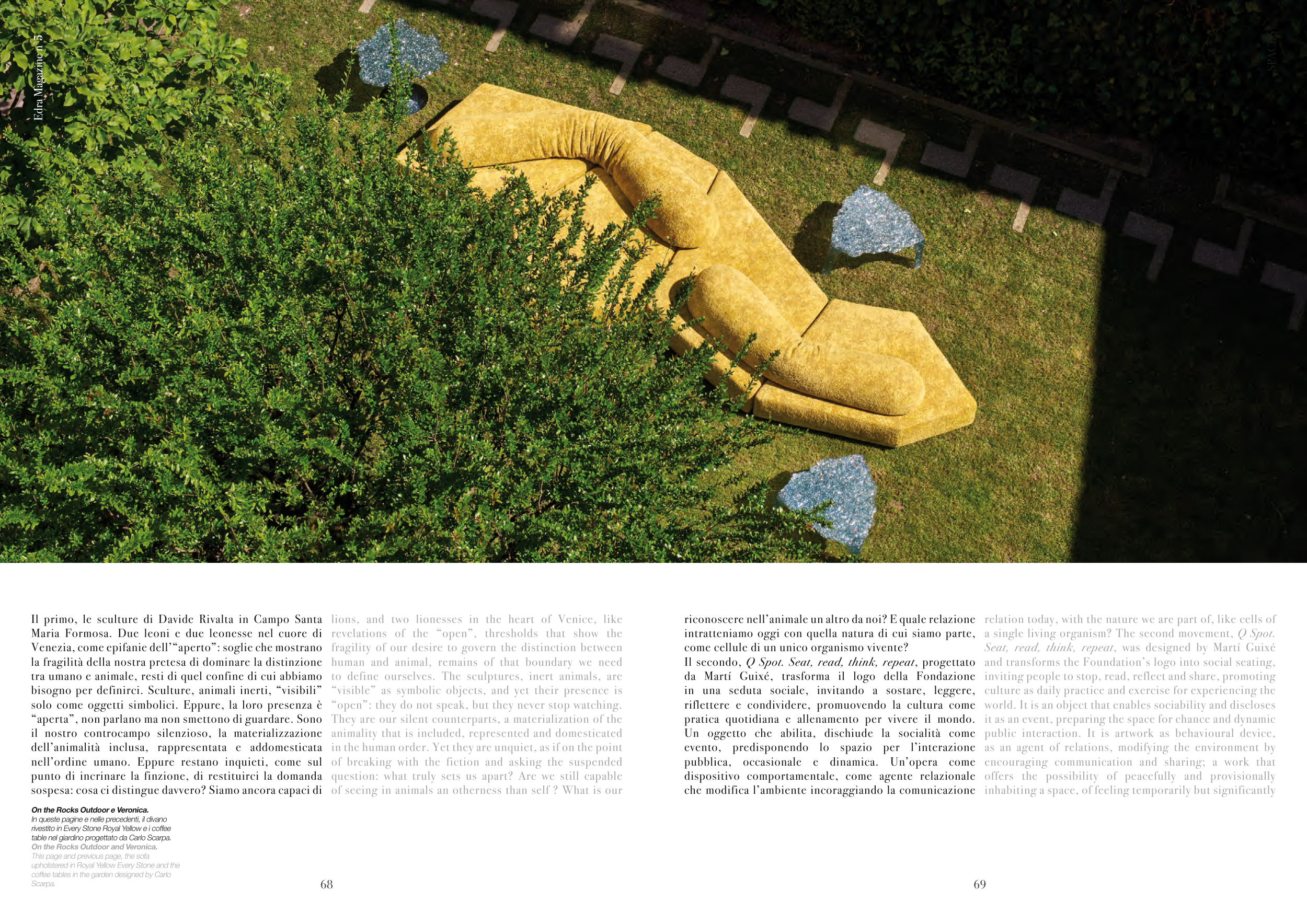
On the Rocks Outdoor e Veronica.
In queste pagine e nelle precedenti, il divano
rivestito in Every Stone Royal Yellow e i coffee
table nel giardino progettato da Carlo Scarpa.
On the Rocks Outdoor and Veronica.
This page and previous page, the sofa
upholstered in Royal Yellow Every Stone and the
coffee tables in the garden designed by Carlo
Scarpa.
lions, and two lionesses in the heart of Venice, like
revelations of the “open”, thresholds that show the
fragility of our desire to govern the distinction between
human and animal, remains of that boundary we need
to define ourselves. The sculptures, inert animals, are
“visible” as symbolic objects, and yet their presence is
“open”: they do not speak, but they never stop watching.
They are our silent counterparts, a materialization of the
animality that is included, represented and domesticated
in the human order. Yet they are unquiet, as if on the point
of breaking with the fiction and asking the suspended
question: what truly sets us apart? Are we still capable
of seeing in animals an otherness than self ? What is our
relation today, with the nature we are part of, like cells of
a single living organism? The second movement, Q Spot.
Seat, read, think, repeat, was designed by Martí Guixé
and transforms the Foundation’s logo into social seating,
inviting people to stop, read, reflect and share, promoting
culture as daily practice and exercise for experiencing the
world. It is an object that enables sociability and discloses
it as an event, preparing the space for chance and dynamic
public interaction. It is artwork as behavioural device,
as an agent of relations, modifying the environment by
encouraging communication and sharing; a work that
offers the possibility of peacefully and provisionally
inhabiting a space, of feeling temporarily but significantly
Edra Magazine n°5
68
69
SPACES