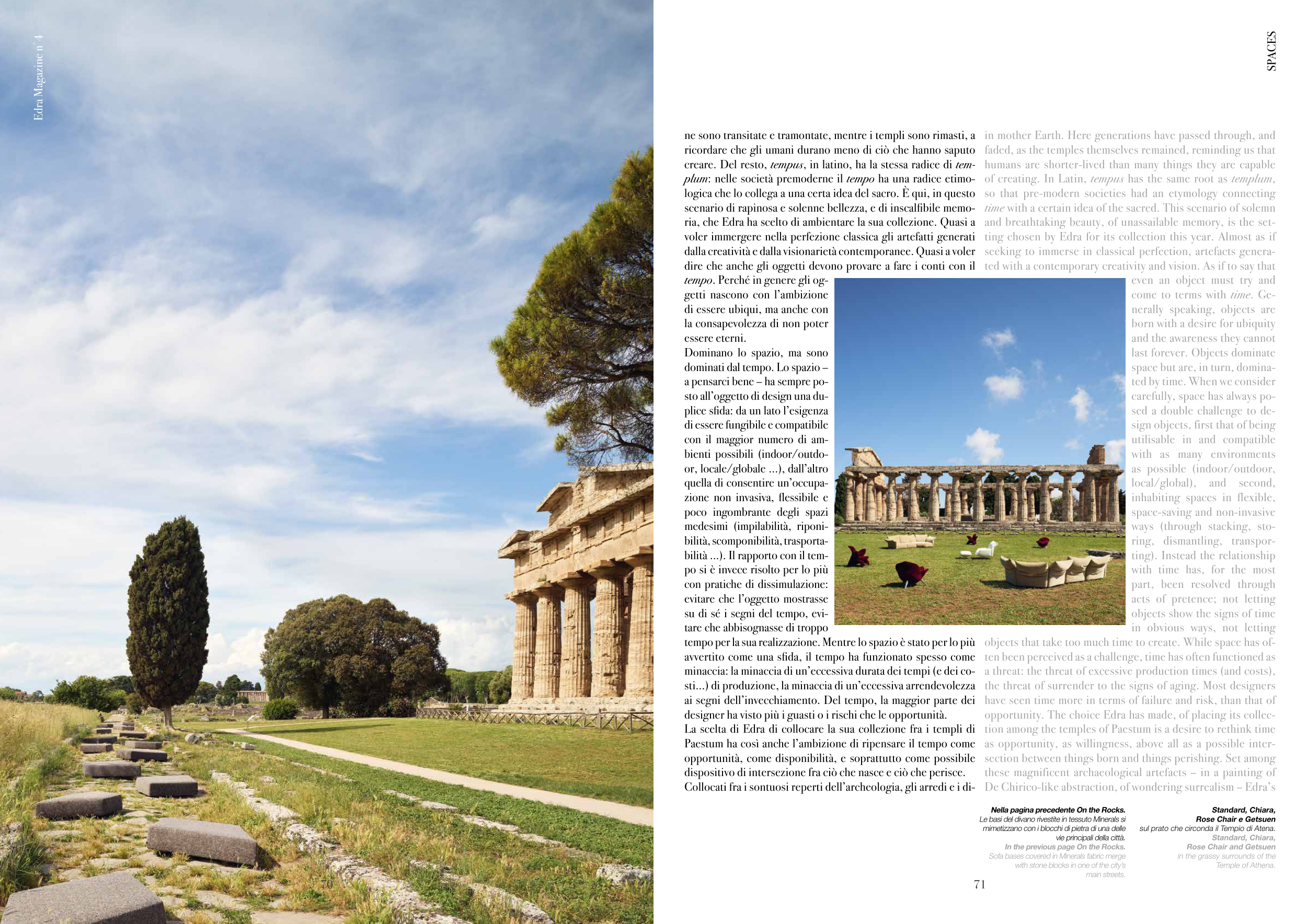
Standard, Chiara,
Rose Chair e Getsuen
sul prato che circonda il Tempio di Atena.
Standard, Chiara,
Rose Chair and Getsuen
in the grassy surrounds of the
Temple of Athena.
Nella pagina precedente On the Rocks.
Le basi del divano rivestite in tessuto Minerals si
mimetizzano con i blocchi di pietra di una delle
vie principali della città.
In the previous page On the Rocks.
Sofa bases covered in Minerals fabric merge
with stone blocks in one of the city’s
main streets.
ne sono transitate e tramontate, mentre i templi sono rimasti, a
ricordare che gli umani durano meno di ciò che hanno saputo
creare. Del resto, tempus, in latino, ha la stessa radice di tem-
plum: nelle società premoderne il tempo ha una radice etimo-
logica che lo collega a una certa idea del sacro. È qui, in questo
scenario di rapinosa e solenne bellezza, e di inscalfibile memo-
ria, che Edra ha scelto di ambientare la sua collezione. Quasi a
voler immergere nella perfezione classica gli artefatti generati
dalla creatività e dalla visionarietà contemporanee. Quasi a voler
dire che anche gli oggetti devono provare a fare i conti con il
tempo. Perché in genere gli og-
getti nascono con l’ambizione
di essere ubiqui, ma anche con
la consapevolezza di non poter
essere eterni.
Dominano lo spazio, ma sono
dominati dal tempo. Lo spazio –
a pensarci bene – ha sempre po-
sto all’oggetto di design una du-
plice sfida: da un lato l’esigenza
di essere fungibile e compatibile
con il maggior numero di am-
bienti possibili (indoor/outdo-
or, locale/globale ...), dall’altro
quella di consentire un’occupa-
zione non invasiva, flessibile e
poco ingombrante degli spazi
medesimi (impilabilità, riponi-
bilità, scomponibilità, trasporta-
bilità ...). Il rapporto con il tem-
po si è invece risolto per lo più
con pratiche di dissimulazione:
evitare che l’oggetto mostrasse
su di sé i segni del tempo, evi-
tare che abbisognasse di troppo
tempo per la sua realizzazione. Mentre lo spazio è stato per lo più
avvertito come una sfida, il tempo ha funzionato spesso come
minaccia: la minaccia di un’eccessiva durata dei tempi (e dei co-
sti…) di produzione, la minaccia di un’eccessiva arrendevolezza
ai segni dell’invecchiamento. Del tempo, la maggior parte dei
designer ha visto più i guasti o i rischi che le opportunità.
La scelta di Edra di collocare la sua collezione fra i templi di
Paestum ha così anche l’ambizione di ripensare il tempo come
opportunità, come disponibilità, e soprattutto come possibile
dispositivo di intersezione fra ciò che nasce e ciò che perisce.
Collocati fra i sontuosi reperti dell’archeologia, gli arredi e i di-
in mother Earth. Here generations have passed through, and
faded, as the temples themselves remained, reminding us that
humans are shorter-lived than many things they are capable
of creating. In Latin, tempus has the same root as templum,
so that pre-modern societies had an etymology connecting
time with a certain idea of the sacred. This scenario of solemn
and breathtaking beauty, of unassailable memory, is the set-
ting chosen by Edra for its collection this year. Almost as if
seeking to immerse in classical perfection, artefacts genera-
ted with a contemporary creativity and vision. As if to say that
even an object must try and
come to terms with time. Ge-
nerally speaking, objects are
born with a desire for ubiquity
and the awareness they cannot
last forever. Objects dominate
space but are, in turn, domina-
ted by time. When we consider
carefully, space has always po-
sed a double challenge to de-
sign objects, first that of being
utilisable in and compatible
with as many environments
as possible (indoor/outdoor,
local/global),
and
second,
inhabiting spaces in flexible,
space-saving and non-invasive
ways (through stacking, sto-
ring, dismantling, transpor-
ting). Instead the relationship
with time has, for the most
part, been resolved through
acts of pretence; not letting
objects show the signs of time
in obvious ways, not letting
objects that take too much time to create. While space has of-
ten been perceived as a challenge, time has often functioned as
a threat: the threat of excessive production times (and costs),
the threat of surrender to the signs of aging. Most designers
have seen time more in terms of failure and risk, than that of
opportunity. The choice Edra has made, of placing its collec-
tion among the temples of Paestum is a desire to rethink time
as opportunity, as willingness, above all as a possible inter-
section between things born and things perishing. Set among
these magnificent archaeological artefacts – in a painting of
De Chirico-like abstraction, of wondering surrealism – Edra’s
Edra Magazine n°4
70
71
SPACES