sguardo e una qualità dell’osservazione che ci riporta allo stupore
di una luce che entra improvvisa nella nostra casa o alla forma di
meraviglia elementare che tutti noi abbiamo vissuto abitando sem-
plicemente le nostre case. Ogni immagine di Ghirri è un ritratto
per oggetti e spazi degli autori che li hanno vissuti e che ci hanno
lavorato. Posso quasi vedere Morandi che lavora lento e inesora-
bile, cercando ogni volta, in una leggera variazione sul tema della
Natura Morta, il significato profondo e silenzioso delle nostre esi-
stenze. Poi lo sguardo si volta al
letto bianco, contadino, appena
rifatto, ai comodini vicini, op-
pure alla porta in legno che dà
nell’appartamento. In ogni im-
magine si sente l’amore di chi ha
osservato in silenzio e ha lasciato
che quel vuoto potesse espri-
mersi, offrendoci un frammento
momentaneo dell’anima di quel
luogo.
È la stessa emozione che provano
tutti i protagonisti anonimi del-
le tele del pittore olandese Jan
Vermeer, fissi davanti o a fianco
della grande finestra da cui sono
inondati di luce. Non si vede mai
fuori, ma solo quello sguardo
assorto o stupito di chi sta svol-
gendo un’azione precisa di cui
l’ambiente domestico diventa
eco che riverbera lo stato d’ani-
mo. La luce del nord è padrona,
ma anche la capacità di questi an-
goli, così perfettamente immagi-
nati, di ampliare e accogliere gli
stati d’animo individuali, rende
questi momenti unici, universali.
La bellezza borghese e domesti-
ca dei luoghi rivela l’incanto del
particolare, del dettaglio che narra un mondo intero e della me-
raviglia che lo accompagna, se solo si ha la voglia di rallentare e
osservare. Ogni tappeto, tessuto, brocca, bicchiere, mobilio, map-
pa geografica alla parete, finestra, diventa occasione di meraviglia,
trappola per gli occhi e tutti i sensi. Rivela il potere di ogni singolo
dettaglio di rapirci, rallentando il corso distratto della nostra vita.
Il sentimento di meraviglia non ha una definita scala di riferimento,
non ha nulla a che fare con la grandezza, ma con l’intensità di quel-
lo che riesce a risvegliare in un desiderio latente che ci accompa-
gna e che si materializza nell’incontro di un luogo o di un oggetto
che sembrava attenderci.
La scala minuta del domestico tende alla compressione simbolica e
visiva di ogni elemento. Annulla la miopia che spesso ci accompa-
gna, offrendo occasioni d’incontro inattese che ci avvicinano a una
dimensione quasi sacrale del luogo e dei suoi caratteri profondi,
che siano positivi o negativi.
Il potere di un dettaglio o di un odore che emerge improvviso ha la
capacità di risvegliare emozioni profonde, incagliate nell’animo e
nella memoria, ampliando a dismisura lo spazio e il metro con cui
lo osserviamo. Alcuni spazi domestici, non necessariamente addo-
mesticati nel nostro spirito, offrono, attraverso dettagli apparente-
mente innocui, un potere scatenante delle emozioni private capaci
di raccontare in un attimo gioia, illusioni, violenza, sopraffazione,
speranze, tradimenti, legami, trasformando i luoghi più familiari in
condizioni universali, condivisibili.
La casa come raccolta delle ossessioni borghesi e contemporanee
risuona in maniera paradossale con le Wunderkammer che si mol-
tiplicarono in tutta Europa tra il Cinquecento e il Settecento. Ca-
mere preziose e riservate a pochi intimi in cui il ricco committente
raccoglieva tutto quello che poteva sembrare raro, sorprendente,
inaspettato, mostruoso tra le stranezze della Natura, le opere di
mondi lontani e il virtuosismo tecnico e artigianale dei prodotti.
Ogni oggetto doveva sorprendere, microcosmo soggiogante tutti i
sensi e insieme raccolta di bellezza in uno spazio separato dal resto
del palazzo, scrigno in cui perdersi e viaggio nella memoria e bel-
lezza di un mondo che stava espandendosi agli occhi degli abitanti
del vecchio mondo. Il tempo che corre sempre più veloce prende
la forma dei primi orologi meccanici e degli automi cesellati nei
metalli più preziosi che popolano queste stanze insieme ad animali
a tre teste, antichità, quadri che rimandano ad altri mondi e pae-
saggi esotici, conchiglie e coralli lavorati preziosamente, papiri e
polvere di mummia, gioielli, animali tropicali impagliati, costumi,
piume, reliquie, parti anatomiche riprodotte in cera. Materiali che
invadono gli occhi e i sensi. Labirinto della mente in cui perdersi
in un mondo che non sapeva ancora se essere alchemico o moder-
no, ma che celava nel cuore profondo della residenza nobiliare uno
scrigno protetto gelosamente.
Ogni interno domestico diventa una potenziale scatola del tempo,
come nei lavori dell’artista americano Gordon Matta Clark che, tra
gli anni Sessanta e Settanta del secolo scorso, acquistava case ab-
bandonate nelle periferie delle grandi città statunitensi e le segava
longitudinalmente per portare in scena, all’aperto, tutte le tracce
infinite delle vite che le avevano attraversate. Improvvisamente,
quei pezzi esposti in un museo, ci raccontano della nostra storia
e della sua fragilità aggrappate a una tappezzeria strappata, alla sa-
goma di un quadro che non c’è più, ai segni dei nostri passi sul
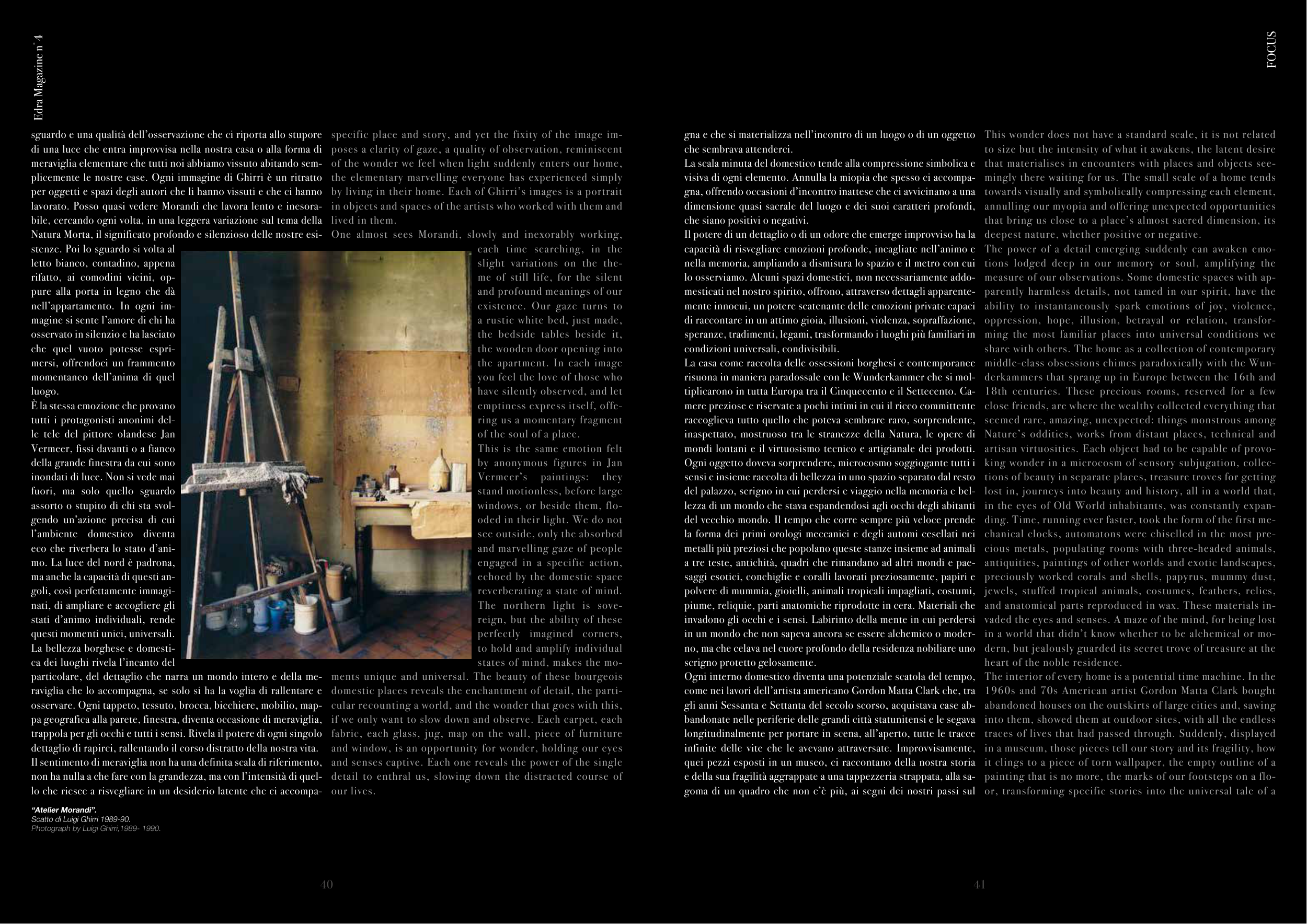
“Atelier Morandi”.
Scatto di Luigi Ghirri 1989-90.
Photograph by Luigi Ghirri,1989- 1990.
specific place and story, and yet the fixity of the image im-
poses a clarity of gaze, a quality of observation, reminiscent
of the wonder we feel when light suddenly enters our home,
the elementary marvelling everyone has experienced simply
by living in their home. Each of Ghirri’s images is a portrait
in objects and spaces of the artists who worked with them and
lived in them.
One almost sees Morandi, slowly and inexorably working,
each time searching, in the
slight variations on the the-
me of still life, for the silent
and profound meanings of our
existence. Our gaze turns to
a rustic white bed, just made,
the bedside tables beside it,
the wooden door opening into
the apartment. In each image
you feel the love of those who
have silently observed, and let
emptiness express itself, offe-
ring us a momentary fragment
of the soul of a place.
This is the same emotion felt
by anonymous figures in Jan
Vermeer’s
paintings:
they
stand motionless, before large
windows, or beside them, flo-
oded in their light. We do not
see outside, only the absorbed
and marvelling gaze of people
engaged in a specific action,
echoed by the domestic space
reverberating a state of mind.
The northern light is sove-
reign, but the ability of these
perfectly imagined corners,
to hold and amplify individual
states of mind, makes the mo-
ments unique and universal. The beauty of these bourgeois
domestic places reveals the enchantment of detail, the parti-
cular recounting a world, and the wonder that goes with this,
if we only want to slow down and observe. Each carpet, each
fabric, each glass, jug, map on the wall, piece of furniture
and window, is an opportunity for wonder, holding our eyes
and senses captive. Each one reveals the power of the single
detail to enthral us, slowing down the distracted course of
our lives.
This wonder does not have a standard scale, it is not related
to size but the intensity of what it awakens, the latent desire
that materialises in encounters with places and objects see-
mingly there waiting for us. The small scale of a home tends
towards visually and symbolically compressing each element,
annulling our myopia and offering unexpected opportunities
that bring us close to a place’s almost sacred dimension, its
deepest nature, whether positive or negative.
The power of a detail emerging suddenly can awaken emo-
tions lodged deep in our memory or soul, amplifying the
measure of our observations. Some domestic spaces with ap-
parently harmless details, not tamed in our spirit, have the
ability to instantaneously spark emotions of joy, violence,
oppression, hope, illusion, betrayal or relation, transfor-
ming the most familiar places into universal conditions we
share with others. The home as a collection of contemporary
middle-class obsessions chimes paradoxically with the Wun-
derkammers that sprang up in Europe between the 16th and
18th centuries. These precious rooms, reserved for a few
close friends, are where the wealthy collected everything that
seemed rare, amazing, unexpected: things monstrous among
Nature’s oddities, works from distant places, technical and
artisan virtuosities. Each object had to be capable of provo-
king wonder in a microcosm of sensory subjugation, collec-
tions of beauty in separate places, treasure troves for getting
lost in, journeys into beauty and history, all in a world that,
in the eyes of Old World inhabitants, was constantly expan-
ding. Time, running ever faster, took the form of the first me-
chanical clocks, automatons were chiselled in the most pre-
cious metals, populating rooms with three-headed animals,
antiquities, paintings of other worlds and exotic landscapes,
preciously worked corals and shells, papyrus, mummy dust,
jewels, stuffed tropical animals, costumes, feathers, relics,
and anatomical parts reproduced in wax. These materials in-
vaded the eyes and senses. A maze of the mind, for being lost
in a world that didn’t know whether to be alchemical or mo-
dern, but jealously guarded its secret trove of treasure at the
heart of the noble residence.
The interior of every home is a potential time machine. In the
1960s and 70s American artist Gordon Matta Clark bought
abandoned houses on the outskirts of large cities and, sawing
into them, showed them at outdoor sites, with all the endless
traces of lives that had passed through. Suddenly, displayed
in a museum, those pieces tell our story and its fragility, how
it clings to a piece of torn wallpaper, the empty outline of a
painting that is no more, the marks of our footsteps on a flo-
or, transforming specific stories into the universal tale of a
Edra Magazine n°4
40
41
FOCUS