alle truppe del Generale Radetzky, da Massimiliano I d’Asburgo-
Lorena fino a Re Umberto I di Savoia, il cui assassinio eclissò
per sempre, nel 1900, la destinazione regale della villa.
Durante i suoi quasi 250 anni di storia, l’architettura ha subito
profonde trasformazioni e, mentre restava ferma la facies
delineata dal Piermarini, con l’eleganza e la maestosità che
ancora oggi stupiscono, la
Reggia si reiventava più volte.
Pochi sanno, infatti, che proprio
nella Villa Reale di Monza
nel
1923,
contestualmente
all’apertura dell’Università di
Arti decorative, ribattezzata
poi ISIA – Istituto superiore
per le industrie artistiche di
Monza –, venne inaugurata
l’Esposizione internazionale di
arti decorative. Una mostra di
successo, riallestita nella Villa
Reale nel 1925, 1927 e 1930,
che divenne famosa come la
“Triennale di Milano” dopo il
trasferimento nel capoluogo
lombardo.
Tanti mutamenti hanno forgiato
un’identità variegata: asburgica
di stampo neoclassico, insieme
sabauda
in
stile
floreale;
legata a quell’artigianato che
può
dirsi
antesignano
del
design e protesa verso l’arte
contemporanea.
Una
storia
così travagliata ha inciso diversi
tratti nella fisionomia del luogo,
senza però radicarvi un preciso
carattere identitario: privando
gli interni di quasi tutte le
opere d’arte e le suppellettili,
rimosse o andate distrutte,
ha lasciato solo alla struttura
l’originaria
grandiosità.
In
questa prospettiva, seguendo
l’esempio del Quirinale, grazie alla visione del Presidente
Paolo Pilotto e su impulso del Direttore Generale Giuseppe
Distefano, il Consorzio Villa Reale e Parco di Monza ha
avviato il progetto Reggia Contemporanea. Un’iniziativa a
cui Edra ha partecipato con due splendidi lavori di Jacopo
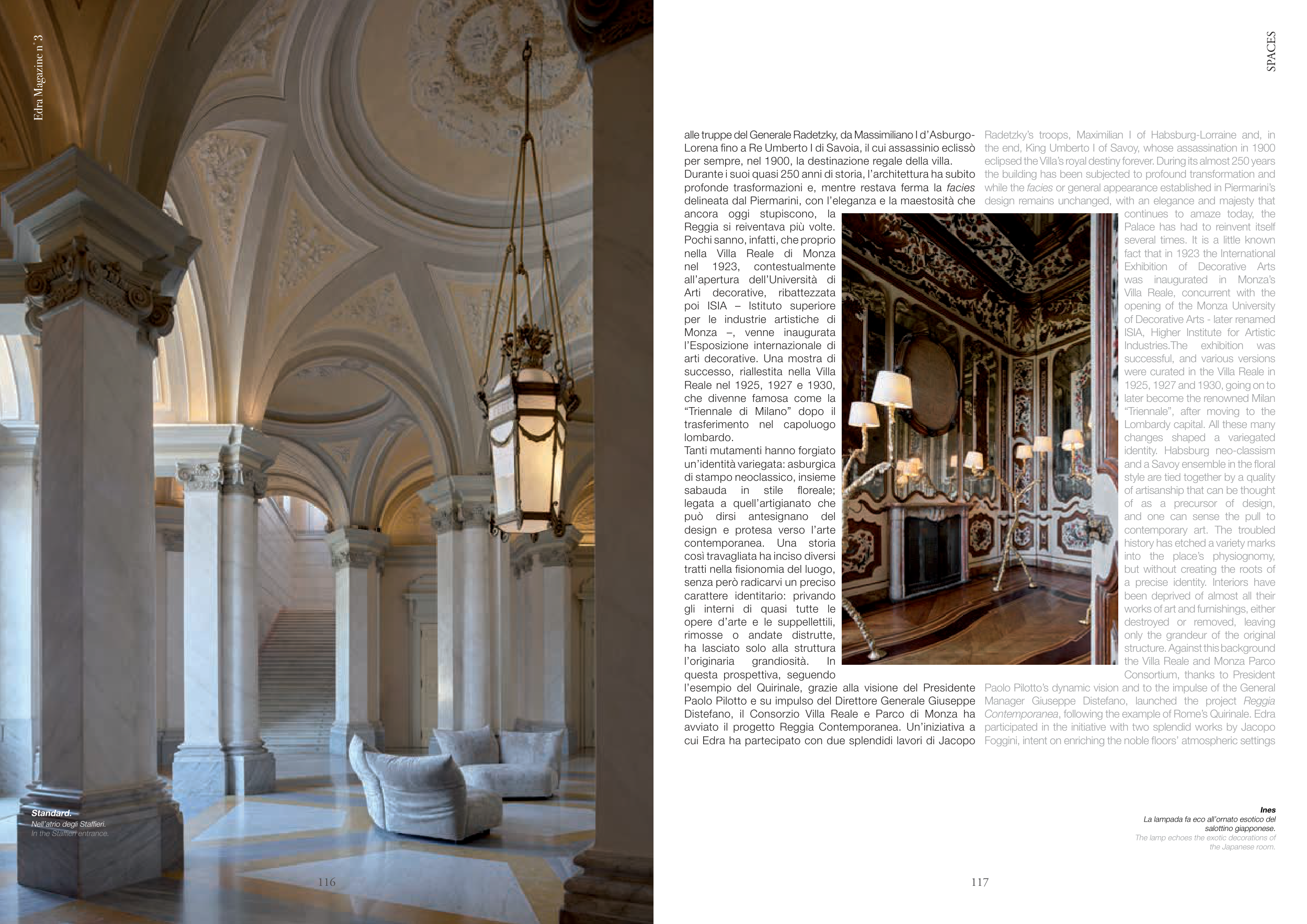
Ines
La lampada fa eco all’ornato esotico del
salottino giapponese.
The lamp echoes the exotic decorations of
the Japanese room.
Standard.
Nell’atrio degli Staffieri.
In the Staffieri entrance.
Radetzky’s troops, Maximilian I of Habsburg-Lorraine and, in
the end, King Umberto I of Savoy, whose assassination in 1900
eclipsed the Villa’s royal destiny forever. During its almost 250 years
the building has been subjected to profound transformation and
while the facies or general appearance established in Piermarini’s
design remains unchanged, with an elegance and majesty that
continues to amaze today, the
Palace has had to reinvent itself
several times. It is a little known
fact that in 1923 the International
Exhibition of Decorative Arts
was inaugurated in Monza’s
Villa Reale, concurrent with the
opening of the Monza University
of Decorative Arts - later renamed
ISIA, Higher Institute for Artistic
Industries.The
exhibition
was
successful, and various versions
were curated in the Villa Reale in
1925, 1927 and 1930, going on to
later become the renowned Milan
“Triennale”, after moving to the
Lombardy capital. All these many
changes shaped a variegated
identity. Habsburg neo-classism
and a Savoy ensemble in the floral
style are tied together by a quality
of artisanship that can be thought
of as a precursor of design,
and one can sense the pull to
contemporary art. The troubled
history has etched a variety marks
into the place’s physiognomy,
but without creating the roots of
a precise identity. Interiors have
been deprived of almost all their
works of art and furnishings, either
destroyed or removed, leaving
only the grandeur of the original
structure. Against this background
the Villa Reale and Monza Parco
Consortium, thanks to President
Paolo Pilotto’s dynamic vision and to the impulse of the General
Manager Giuseppe Distefano, launched the project Reggia
Contemporanea, following the example of Rome’s Quirinale. Edra
participated in the initiative with two splendid works by Jacopo
Foggini, intent on enriching the noble floors’ atmospheric settings
Edra Magazine n°3
116
117
SPACES