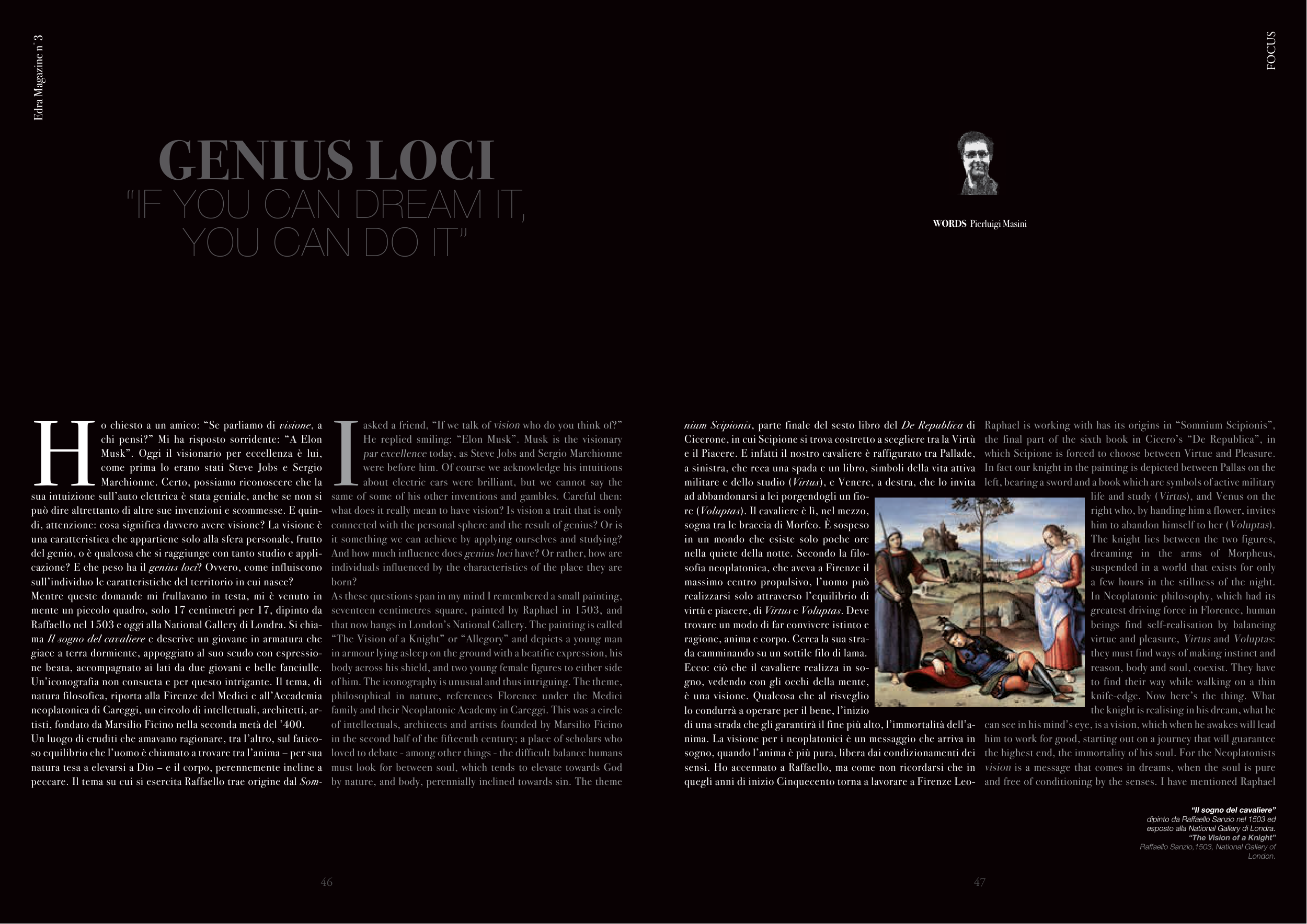
“Il sogno del cavaliere”
dipinto da Raff aello Sanzio nel 1503 ed
esposto alla National Gallery di Londra.
“The Vision of a Knight”
Raff aello Sanzio,1503, National Gallery of
London.
H
o chiesto a un amico: “Se parliamo di visione, a
chi pensi?” Mi ha risposto sorridente: “A Elon
Musk”. Oggi il visionario per eccellenza è lui,
come prima lo erano stati Steve Jobs e Sergio
Marchionne. Certo, possiamo riconoscere che la
sua intuizione sull’auto elettrica è stata geniale, anche se non si
può dire altrettanto di altre sue invenzioni e scommesse. E quin-
di, attenzione: cosa significa davvero avere visione? La visione è
una caratteristica che appartiene solo alla sfera personale, frutto
del genio, o è qualcosa che si raggiunge con tanto studio e appli-
cazione? E che peso ha il genius loci? Ovvero, come influiscono
sull’individuo le caratteristiche del territorio in cui nasce?
Mentre queste domande mi frullavano in testa, mi è venuto in
mente un piccolo quadro, solo 17 centimetri per 17, dipinto da
Raffaello nel 1503 e oggi alla National Gallery di Londra. Si chia-
ma Il sogno del cavaliere e descrive un giovane in armatura che
giace a terra dormiente, appoggiato al suo scudo con espressio-
ne beata, accompagnato ai lati da due giovani e belle fanciulle.
Un’iconografia non consueta e per questo intrigante. Il tema, di
natura filosofica, riporta alla Firenze del Medici e all’Accademia
neoplatonica di Careggi, un circolo di intellettuali, architetti, ar-
tisti, fondato da Marsilio Ficino nella seconda metà del ’400.
Un luogo di eruditi che amavano ragionare, tra l’altro, sul fatico-
so equilibrio che l’uomo è chiamato a trovare tra l’anima – per sua
natura tesa a elevarsi a Dio – e il corpo, perennemente incline a
peccare. Il tema su cui si esercita Raffaello trae origine dal Som-
I
asked a friend, “If we talk of vision who do you think of?”
He replied smiling: “Elon Musk”. Musk is the visionary
par excellence today, as Steve Jobs and Sergio Marchionne
were before him. Of course we acknowledge his intuitions
about electric cars were brilliant, but we cannot say the
same of some of his other inventions and gambles. Careful then:
what does it really mean to have vision? Is vision a trait that is only
connected with the personal sphere and the result of genius? Or is
it something we can achieve by applying ourselves and studying?
And how much influence does genius loci have? Or rather, how are
individuals influenced by the characteristics of the place they are
born?
As these questions span in my mind I remembered a small painting,
seventeen centimetres square, painted by Raphael in 1503, and
that now hangs in London’s National Gallery. The painting is called
“The Vision of a Knight” or “Allegory” and depicts a young man
in armour lying asleep on the ground with a beatific expression, his
body across his shield, and two young female figures to either side
of him. The iconography is unusual and thus intriguing. The theme,
philosophical in nature, references Florence under the Medici
family and their Neoplatonic Academy in Careggi. This was a circle
of intellectuals, architects and artists founded by Marsilio Ficino
in the second half of the fifteenth century; a place of scholars who
loved to debate - among other things - the difficult balance humans
must look for between soul, which tends to elevate towards God
by nature, and body, perennially inclined towards sin. The theme
WORDS Pierluigi Masini
GENIUS LOCI
“IF YOU CAN DREAM IT,
YOU CAN DO IT”
nium Scipionis, parte finale del sesto libro del De Republica di
Cicerone, in cui Scipione si trova costretto a scegliere tra la Virtù
e il Piacere. E infatti il nostro cavaliere è raffigurato tra Pallade,
a sinistra, che reca una spada e un libro, simboli della vita attiva
militare e dello studio (Virtus), e Venere, a destra, che lo invita
ad abbandonarsi a lei porgendogli un fio-
re (Voluptas). Il cavaliere è lì, nel mezzo,
sogna tra le braccia di Morfeo. È sospeso
in un mondo che esiste solo poche ore
nella quiete della notte. Secondo la filo-
sofia neoplatonica, che aveva a Firenze il
massimo centro propulsivo, l’uomo può
realizzarsi solo attraverso l’equilibrio di
virtù e piacere, di Virtus e Voluptas. Deve
trovare un modo di far convivere istinto e
ragione, anima e corpo. Cerca la sua stra-
da camminando su un sottile filo di lama.
Ecco: ciò che il cavaliere realizza in so-
gno, vedendo con gli occhi della mente,
è una visione. Qualcosa che al risveglio
lo condurrà a operare per il bene, l’inizio
di una strada che gli garantirà il fine più alto, l’immortalità dell’a-
nima. La visione per i neoplatonici è un messaggio che arriva in
sogno, quando l’anima è più pura, libera dai condizionamenti dei
sensi. Ho accennato a Raffaello, ma come non ricordarsi che in
quegli anni di inizio Cinquecento torna a lavorare a Firenze Leo-
Raphael is working with has its origins in “Somnium Scipionis”,
the final part of the sixth book in Cicero’s “De Republica”, in
which Scipione is forced to choose between Virtue and Pleasure.
In fact our knight in the painting is depicted between Pallas on the
left, bearing a sword and a book which are symbols of active military
life and study (Virtus), and Venus on the
right who, by handing him a flower, invites
him to abandon himself to her (Voluptas).
The knight lies between the two figures,
dreaming in the arms of Morpheus,
suspended in a world that exists for only
a few hours in the stillness of the night.
In Neoplatonic philosophy, which had its
greatest driving force in Florence, human
beings find self-realisation by balancing
virtue and pleasure, Virtus and Voluptas:
they must find ways of making instinct and
reason, body and soul, coexist. They have
to find their way while walking on a thin
knife-edge. Now here’s the thing. What
the knight is realising in his dream, what he
can see in his mind’s eye, is a vision, which when he awakes will lead
him to work for good, starting out on a journey that will guarantee
the highest end, the immortality of his soul. For the Neoplatonists
vision is a message that comes in dreams, when the soul is pure
and free of conditioning by the senses. I have mentioned Raphael
Edra Magazine n°3
46
47
FOCUS