C’è CHi
CREA
E CHi COpia
a stOry OF tHOsE wHO
CREATE
and tHOsE wHO COpy
una vErità vECCHia COME il MOndO
a trutH as Old as tHE wOrld
D
ice Francesco Binfaré che le sue idee sono
generatrici. Cioè, prima che gli vengano in
mente non esiste qualcosa di simile, nemmeno
di analogo o vicino anche solo un po’. Per
esempio: una notte Binfaré ritagliò su un foglio
di carta la sagoma della figura che gli era appena apparsa
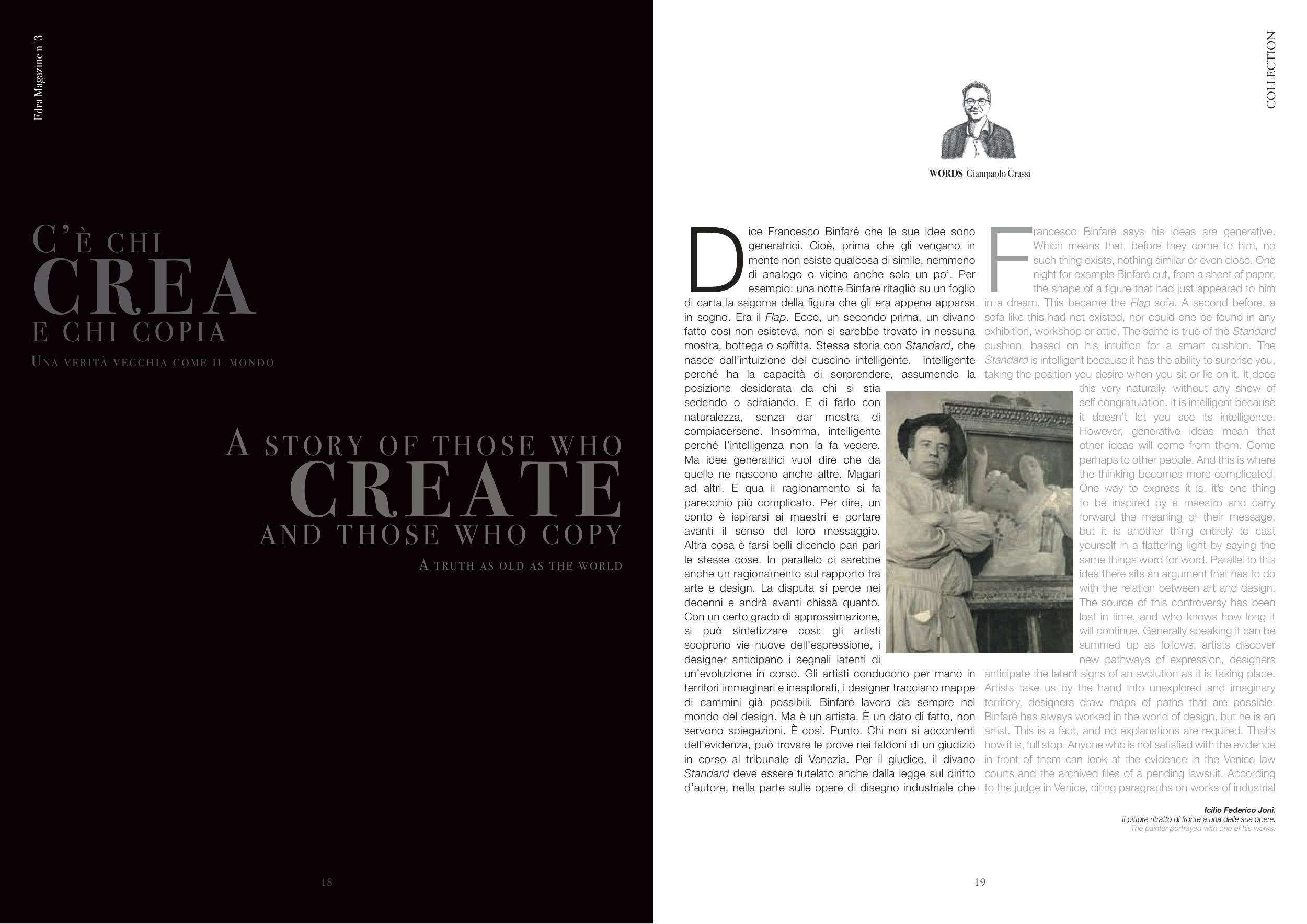
in sogno. Era il Flap. Ecco, un secondo prima, un divano
fatto così non esisteva, non si sarebbe trovato in nessuna
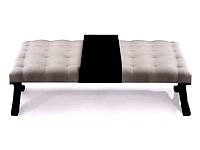
mostra, bottega o soffitta. Stessa storia con Standard, che
nasce dall’intuizione del cuscino intelligente. Intelligente
perché ha la capacità di sorprendere, assumendo la
posizione desiderata da chi si stia
sedendo o sdraiando. E di farlo con
naturalezza,
senza
dar
mostra
di
compiacersene. Insomma, intelligente
perché l’intelligenza non la fa vedere.
Ma idee generatrici vuol dire che da
quelle ne nascono anche altre. Magari
ad altri. E qua il ragionamento si fa
parecchio più complicato. Per dire, un
conto è ispirarsi ai maestri e portare
avanti il senso del loro messaggio.
Altra cosa è farsi belli dicendo pari pari
le stesse cose. In parallelo ci sarebbe
anche un ragionamento sul rapporto fra
arte e design. La disputa si perde nei
decenni e andrà avanti chissà quanto.
Con un certo grado di approssimazione,
si può sintetizzare così: gli artisti
scoprono vie nuove dell’espressione, i
designer anticipano i segnali latenti di
un’evoluzione in corso. Gli artisti conducono per mano in
territori immaginari e inesplorati, i designer tracciano mappe
di cammini già possibili. Binfaré lavora da sempre nel
mondo del design. Ma è un artista. È un dato di fatto, non
servono spiegazioni. È così. Punto. Chi non si accontenti
dell’evidenza, può trovare le prove nei faldoni di un giudizio
in corso al tribunale di Venezia. Per il giudice, il divano
Standard deve essere tutelato anche dalla legge sul diritto
d’autore, nella parte sulle opere di disegno industriale che
F
rancesco Binfaré says his ideas are generative.
Which means that, before they come to him, no
such thing exists, nothing similar or even close. One
night for example Binfaré cut, from a sheet of paper,
the shape of a figure that had just appeared to him
in a dream. This became the Flap sofa. A second before, a
sofa like this had not existed, nor could one be found in any
exhibition, workshop or attic. The same is true of the Standard
cushion, based on his intuition for a smart cushion. The
Standard is intelligent because it has the ability to surprise you,
taking the position you desire when you sit or lie on it. It does
this very naturally, without any show of
self congratulation. It is intelligent because
it doesn’t let you see its intelligence.
However, generative ideas mean that
other ideas will come from them. Come
perhaps to other people. And this is where
the thinking becomes more complicated.
One way to express it is, it’s one thing
to be inspired by a maestro and carry
forward the meaning of their message,
but it is another thing entirely to cast
yourself in a flattering light by saying the
same things word for word. Parallel to this
idea there sits an argument that has to do
with the relation between art and design.
The source of this controversy has been
lost in time, and who knows how long it
will continue. Generally speaking it can be
summed up as follows: artists discover
new pathways of expression, designers
anticipate the latent signs of an evolution as it is taking place.
Artists take us by the hand into unexplored and imaginary
territory, designers draw maps of paths that are possible.
Binfaré has always worked in the world of design, but he is an
artist. This is a fact, and no explanations are required. That’s
how it is, full stop. Anyone who is not satisfied with the evidence
in front of them can look at the evidence in the Venice law
courts and the archived files of a pending lawsuit. According
to the judge in Venice, citing paragraphs on works of industrial
WORDS Giampaolo Grassi
Icilio Federico Joni.
Il pittore ritratto di fronte a una delle sue opere.
The painter portrayed with one of his works.
Edra Magazine n°3
18
19
COLLECTION