72
73
Cappella consacrata a San Giovanni
sull’isola Li Galli.
Chapel consecrated to St. John
on Li Galli Island.
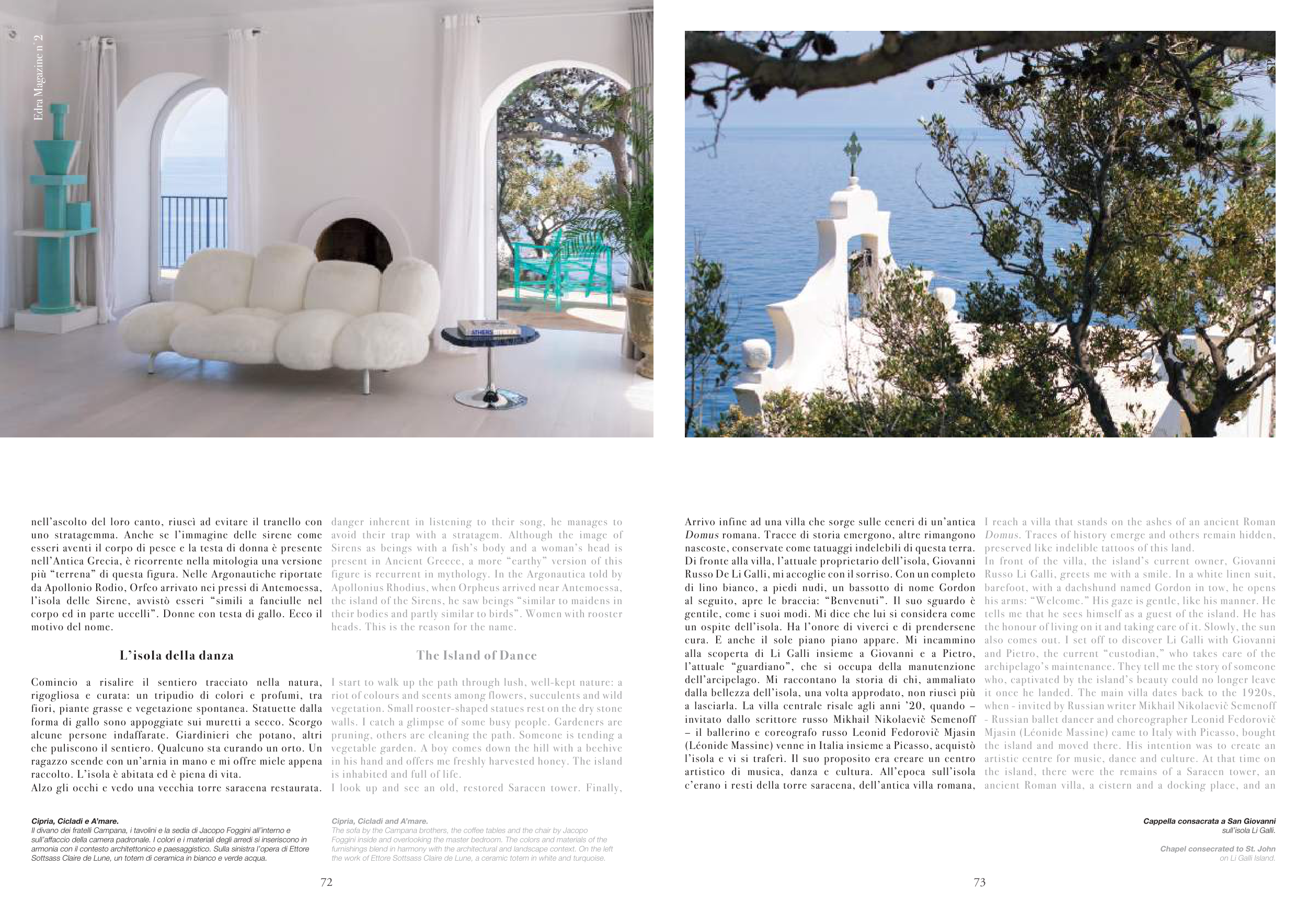
Cipria, Cicladi e A’mare.
Il divano dei fratelli Campana, i tavolini e la sedia di Jacopo Foggini all’interno e
sull’affaccio della camera padronale. I colori e i materiali degli arredi si inseriscono in
armonia con il contesto architettonico e paesaggistico. Sulla sinistra l’opera di Ettore
Sottsass Claire de Lune, un totem di ceramica in bianco e verde acqua.
Cipria, Cicladi and A’mare.
The sofa by the Campana brothers, the coffee tables and the chair by Jacopo
Foggini inside and overlooking the master bedroom. The colors and materials of the
furnishings blend in harmony with the architectural and landscape context. On the left
the work of Ettore Sottsass Claire de Lune, a ceramic totem in white and turquoise.
nell’ascolto del loro canto, riuscì ad evitare il tranello con
uno stratagemma. Anche se l’immagine delle sirene come
esseri aventi il corpo di pesce e la testa di donna è presente
nell’Antica Grecia, è ricorrente nella mitologia una versione
più “terrena” di questa figura. Nelle Argonautiche riportate
da Apollonio Rodio, Orfeo arrivato nei pressi di Antemoessa,
l’isola delle Sirene, avvistò esseri “simili a fanciulle nel
corpo ed in parte uccelli”. Donne con testa di gallo. Ecco il
motivo del nome.
L’isola della danza
Comincio a risalire il sentiero tracciato nella natura,
rigogliosa e curata: un tripudio di colori e profumi, tra
fiori, piante grasse e vegetazione spontanea. Statuette dalla
forma di gallo sono appoggiate sui muretti a secco. Scorgo
alcune persone indaffarate. Giardinieri che potano, altri
che puliscono il sentiero. Qualcuno sta curando un orto. Un
ragazzo scende con un’arnia in mano e mi offre miele appena
raccolto. L’isola è abitata ed è piena di vita.
Alzo gli occhi e vedo una vecchia torre saracena restaurata.
Arrivo infine ad una villa che sorge sulle ceneri di un’antica
Domus romana. Tracce di storia emergono, altre rimangono
nascoste, conservate come tatuaggi indelebili di questa terra.
Di fronte alla villa, l’attuale proprietario dell’isola, Giovanni
Russo De Li Galli, mi accoglie con il sorriso. Con un completo
di lino bianco, a piedi nudi, un bassotto di nome Gordon
al seguito, apre le braccia: “Benvenuti”. Il suo sguardo è
gentile, come i suoi modi. Mi dice che lui si considera come
un ospite dell’isola. Ha l’onore di viverci e di prendersene
cura. E anche il sole piano piano appare. Mi incammino
alla scoperta di Li Galli insieme a Giovanni e a Pietro,
l’attuale “guardiano”, che si occupa della manutenzione
dell’arcipelago. Mi raccontano la storia di chi, ammaliato
dalla bellezza dell’isola, una volta approdato, non riuscì più
a lasciarla. La villa centrale risale agli anni ’20, quando –
invitato dallo scrittore russo Mikhail Nikolaevič Semenoff
– il ballerino e coreografo russo Leonid Fedorovič Mjasin
(Léonide Massine) venne in Italia insieme a Picasso, acquistò
l’isola e vi si traferì. Il suo proposito era creare un centro
artistico di musica, danza e cultura. All’epoca sull’isola
c’erano i resti della torre saracena, dell’antica villa romana,
danger inherent in listening to their song, he manages to
avoid their trap with a stratagem. Although the image of
Sirens as beings with a fish’s body and a woman’s head is
present in Ancient Greece, a more “earthy” version of this
figure is recurrent in mythology. In the Argonautica told by
Apollonius Rhodius, when Orpheus arrived near Antemoessa,
the island of the Sirens, he saw beings “similar to maidens in
their bodies and partly similar to birds”. Women with rooster
heads. This is the reason for the name.
The Island of Dance
I start to walk up the path through lush, well-kept nature: a
riot of colours and scents among flowers, succulents and wild
vegetation. Small rooster-shaped statues rest on the dry stone
walls. I catch a glimpse of some busy people. Gardeners are
pruning, others are cleaning the path. Someone is tending a
vegetable garden. A boy comes down the hill with a beehive
in his hand and offers me freshly harvested honey. The island
is inhabited and full of life.
I look up and see an old, restored Saracen tower. Finally,
I reach a villa that stands on the ashes of an ancient Roman
Domus. Traces of history emerge and others remain hidden,
preserved like indelible tattoos of this land.
In front of the villa, the island’s current owner, Giovanni
Russo Li Galli, greets me with a smile. In a white linen suit,
barefoot, with a dachshund named Gordon in tow, he opens
his arms: “Welcome.” His gaze is gentle, like his manner. He
tells me that he sees himself as a guest of the island. He has
the honour of living on it and taking care of it. Slowly, the sun
also comes out. I set off to discover Li Galli with Giovanni
and Pietro, the current “custodian,” who takes care of the
archipelago’s maintenance. They tell me the story of someone
who, captivated by the island’s beauty could no longer leave
it once he landed. The main villa dates back to the 1920s,
when - invited by Russian writer Mikhail Nikolaevič Semenoff
- Russian ballet dancer and choreographer Leonid Fedorovič
Mjasin (Léonide Massine) came to Italy with Picasso, bought
the island and moved there. His intention was to create an
artistic centre for music, dance and culture. At that time on
the island, there were the remains of a Saracen tower, an
ancient Roman villa, a cistern and a docking place, and an
Edra Magazine n°2
SPACES