56
57
A’mare.
La collezione di Jacopo Foggini
fotografata sulla terrazza dell’
Hotel Bellevue Syrene a Sorrento.
Jacopo Foggini’s collection
photographed on the terrace
of the Hotel Bellevue Syrene in
Sorrento.
B
otticelli dipinge La Primavera intorno al 1482.
Il quadro doveva celebrare il buon governo di
Firenze e rappresentare il pensiero neoplatonico
di Marsilio Ficino e Pico della Mirandola. In quel
dipinto Flora, incinta e con un abito ricoperto
di fi ori, rappresentava Florentia – allegoria di Firenze, città
dove fi oriscono le arti.
Qualcuno si starà chiedendo: perché parliamo qui di
Botticelli? Perché, da un inventario dei beni del 1499,
sappiamo che l’opera era collocata sopra una cassapanca con
spalliera in legno di pino. La tavola era stata pagata cento
lire, la cassapanca ottantaquattro, solo sedici lire in meno di
un capolavoro di inestimabile valore. A quel tempo comprare
una cassapanca in legno di pino o un dipinto di Botticelli
non faceva grande differenza: Botticelli allora era un pittore
affermato (e di certo sottopagato).
Sono partito dalla ricerca di queste motivazioni per indagare
il rapporto tra arte e design, nell’accezione specifi ca che
in Italia normalmente diamo a quest’ultimo, legato non
al mondo del progetto tout court ma all’ambito specifi co
dell’arredamento. Voglio mettere a fuoco le differenze,
quel solco profondo che si è creato dall’epoca romantica in
poi, ma prima penso sia utile portare qualche rifl essione sul
concetto di uso, che di fatto separa l’arte dall’arredamento e
introdurre il tema dei materiali come elemento distintivo di
quest’ultimo.
B
otticelli painted La Primavera around 1482.
The painting was meant to celebrate the
good government of Florence and represent
the Neo-Platonic thought of Marsilio Ficino
and Pico della Mirandola. In the painting,
Flora, pregnant and wearing a dress covered in fl owers,
represented Florentia - an allegory of Florence, the city
where the arts fl ourish.
Some may be wondering: why are we talking about Botticelli
here? Because we know from an inventory of assets in
1499 that the work was placed on a pinewood chest with a
back panel. The painting had cost one hundred lire, the
chest eighty-four, only sixteen lire less than a priceless
masterpiece. At that time, buying a pinewood chest or a
Botticelli painting made little difference: Botticelli was
then an established (and undoubtedly underpaid) painter.
I started from the study of these motivations to investigate
the relationship between art and design, in the specifi c
meaning that we usually give to the latter in Italy, where it
is not linked to the world of plans and projects tout court
but to the specifi c sphere of furniture. I want to focus on the
differences, that deep gap that originated in the Romantic
era. But fi rst, I think it is helpful to refl ect on the concept
of use, which in fact separates art from furniture, and
introduce the subject of materials as a distinctive element of
the latter.
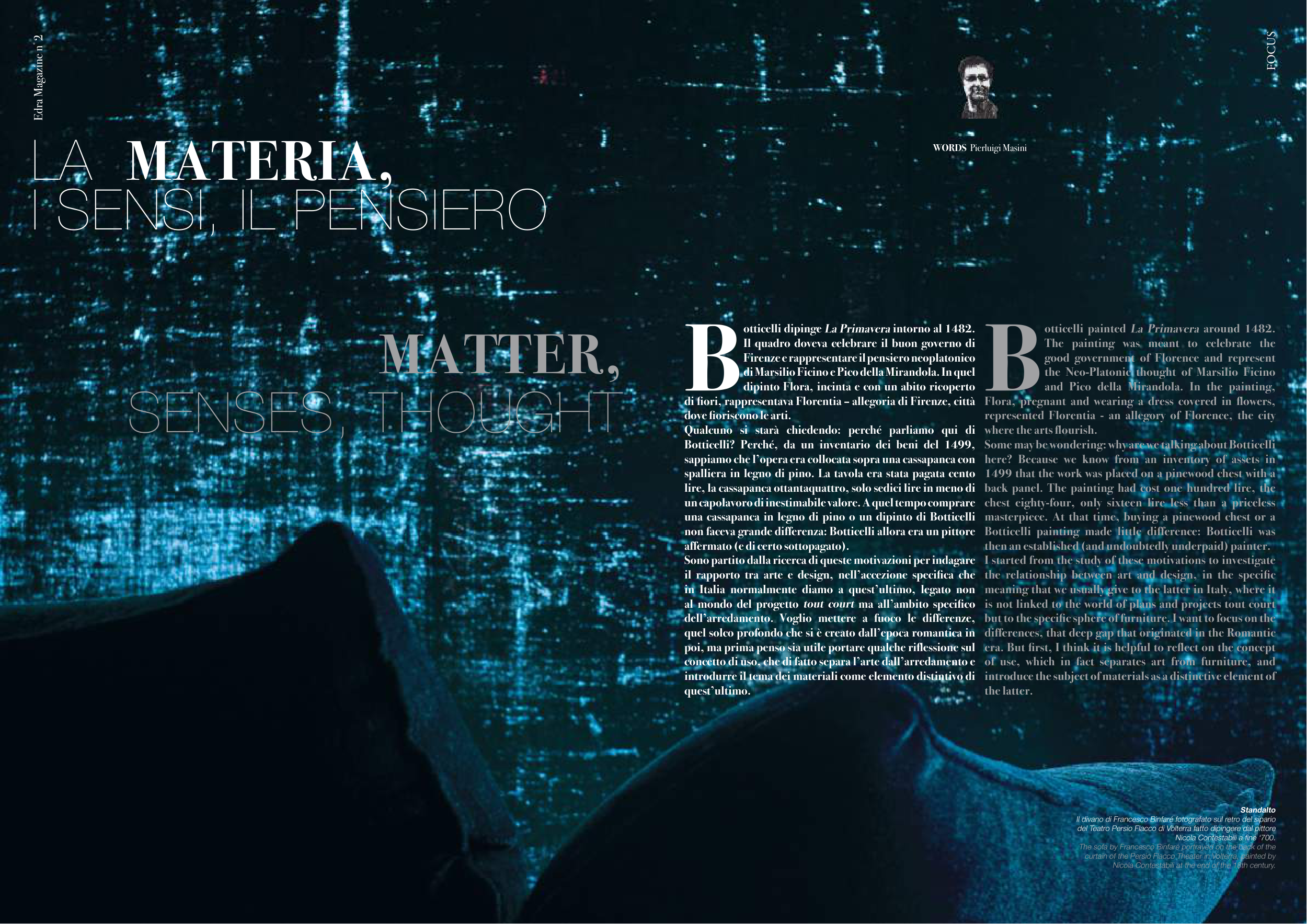
Standalto
Il divano di Francesco Binfaré fotografato sul retro del sipario
del Teatro Persio Flacco di Volterra fatto dipingere dal pittore
Nicola Contestabili a fi ne ‘700.
The sofa by Francesco Binfaré portrayed on the back of the
curtain of the Persio Flacco Theater in Volterra, painted by
Nicola Contestabili at the end of the 18th century.
WORDS Pierluigi Masini
LA MATERIA,
I SENSI, IL PENSIERO
MATTER,
SENSES, THOUGHT
Edra Magazine n°2
FOCUS