32
33
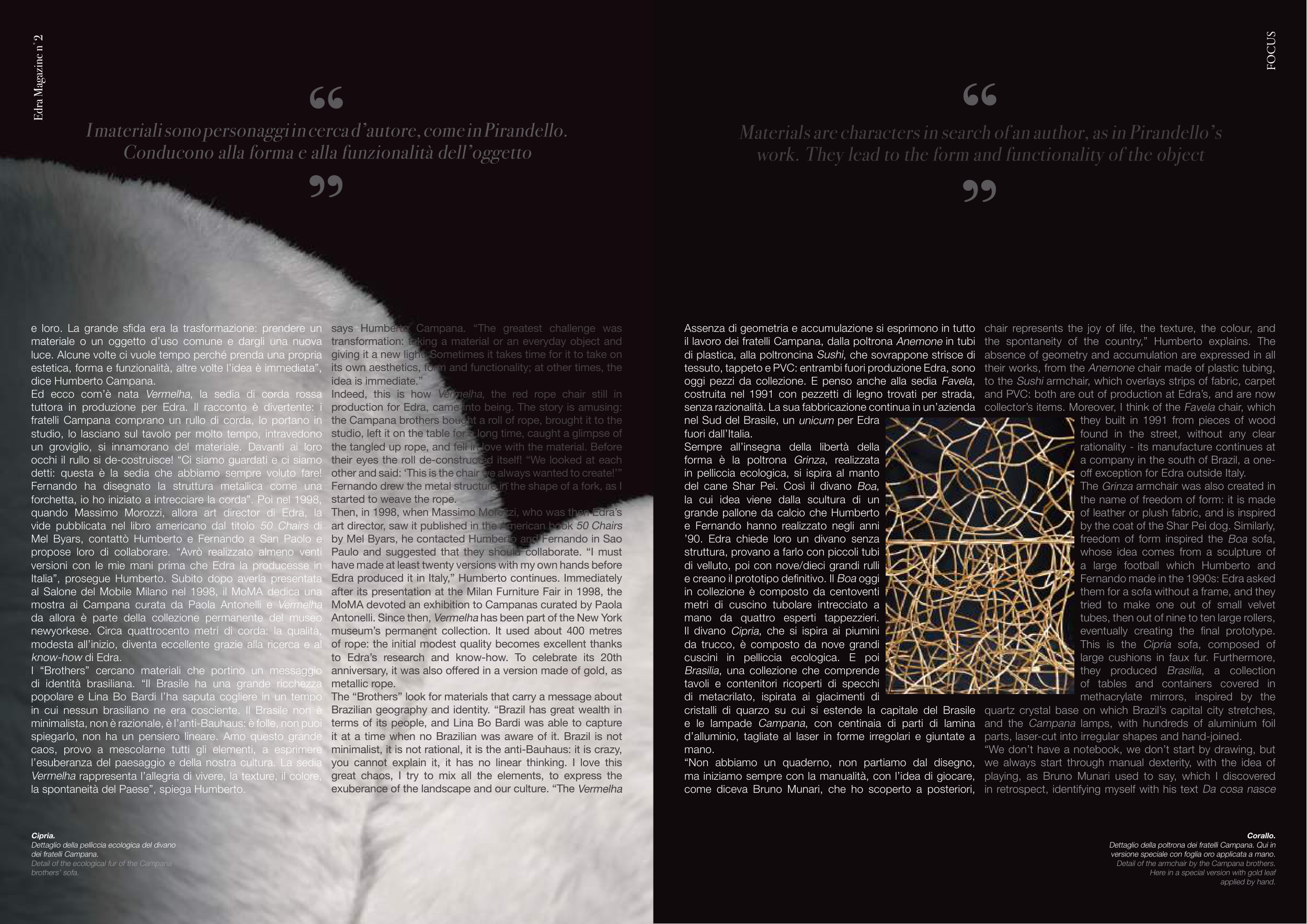
Corallo.
Dettaglio della poltrona dei fratelli Campana. Qui in
versione speciale con foglia oro applicata a mano.
Detail of the armchair by the Campana brothers.
Here in a special version with gold leaf
applied by hand.
Cipria.
Dettaglio della pelliccia ecologica del divano
dei fratelli Campana.
Detail of the ecological fur of the Campana
brothers’ sofa.
Materials are characters in search of an author, as in Pirandello’s
work. They lead to the form and functionality of the object
“
“
I materiali sono personaggi in cerca d’autore, come in Pirandello.
Conducono alla forma e alla funzionalità dell’oggetto
“
“
Assenza di geometria e accumulazione si esprimono in tutto
il lavoro dei fratelli Campana, dalla poltrona Anemone in tubi
di plastica, alla poltroncina Sushi, che sovrappone strisce di
tessuto, tappeto e PVC: entrambi fuori produzione Edra, sono
oggi pezzi da collezione. E penso anche alla sedia Favela,
costruita nel 1991 con pezzetti di legno trovati per strada,
senza razionalità. La sua fabbricazione continua in un’azienda
nel Sud del Brasile, un unicum per Edra
fuori dall’Italia.
Sempre all’insegna della libertà della
forma è la poltrona Grinza, realizzata
in pelliccia ecologica, si ispira al manto
del cane Shar Pei. Così il divano Boa,
la cui idea viene dalla scultura di un
grande pallone da calcio che Humberto
e Fernando hanno realizzato negli anni
’90. Edra chiede loro un divano senza
struttura, provano a farlo con piccoli tubi
di velluto, poi con nove/dieci grandi rulli
e creano il prototipo definitivo. Il Boa oggi
in collezione è composto da centoventi
metri di cuscino tubolare intrecciato a
mano da quattro esperti tappezzieri.
Il divano Cipria, che si ispira ai piumini
da trucco, è composto da nove grandi
cuscini in pelliccia ecologica. E poi
Brasilia, una collezione che comprende
tavoli e contenitori ricoperti di specchi
di metacrilato, ispirata ai giacimenti di
cristalli di quarzo su cui si estende la capitale del Brasile
e le lampade Campana, con centinaia di parti di lamina
d’alluminio, tagliate al laser in forme irregolari e giuntate a
mano.
“Non abbiamo un quaderno, non partiamo dal disegno,
ma iniziamo sempre con la manualità, con l’idea di giocare,
come diceva Bruno Munari, che ho scoperto a posteriori,
e loro. La grande sfida era la trasformazione: prendere un
materiale o un oggetto d’uso comune e dargli una nuova
luce. Alcune volte ci vuole tempo perché prenda una propria
estetica, forma e funzionalità, altre volte l’idea è immediata”,
dice Humberto Campana.
Ed ecco com’è nata Vermelha, la sedia di corda rossa
tuttora in produzione per Edra. Il racconto è divertente: i
fratelli Campana comprano un rullo di corda, lo portano in
studio, lo lasciano sul tavolo per molto tempo, intravedono
un groviglio, si innamorano del materiale. Davanti ai loro
occhi il rullo si de-costruisce! “Ci siamo guardati e ci siamo
detti: questa è la sedia che abbiamo sempre voluto fare!
Fernando ha disegnato la struttura metallica come una
forchetta, io ho iniziato a intrecciare la corda”. Poi nel 1998,
quando Massimo Morozzi, allora art director di Edra, la
vide pubblicata nel libro americano dal titolo 50 Chairs di
Mel Byars, contattò Humberto e Fernando a San Paolo e
propose loro di collaborare. “Avrò realizzato almeno venti
versioni con le mie mani prima che Edra la producesse in
Italia”, prosegue Humberto. Subito dopo averla presentata
al Salone del Mobile Milano nel 1998, il MoMA dedica una
mostra ai Campana curata da Paola Antonelli e Vermelha
da allora è parte della collezione permanente del museo
newyorkese. Circa quattrocento metri di corda: la qualità,
modesta all’inizio, diventa eccellente grazie alla ricerca e al
know-how di Edra.
I “Brothers” cercano materiali che portino un messaggio
di identità brasiliana. “Il Brasile ha una grande ricchezza
popolare e Lina Bo Bardi l’ha saputa cogliere in un tempo
in cui nessun brasiliano ne era cosciente. Il Brasile non è
minimalista, non è razionale, è l’anti-Bauhaus: è folle, non puoi
spiegarlo, non ha un pensiero lineare. Amo questo grande
caos, provo a mescolarne tutti gli elementi, a esprimere
l’esuberanza del paesaggio e della nostra cultura. La sedia
Vermelha rappresenta l’allegria di vivere, la texture, il colore,
la spontaneità del Paese”, spiega Humberto.
says Humberto Campana. “The greatest challenge was
transformation: taking a material or an everyday object and
giving it a new light. Sometimes it takes time for it to take on
its own aesthetics, form and functionality; at other times, the
idea is immediate.”
Indeed, this is how Vermelha, the red rope chair still in
production for Edra, came into being. The story is amusing:
the Campana brothers bought a roll of rope, brought it to the
studio, left it on the table for a long time, caught a glimpse of
the tangled up rope, and fell in love with the material. Before
their eyes the roll de-constructed itself! “We looked at each
other and said: ‘This is the chair we always wanted to create!’”
Fernando drew the metal structure in the shape of a fork, as I
started to weave the rope.
Then, in 1998, when Massimo Morozzi, who was then Edra’s
art director, saw it published in the American book 50 Chairs
by Mel Byars, he contacted Humberto and Fernando in Sao
Paulo and suggested that they should collaborate. “I must
have made at least twenty versions with my own hands before
Edra produced it in Italy,” Humberto continues. Immediately
after its presentation at the Milan Furniture Fair in 1998, the
MoMA devoted an exhibition to Campanas curated by Paola
Antonelli. Since then, Vermelha has been part of the New York
museum’s permanent collection. It used about 400 metres
of rope: the initial modest quality becomes excellent thanks
to Edra’s research and know-how. To celebrate its 20th
anniversary, it was also offered in a version made of gold, as
metallic rope.
The “Brothers” look for materials that carry a message about
Brazilian geography and identity. “Brazil has great wealth in
terms of its people, and Lina Bo Bardi was able to capture
it at a time when no Brazilian was aware of it. Brazil is not
minimalist, it is not rational, it is the anti-Bauhaus: it is crazy,
you cannot explain it, it has no linear thinking. I love this
great chaos, I try to mix all the elements, to express the
exuberance of the landscape and our culture. “The Vermelha
chair represents the joy of life, the texture, the colour, and
the spontaneity of the country,” Humberto explains. The
absence of geometry and accumulation are expressed in all
their works, from the Anemone chair made of plastic tubing,
to the Sushi armchair, which overlays strips of fabric, carpet
and PVC: both are out of production at Edra’s, and are now
collector’s items. Moreover, I think of the Favela chair, which
they built in 1991 from pieces of wood
found in the street, without any clear
rationality - its manufacture continues at
a company in the south of Brazil, a one-
off exception for Edra outside Italy.
The Grinza armchair was also created in
the name of freedom of form: it is made
of leather or plush fabric, and is inspired
by the coat of the Shar Pei dog. Similarly,
freedom of form inspired the Boa sofa,
whose idea comes from a sculpture of
a large football which Humberto and
Fernando made in the 1990s: Edra asked
them for a sofa without a frame, and they
tried to make one out of small velvet
tubes, then out of nine to ten large rollers,
eventually creating the final prototype.
This is the Cipria sofa, composed of
large cushions in faux fur. Furthermore,
they produced Brasilia, a collection
of tables and containers covered in
methacrylate mirrors, inspired by the
quartz crystal base on which Brazil’s capital city stretches,
and the Campana lamps, with hundreds of aluminium foil
parts, laser-cut into irregular shapes and hand-joined.
“We don’t have a notebook, we don’t start by drawing, but
we always start through manual dexterity, with the idea of
playing, as Bruno Munari used to say, which I discovered
in retrospect, identifying myself with his text Da cosa nasce
Edra Magazine n°2
FOCUS