73
D
ice Francesco Binfaré che lui ha un privilegio:
può sbirciare l’antica storia del comfort dal
suo “spioncino personale e contemporaneo”.
L’avventura professionale di Binfaré offre un
osservatorio ben più arioso di uno ‘spioncino’.
Però lui usa proprio quel termine lì. Sobrio ed essenziale.
Niente piedistalli e fanfare. Nel suo racconto va subito
al nocciolo. “Dai troni dei faraoni ai canapè dei palazzi
settecenteschi, per secoli e secoli le sedute sono state
figlie di una stessa tecnica: un telaio
in legno, che impone la postura, e
un’imbottitura, che attenua la rigidità. La
prima rivoluzione arriva negli anni ‘60,
con il poliuretano espanso: soprattutto
nella versione stampata, che ha liberato
le forme. E poi c’è l’accelerazione dei
collanti, che consentono assemblaggi
sapienti e duraturi. A quel punto la
tecnica può snobbare i vincoli del telaio,
i designer industriali possono spaziare
con le loro interpretazioni”.
È in quel momento che Binfaré si
affaccia al suo spioncino. “E comincio
a osservare le persone. Studio i
passeggeri sui seggiolini del tram a
Milano o i bagnanti nelle spiagge del
Salento, mentre prendono il sole in
riva al mare, sulla roccia. Vedo come
i loro corpi si adattano, come cercano
la posizione migliore, quella preferita.
Perché un divano è il ritratto di come
vogliamo stare seduti. La mia ricerca della comodità, o
sulla comodità, parte da lì”. Ed è figlia del presente. Binfaré
assorbe ciò che gli sta attorno e lo rielabora, filtrandolo col
F
rancesco Binfaré says that he has a privilege:
he can have a peep into the ancient history of
comfort through his “personal and contemporary
peephole”. Binfaré’s professional adventure
offers a more airy view than a ‘peephole’. But he
uses exactly that term. Sober and essential. No
pedestals and fanfare. In his story he immediately goes to
the core. “For centuries and centuries, from the pharaohs’
thrones to the sofas of 18th-century buildings, seats
have been the offspring of one and the
same technique: a wooden frame that
imposes the posture and a padding that
softens its rigidity. The first real revolution
comes in the ‘60s, with polyurethane
foam: especially in the printed version,
which freed the forms. And then there
is the spread of the adhesives, which
allow wise and lasting assembly. At that
point, the technique can give the brush-
off to the constraints of the frame, and
industrial designers can let their creativity
roam freely”.
It is then that Binfaré looks through
the peephole. “And I start to look at
the people. I study the passengers on
the tram in Milan or the tourists on the
beaches in Salento, as they sunbathe
down by the sea, on the rocks. I see the
way their bodies adapt, how they look
for the best position, their favourite one.
Because a sofa is the portrait of the way
we want to sit. My exploration for comfort, or into comfort,
comes from there». And it is the child of its time. Binfaré
absorbes what surrounds him and re-elaborates it, filtering
WORDS Giampaolo Grassi
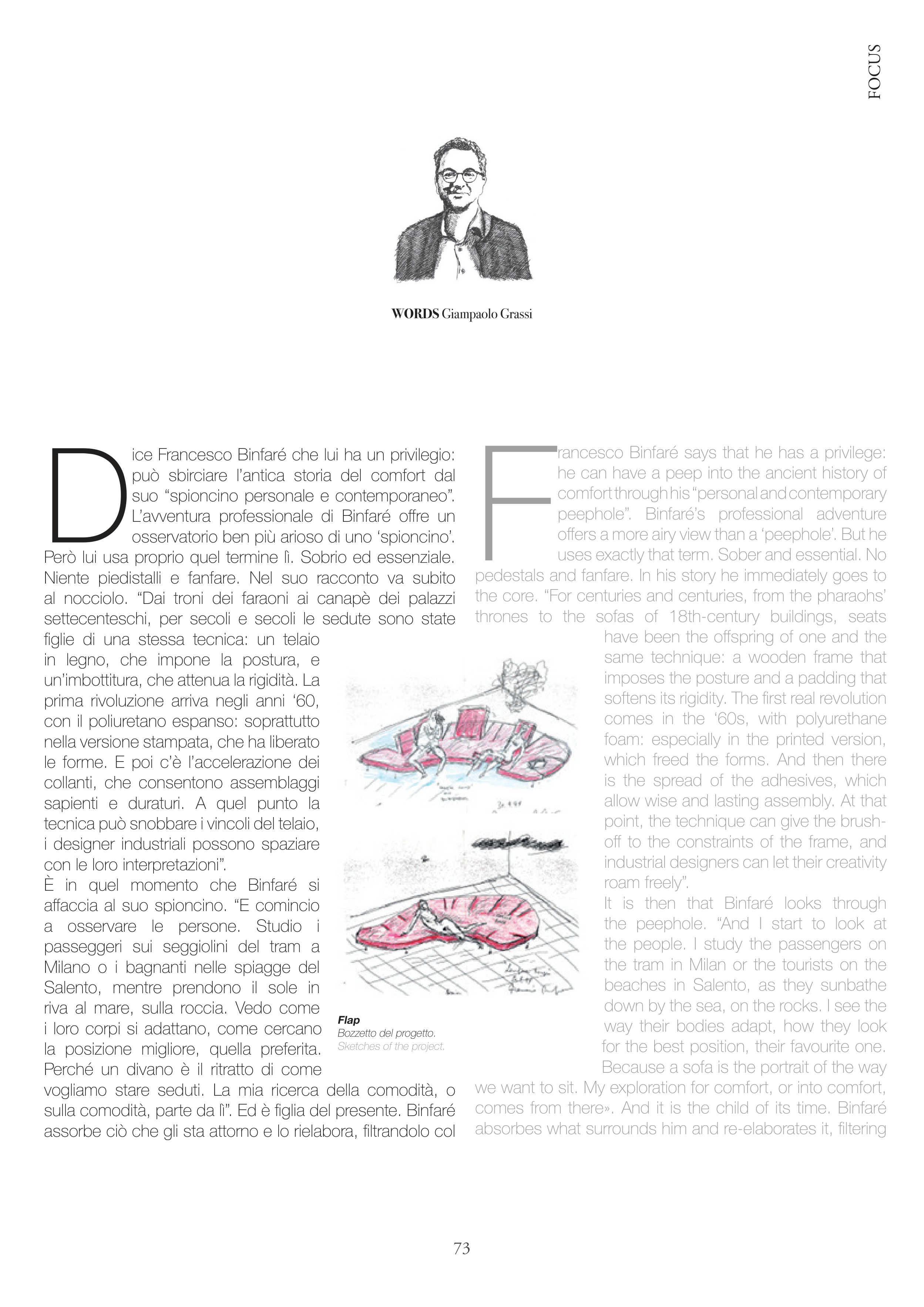
Flap
Bozzetto del progetto.nvita all’abbraccio
Sketches of the project.
FOCUS