52
la tramandabilità, genera un effetto timeless che si porta dietro
anche altre piacevoli conseguenze. In primo luogo, il messaggio
che arriva è che così facendo si supera la soglia dell’oggi, terreno
di caccia preferito dalle aziende di design e del marketing più
scontato: nella proiezione sul domani, ieri e oggi convivono
superando il tempo. E possono farlo solo se il valore del prodotto
in sé, il suo ciclo di vita, è davvero fuori dal comune.
Quindi diventa coerente la ricerca sui materiali, in termini
di benessere destinato a durare nel tempo, che è un’altra
caratteristica su cui Edra ha costruito la sua proposta. Inoltre i
nuovi pubblici sempre più apprezzano le cose fatte per durare,
che trascorrono il tempo con noi e fanno parte della nostra
vita, non solo della nostra casa. Il contrario di quello che veniva
richiesto dal mercato negli anni ‘70.
Seconda conseguenza è che si sta mettendo da parte la logica delle
‘ultime novità’, delle tendenze e della moda, per aprire la porta
alla classicità. A qualcosa che identifica l’azienda, che si rinnova
con passi lenti, che ha forza e solidità.
Il concetto di classico: noi italiani non possiamo prescindere dal
concetto di classico perché ne siamo immersi, circondati al punto
stesso di non accorgercene. Viviamo la tradizione, la raffinatezza
e l’eleganza delle nostre città, dei nostri borghi e del nostro
paesaggio, e insieme amiamo l’innovazione, da sempre.
E’ un’altra cosa che ci contraddistingue. Spirito moderno e forma
classica. Il classico, e di conseguenza l’anticlassico, è come un
fiume sotterraneo e ogni tanto sale in superficie. Pensiamo a
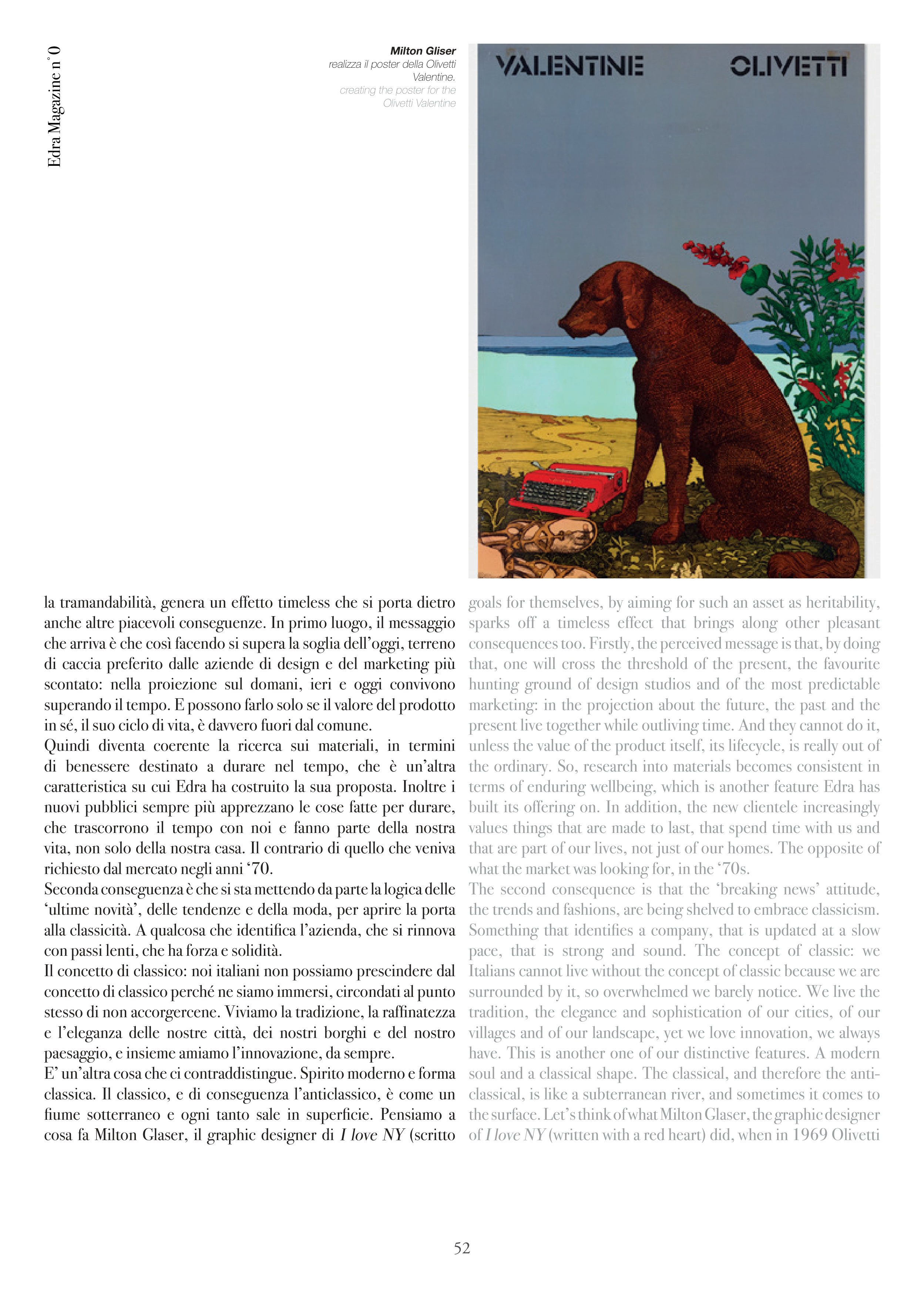
cosa fa Milton Glaser, il graphic designer di I love NY (scritto
Milton Gliser
realizza il poster della Olivetti
Valentine.
creating the poster for the
Olivetti Valentine
goals for themselves, by aiming for such an asset as heritability,
sparks off a timeless effect that brings along other pleasant
consequences too. Firstly, the perceived message is that, by doing
that, one will cross the threshold of the present, the favourite
hunting ground of design studios and of the most predictable
marketing: in the projection about the future, the past and the
present live together while outliving time. And they cannot do it,
unless the value of the product itself, its lifecycle, is really out of
the ordinary. So, research into materials becomes consistent in
terms of enduring wellbeing, which is another feature Edra has
built its offering on. In addition, the new clientele increasingly
values things that are made to last, that spend time with us and
that are part of our lives, not just of our homes. The opposite of
what the market was looking for, in the ‘70s.
The second consequence is that the ‘breaking news’ attitude,
the trends and fashions, are being shelved to embrace classicism.
Something that identifies a company, that is updated at a slow
pace, that is strong and sound. The concept of classic: we
Italians cannot live without the concept of classic because we are
surrounded by it, so overwhelmed we barely notice. We live the
tradition, the elegance and sophistication of our cities, of our
villages and of our landscape, yet we love innovation, we always
have. This is another one of our distinctive features. A modern
soul and a classical shape. The classical, and therefore the anti-
classical, is like a subterranean river, and sometimes it comes to
the surface. Let’s think of what Milton Glaser, the graphic designer
of I love NY (written with a red heart) did, when in 1969 Olivetti
Edra Magazine n°0