CELINE BATHTUB
2 October 1910: King Alfonso XIII presided over the lavish
inauguration ceremony of the first luxury hotel in the Spanish
capital. His presence was not merely ceremonial: he had been
the one who, upon returning from a trip, had wanted Madrid to
have a temple of hospitality that would rival those of Paris and
London. To bring this vision to life, he invested a substantial
capital in the construction of a grand palace and appointed
César Ritz, “the king of hoteliers and the hotelier of kings,” to
oversee every aspect of the project.
With the opening of the Ritz, the Belle Époque also came to
Madrid. The building was adorned with precious marbles
and fine woods, not to mention 200,000 exquisite porcelain
pieces crafted in Limoges, gold and silver cutlery forged by
The Goldsmiths, and linen spun in Ireland. Such refinement
was also accompanied by the arrival of new social rituals,
such as the afternoon tea ceremony, and of guests who would
make this place legendary. Its suites would host royal families
and Maharajas, the political and cultural history of an entire
century flowing over its extensive carpets, tracing history from
Mata Hari’s check-in under a false name (1916) and the peace
talks between Bush and Gorbachev (1991); the tumultuous
nights of Randolph Hearst, the honeymoon of Prince Rainier
of Monaco and Grace Kelly (1956), and the flirtation between
Frank Sinatra and Ava Gardner, not to mention the four visits
of Ernest Hemingway, who, between 1937 and 1938, would stay
here and visit the nearby Prado Museum to “learn to write from
Goya’s paintings”.
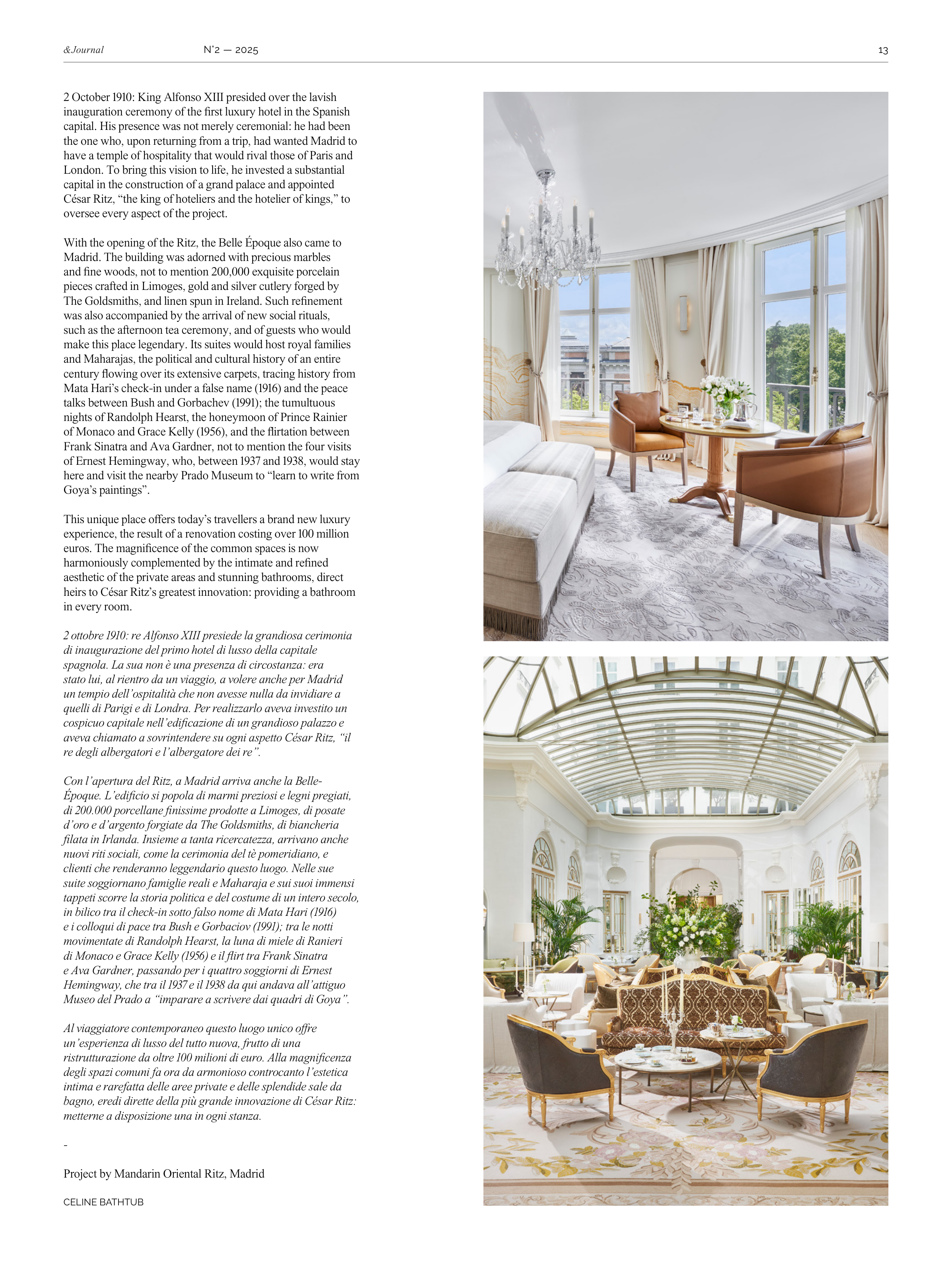
This unique place offers today’s travellers a brand new luxury
experience, the result of a renovation costing over 100 million
euros. The magnificence of the common spaces is now
harmoniously complemented by the intimate and refined
aesthetic of the private areas and stunning bathrooms, direct
heirs to César Ritz’s greatest innovation: providing a bathroom
in every room.
2 ottobre 1910: re Alfonso XIII presiede la grandiosa cerimonia
di inaugurazione del primo hotel di lusso della capitale
spagnola. La sua non è una presenza di circostanza: era
stato lui, al rientro da un viaggio, a volere anche per Madrid
un tempio dell’ospitalità che non avesse nulla da invidiare a
quelli di Parigi e di Londra. Per realizzarlo aveva investito un
cospicuo capitale nell’edificazione di un grandioso palazzo e
aveva chiamato a sovrintendere su ogni aspetto César Ritz, “il
re degli albergatori e l’albergatore dei re”.
Con l’apertura del Ritz, a Madrid arriva anche la Belle-
Époque. L’edificio si popola di marmi preziosi e legni pregiati,
di 200.000 porcellane finissime prodotte a Limoges, di posate
d’oro e d’argento forgiate da The Goldsmiths, di biancheria
filata in Irlanda. Insieme a tanta ricercatezza, arrivano anche
nuovi riti sociali, come la cerimonia del tè pomeridiano, e
clienti che renderanno leggendario questo luogo. Nelle sue
suite soggiornano famiglie reali e Maharaja e sui suoi immensi
tappeti scorre la storia politica e del costume di un intero secolo,
in bilico tra il check-in sotto falso nome di Mata Hari (1916)
e i colloqui di pace tra Bush e Gorbaciov (1991); tra le notti
movimentate di Randolph Hearst, la luna di miele di Ranieri
di Monaco e Grace Kelly (1956) e il flirt tra Frank Sinatra
e Ava Gardner, passando per i quattro soggiorni di Ernest
Hemingway, che tra il 1937 e il 1938 da qui andava all’attiguo
Museo del Prado a “imparare a scrivere dai quadri di Goya”.
Al viaggiatore contemporaneo questo luogo unico offre
un’esperienza di lusso del tutto nuova, frutto di una
ristrutturazione da oltre 100 milioni di euro. Alla magnificenza
degli spazi comuni fa ora da armonioso controcanto l’estetica
intima e rarefatta delle aree private e delle splendide sale da
bagno, eredi dirette della più grande innovazione di César Ritz:
metterne a disposizione una in ogni stanza.
-
Project by Mandarin Oriental Ritz, Madrid
13
&Journal
N°2 — 2025