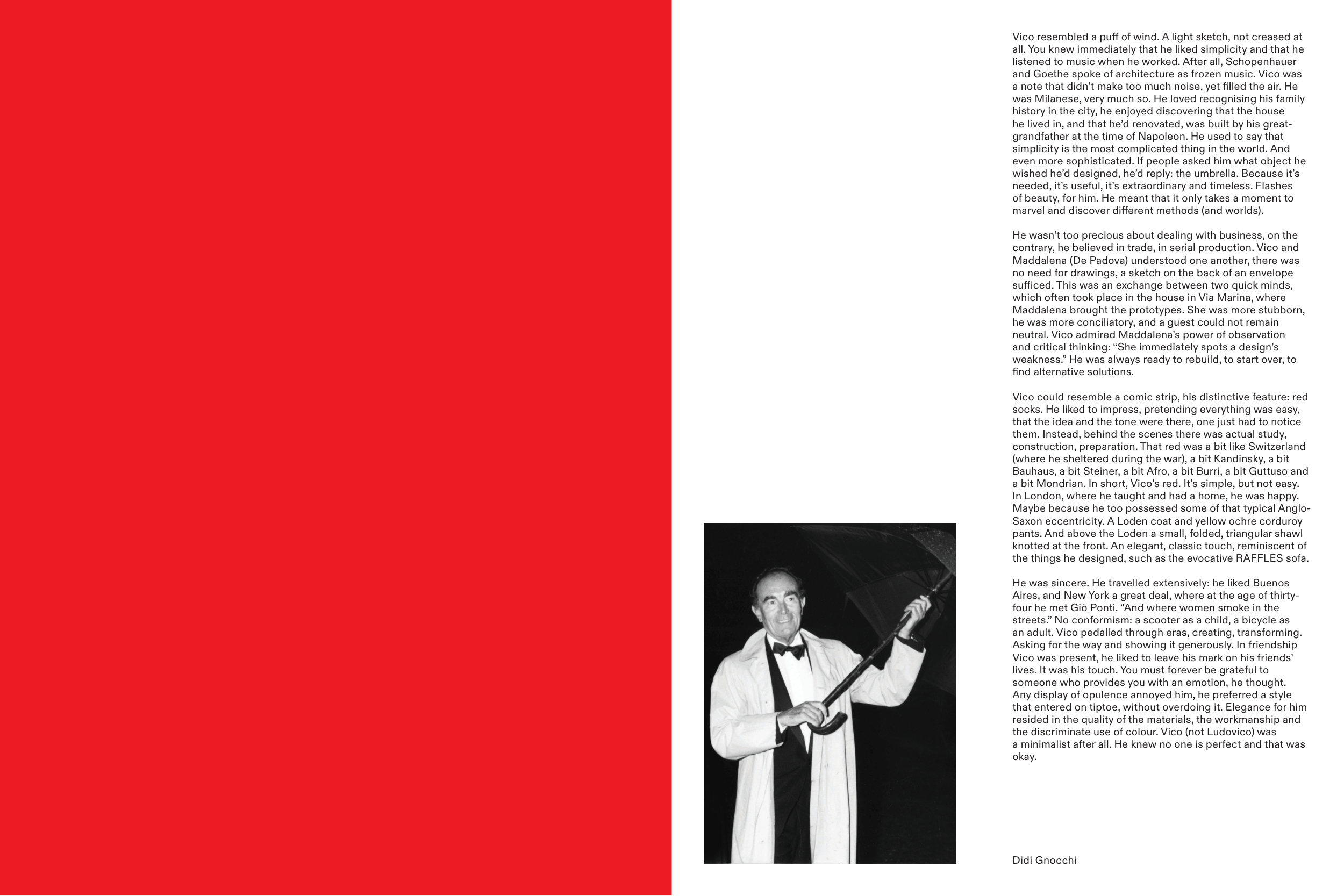
Vico resembled a puff of wind. A light sketch, not creased at
all. You knew immediately that he liked simplicity and that he
listened to music when he worked. After all, Schopenhauer
and Goethe spoke of architecture as frozen music. Vico was
a note that didn’t make too much noise, yet filled the air. He
was Milanese, very much so. He loved recognising his family
history in the city, he enjoyed discovering that the house
he lived in, and that he’d renovated, was built by his great-
grandfather at the time of Napoleon. He used to say that
simplicity is the most complicated thing in the world. And
even more sophisticated. If people asked him what object he
wished he’d designed, he’d reply: the umbrella. Because it’s
needed, it’s useful, it’s extraordinary and timeless. Flashes
of beauty, for him. He meant that it only takes a moment to
marvel and discover different methods (and worlds).
He wasn’t too precious about dealing with business, on the
contrary, he believed in trade, in serial production. Vico and
Maddalena (De Padova) understood one another, there was
no need for drawings, a sketch on the back of an envelope
sufficed. This was an exchange between two quick minds,
which often took place in the house in Via Marina, where
Maddalena brought the prototypes. She was more stubborn,
he was more conciliatory, and a guest could not remain
neutral. Vico admired Maddalena’s power of observation
and critical thinking: “She immediately spots a design’s
weakness.” He was always ready to rebuild, to start over, to
find alternative solutions.
Vico could resemble a comic strip, his distinctive feature: red
socks. He liked to impress, pretending everything was easy,
that the idea and the tone were there, one just had to notice
them. Instead, behind the scenes there was actual study,
construction, preparation. That red was a bit like Switzerland
(where he sheltered during the war), a bit Kandinsky, a bit
Bauhaus, a bit Steiner, a bit Afro, a bit Burri, a bit Guttuso and
a bit Mondrian. In short, Vico’s red. It’s simple, but not easy.
In London, where he taught and had a home, he was happy.
Maybe because he too possessed some of that typical Anglo-
Saxon eccentricity. A Loden coat and yellow ochre corduroy
pants. And above the Loden a small, folded, triangular shawl
knotted at the front. An elegant, classic touch, reminiscent of
the things he designed, such as the evocative RAFFLES sofa.
He was sincere. He travelled extensively: he liked Buenos
Aires, and New York a great deal, where at the age of thirty-
four he met Giò Ponti. “And where women smoke in the
streets.” No conformism: a scooter as a child, a bicycle as
an adult. Vico pedalled through eras, creating, transforming.
Asking for the way and showing it generously. In friendship
Vico was present, he liked to leave his mark on his friends’
lives. It was his touch. You must forever be grateful to
someone who provides you with an emotion, he thought.
Any display of opulence annoyed him, he preferred a style
that entered on tiptoe, without overdoing it. Elegance for him
resided in the quality of the materials, the workmanship and
the discriminate use of colour. Vico (not Ludovico) was
a minimalist after all. He knew no one is perfect and that was
okay.
Didi Gnocchi