142
“I try to design something that the designers I admire
will like..but also what my mother would want to have in
her home. I think this is possible,” he says.
This juxtaposition can be seen from Miller’s earliest work,
such as his Superordinate Antler Lamp series from 2003,
which reimagines the antler lamps often found in rural
settings as a series of luxurious ceramic light sculptures.
Created especially for a group exhibition, the series was
the first lighting Miller designed, and was seminal for his
career direction, igniting a passion that led to further
lighting design and eventually to establishing Roll &
Hill in 2010. It also set a precedent for the impact
of his work, quickly appearing in numerous fashionable
urban environments, and influencing the emergence of a more
nature-oriented modernism.
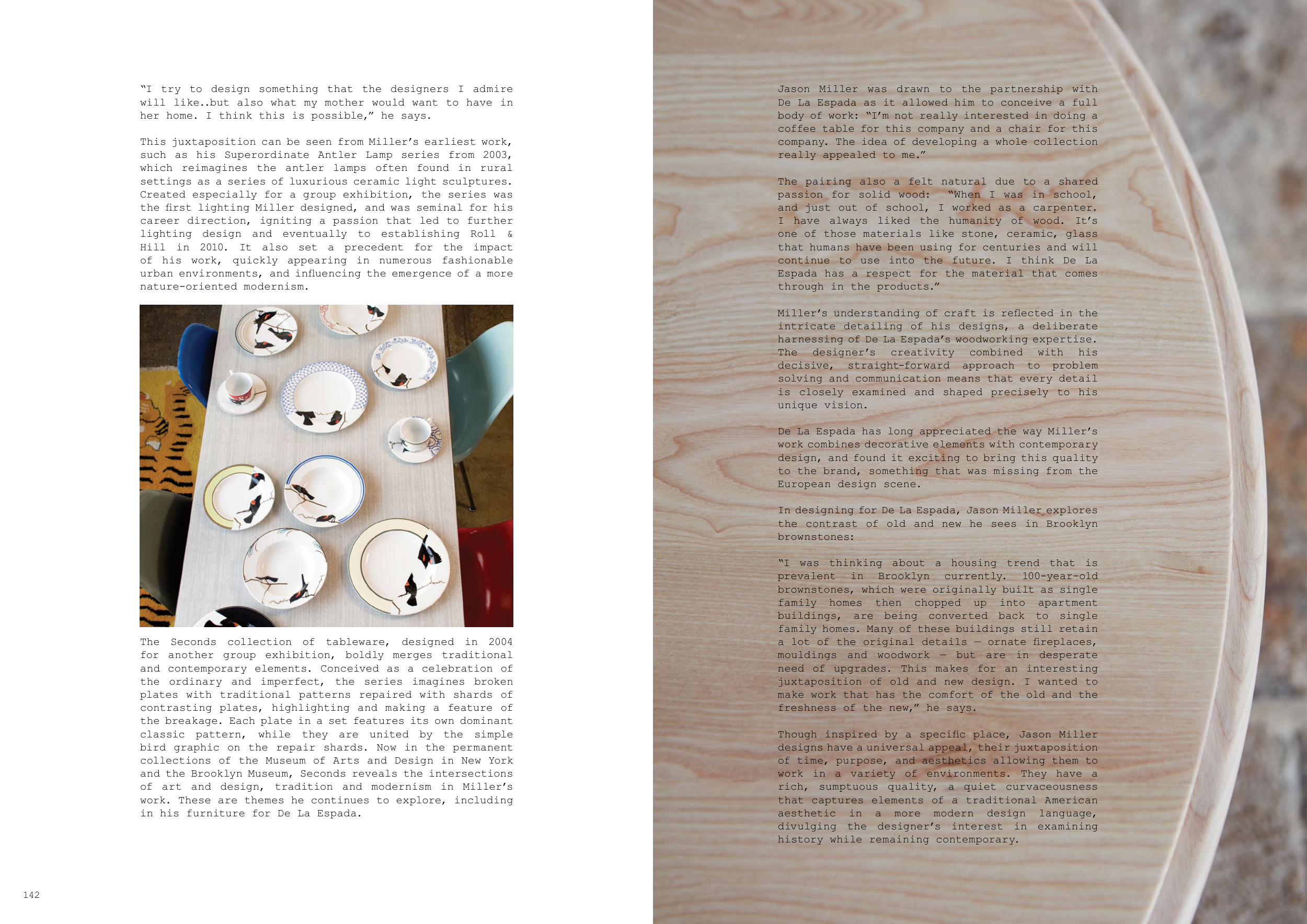
The Seconds collection of tableware, designed in 2004
for another group exhibition, boldly merges traditional
and contemporary elements. Conceived as a celebration of
the ordinary and imperfect, the series imagines broken
plates with traditional patterns repaired with shards of
contrasting plates, highlighting and making a feature of
the breakage. Each plate in a set features its own dominant
classic pattern, while they are united by the simple
bird graphic on the repair shards. Now in the permanent
collections of the Museum of Arts and Design in New York
and the Brooklyn Museum, Seconds reveals the intersections
of art and design, tradition and modernism in Miller’s
work. These are themes he continues to explore, including
in his furniture for De La Espada.
Jason Miller was drawn to the partnership with
De La Espada as it allowed him to conceive a full
body of work: “I’m not really interested in doing a
coffee table for this company and a chair for this
company. The idea of developing a whole collection
really appealed to me.”
The pairing also a felt natural due to a shared
passion for solid wood: “When I was in school,
and just out of school, I worked as a carpenter.
I have always liked the humanity of wood. It’s
one of those materials like stone, ceramic, glass
that humans have been using for centuries and will
continue to use into the future. I think De La
Espada has a respect for the material that comes
through in the products.”
Miller’s understanding of craft is reflected in the
intricate detailing of his designs, a deliberate
harnessing of De La Espada’s woodworking expertise.
The designer’s creativity combined with his
decisive, straight-forward approach to problem
solving and communication means that every detail
is closely examined and shaped precisely to his
unique vision.
De La Espada has long appreciated the way Miller’s
work combines decorative elements with contemporary
design, and found it exciting to bring this quality
to the brand, something that was missing from the
European design scene.
In designing for De La Espada, Jason Miller explores
the contrast of old and new he sees in Brooklyn
brownstones:
“I was thinking about a housing trend that is
prevalent in Brooklyn currently. 100-year-old
brownstones, which were originally built as single
family homes then chopped up into apartment
buildings, are being converted back to single
family homes. Many of these buildings still retain
a lot of the original details — ornate fireplaces,
mouldings and woodwork — but are in desperate
need of upgrades. This makes for an interesting
juxtaposition of old and new design. I wanted to
make work that has the comfort of the old and the
freshness of the new,” he says.
Though inspired by a specific place, Jason Miller
designs have a universal appeal, their juxtaposition
of time, purpose, and aesthetics allowing them to
work in a variety of environments. They have a
rich, sumptuous quality, a quiet curvaceousness
that captures elements of a traditional American
aesthetic in a more modern design language,
divulging the designer’s interest in examining
history while remaining contemporary.