131
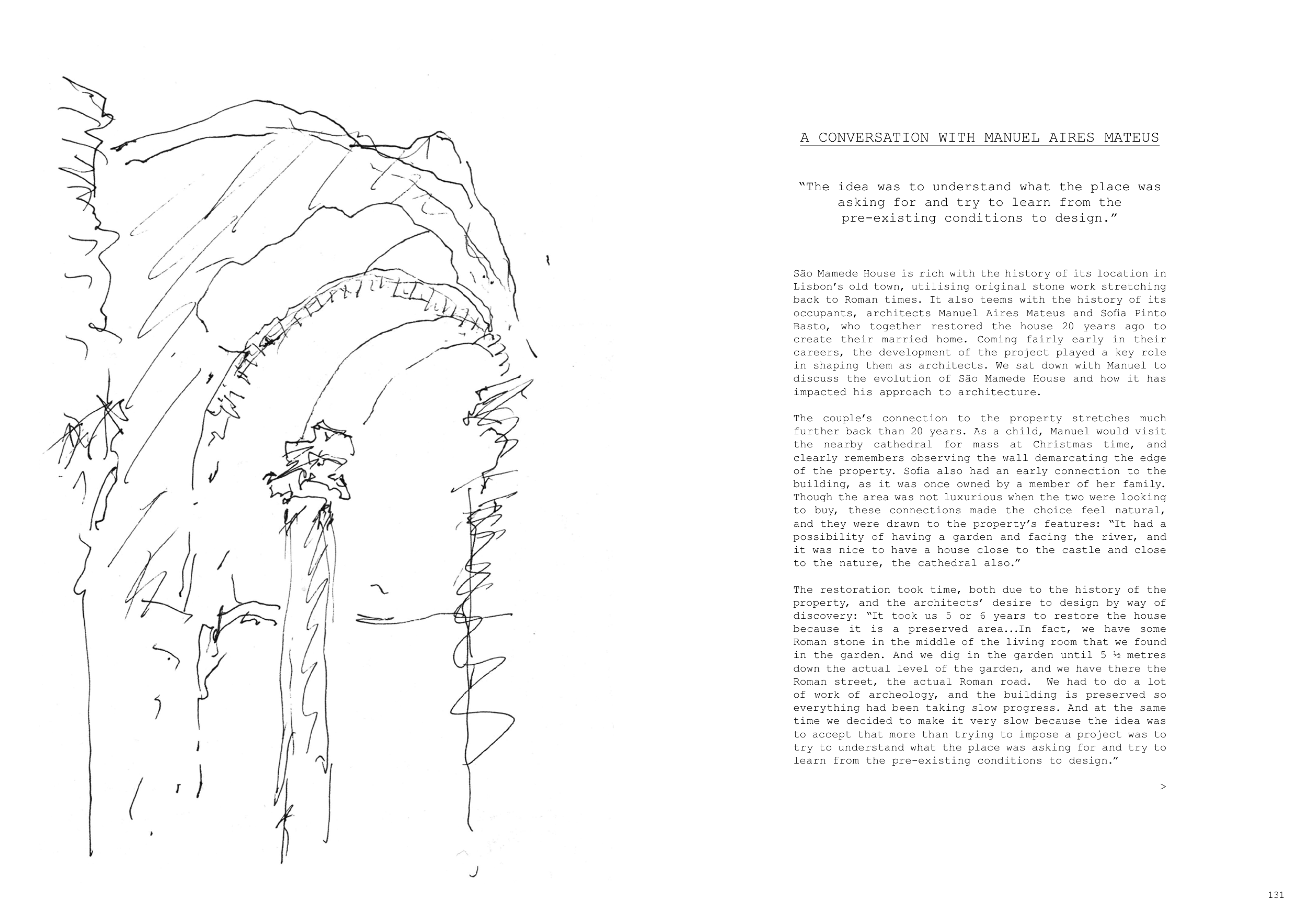
São Mamede House is rich with the history of its location in
Lisbon’s old town, utilising original stone work stretching
back to Roman times. It also teems with the history of its
occupants, architects Manuel Aires Mateus and Sofia Pinto
Basto, who together restored the house 20 years ago to
create their married home. Coming fairly early in their
careers, the development of the project played a key role
in shaping them as architects. We sat down with Manuel to
discuss the evolution of São Mamede House and how it has
impacted his approach to architecture.
The couple’s connection to the property stretches much
further back than 20 years. As a child, Manuel would visit
the nearby cathedral for mass at Christmas time, and
clearly remembers observing the wall demarcating the edge
of the property. Sofia also had an early connection to the
building, as it was once owned by a member of her family.
Though the area was not luxurious when the two were looking
to buy, these connections made the choice feel natural,
and they were drawn to the property’s features: “It had a
possibility of having a garden and facing the river, and
it was nice to have a house close to the castle and close
to the nature, the cathedral also.”
The restoration took time, both due to the history of the
property, and the architects’ desire to design by way of
discovery: “It took us 5 or 6 years to restore the house
because it is a preserved area...In fact, we have some
Roman stone in the middle of the living room that we found
in the garden. And we dig in the garden until 5 ½ metres
down the actual level of the garden, and we have there the
Roman street, the actual Roman road. We had to do a lot
of work of archeology, and the building is preserved so
everything had been taking slow progress. And at the same
time we decided to make it very slow because the idea was
to accept that more than trying to impose a project was to
try to understand what the place was asking for and try to
learn from the pre-existing conditions to design.”
>
A CONVERSATION WITH MANUEL AIRES MATEUS
“The idea was to understand what the place was
asking for and try to learn from the
pre-existing conditions to design.”