64
65
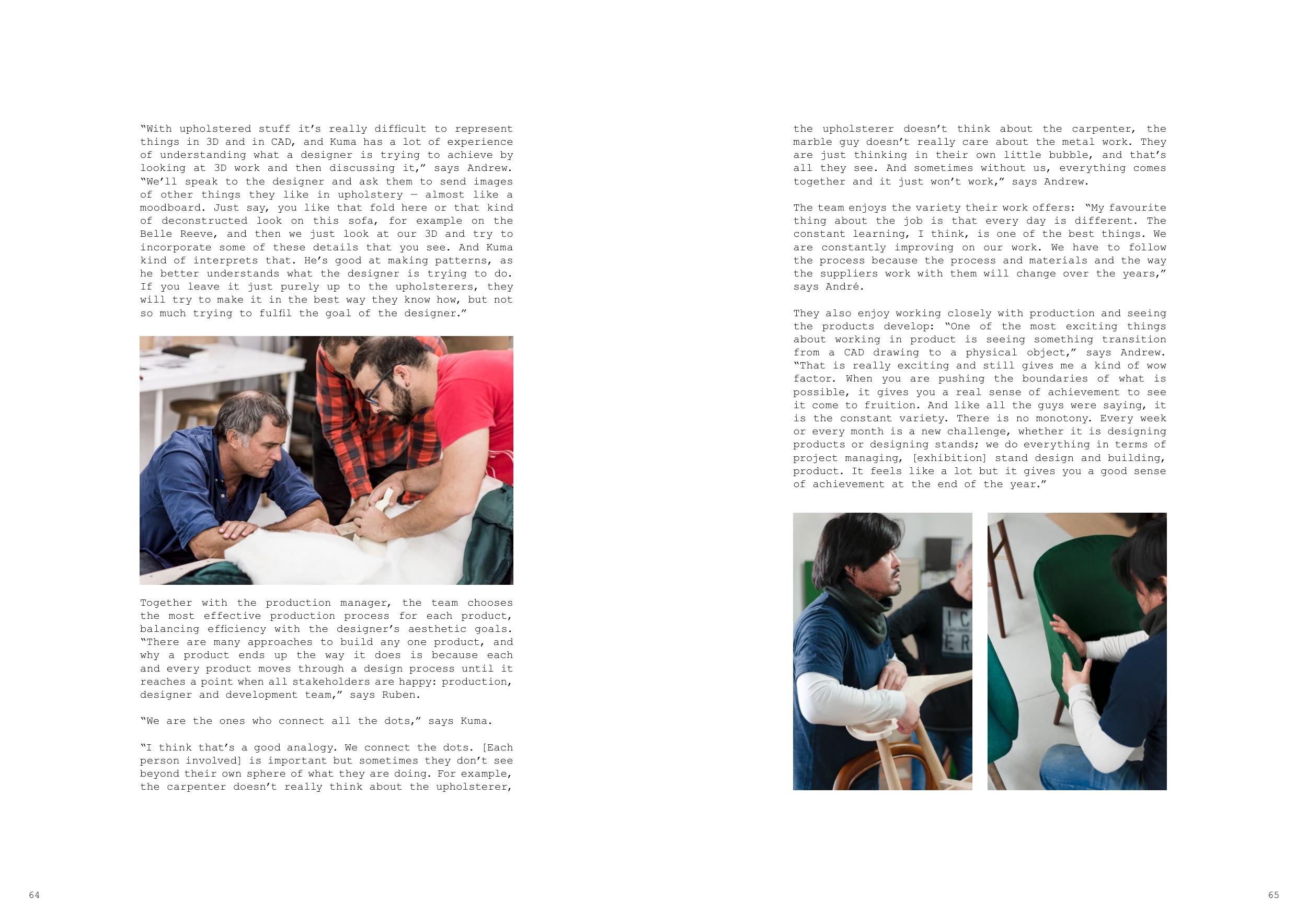
“With upholstered stuff it’s really difficult to represent
things in 3D and in CAD, and Kuma has a lot of experience
of understanding what a designer is trying to achieve by
looking at 3D work and then discussing it,” says Andrew.
“We’ll speak to the designer and ask them to send images
of other things they like in upholstery — almost like a
moodboard. Just say, you like that fold here or that kind
of deconstructed look on this sofa, for example on the
Belle Reeve, and then we just look at our 3D and try to
incorporate some of these details that you see. And Kuma
kind of interprets that. He’s good at making patterns, as
he better understands what the designer is trying to do.
If you leave it just purely up to the upholsterers, they
will try to make it in the best way they know how, but not
so much trying to fulfil the goal of the designer.”
Together with the production manager, the team chooses
the most effective production process for each product,
balancing efficiency with the designer’s aesthetic goals.
“There are many approaches to build any one product, and
why a product ends up the way it does is because each
and every product moves through a design process until it
reaches a point when all stakeholders are happy: production,
designer and development team,” says Ruben.
“We are the ones who connect all the dots,” says Kuma.
“I think that’s a good analogy. We connect the dots. [Each
person involved] is important but sometimes they don’t see
beyond their own sphere of what they are doing. For example,
the carpenter doesn’t really think about the upholsterer,
the upholsterer doesn’t think about the carpenter, the
marble guy doesn’t really care about the metal work. They
are just thinking in their own little bubble, and that’s
all they see. And sometimes without us, everything comes
together and it just won’t work,” says Andrew.
The team enjoys the variety their work offers: “My favourite
thing about the job is that every day is different. The
constant learning, I think, is one of the best things. We
are constantly improving on our work. We have to follow
the process because the process and materials and the way
the suppliers work with them will change over the years,”
says André.
They also enjoy working closely with production and seeing
the products develop: “One of the most exciting things
about working in product is seeing something transition
from a CAD drawing to a physical object,” says Andrew.
“That is really exciting and still gives me a kind of wow
factor. When you are pushing the boundaries of what is
possible, it gives you a real sense of achievement to see
it come to fruition. And like all the guys were saying, it
is the constant variety. There is no monotony. Every week
or every month is a new challenge, whether it is designing
products or designing stands; we do everything in terms of
project managing, [exhibition] stand design and building,
product. It feels like a lot but it gives you a good sense
of achievement at the end of the year.”