When designing Monte da Azarujinha, a converted farmhouse
in the Alentejo region of Portugal, the architects were
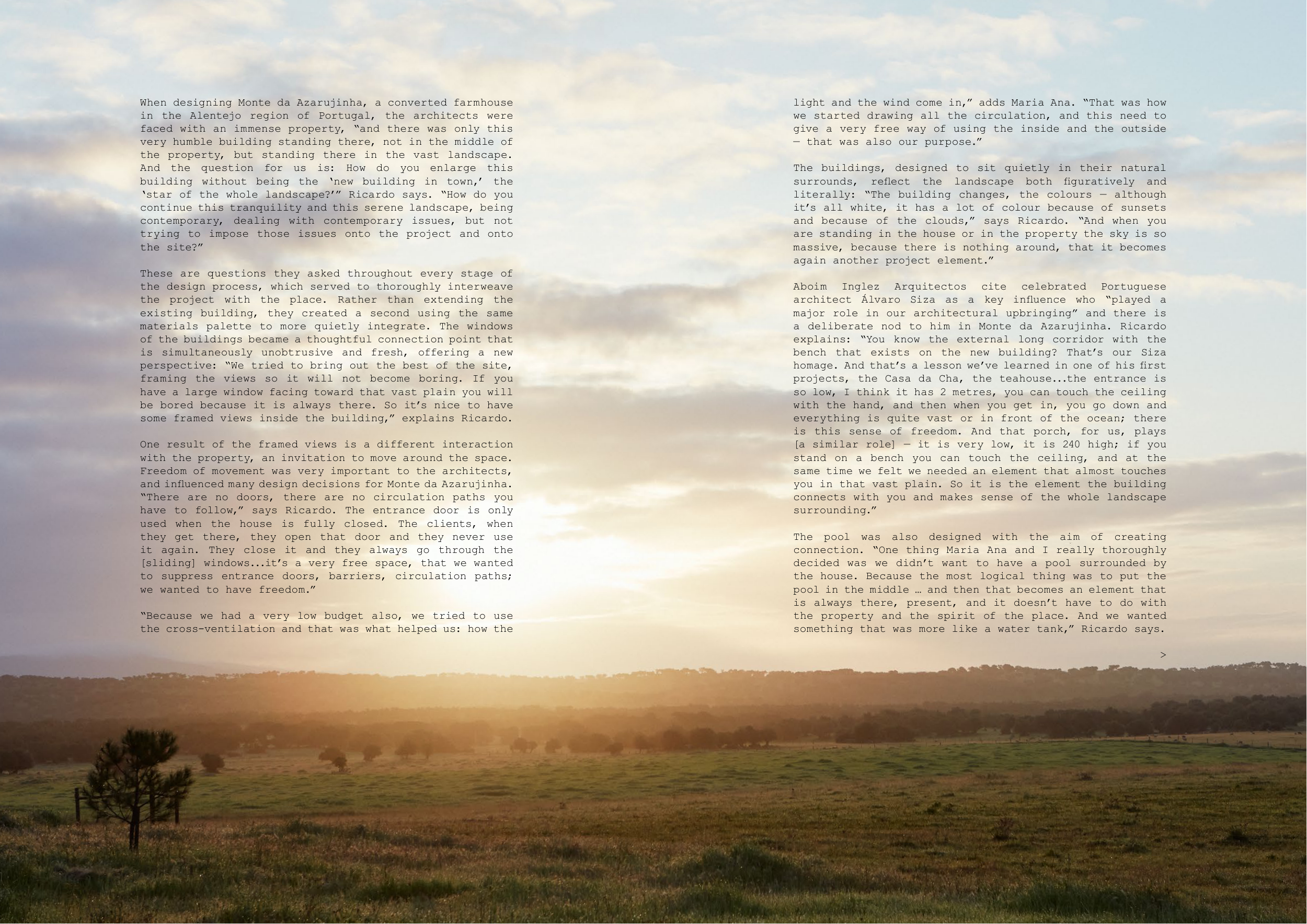
faced with an immense property, “and there was only this
very humble building standing there, not in the middle of
the property, but standing there in the vast landscape.
And the question for us is: How do you enlarge this
building without being the ‘new building in town,’ the
‘star of the whole landscape?’” Ricardo says. “How do you
continue this tranquility and this serene landscape, being
contemporary, dealing with contemporary issues, but not
trying to impose those issues onto the project and onto
the site?”
These are questions they asked throughout every stage of
the design process, which served to thoroughly interweave
the project with the place. Rather than extending the
existing building, they created a second using the same
materials palette to more quietly integrate. The windows
of the buildings became a thoughtful connection point that
is simultaneously unobtrusive and fresh, offering a new
perspective: “We tried to bring out the best of the site,
framing the views so it will not become boring. If you
have a large window facing toward that vast plain you will
be bored because it is always there. So it’s nice to have
some framed views inside the building,” explains Ricardo.
One result of the framed views is a different interaction
with the property, an invitation to move around the space.
Freedom of movement was very important to the architects,
and influenced many design decisions for Monte da Azarujinha.
“There are no doors, there are no circulation paths you
have to follow,” says Ricardo. The entrance door is only
used when the house is fully closed. The clients, when
they get there, they open that door and they never use
it again. They close it and they always go through the
[sliding] windows...it’s a very free space, that we wanted
to suppress entrance doors, barriers, circulation paths;
we wanted to have freedom.”
“Because we had a very low budget also, we tried to use
the cross-ventilation and that was what helped us: how the
light and the wind come in,” adds Maria Ana. “That was how
we started drawing all the circulation, and this need to
give a very free way of using the inside and the outside
— that was also our purpose.”
The buildings, designed to sit quietly in their natural
surrounds, reflect the landscape both figuratively and
literally: “The building changes, the colours — although
it’s all white, it has a lot of colour because of sunsets
and because of the clouds,” says Ricardo. “And when you
are standing in the house or in the property the sky is so
massive, because there is nothing around, that it becomes
again another project element.”
Aboim Inglez Arquitectos cite celebrated Portuguese
architect Álvaro Siza as a key influence who “played a
major role in our architectural upbringing” and there is
a deliberate nod to him in Monte da Azarujinha. Ricardo
explains: “You know the external long corridor with the
bench that exists on the new building? That’s our Siza
homage. And that’s a lesson we’ve learned in one of his first
projects, the Casa da Cha, the teahouse...the entrance is
so low, I think it has 2 metres, you can touch the ceiling
with the hand, and then when you get in, you go down and
everything is quite vast or in front of the ocean; there
is this sense of freedom. And that porch, for us, plays
[a similar role] — it is very low, it is 240 high; if you
stand on a bench you can touch the ceiling, and at the
same time we felt we needed an element that almost touches
you in that vast plain. So it is the element the building
connects with you and makes sense of the whole landscape
surrounding.”
The pool was also designed with the aim of creating
connection. “One thing Maria Ana and I really thoroughly
decided was we didn’t want to have a pool surrounded by
the house. Because the most logical thing was to put the
pool in the middle … and then that becomes an element that
is always there, present, and it doesn’t have to do with
the property and the spirit of the place. And we wanted
something that was more like a water tank,” Ricardo says.
>