#BOUTIQUE ALMINI
Architetto: CZA - Cino Zucchi Architetti
Milano, 2020
Foto: Alberto Parise e Cino Zucchi
L’ampliamento della boutique Almini in
via Bagutta a Milano amplia ed estende
le scelte spaziali, formali e materiche
del piccolo flagship store adiacente -
progettato sempre da CZA - in linea con la
sempre maggiore articolazione di prodotto
e immagine del brand. Il ruolo di uno spazio
di esposizione e vendita come questo
è simile a quello della cassa armonica
di uno strumento musicale capace di
dare pienezza e di generare risonanze
intorno alla melodia prodotta dalle corde.
Lo sfondo non ha bisogno di sostituirsi
all’oggetto; vuole invece costituirne un
“analogo” capace di suscitare emozioni
e generare un sistema di connotazioni
adeguate al suo carattere e stile. Il nuovo
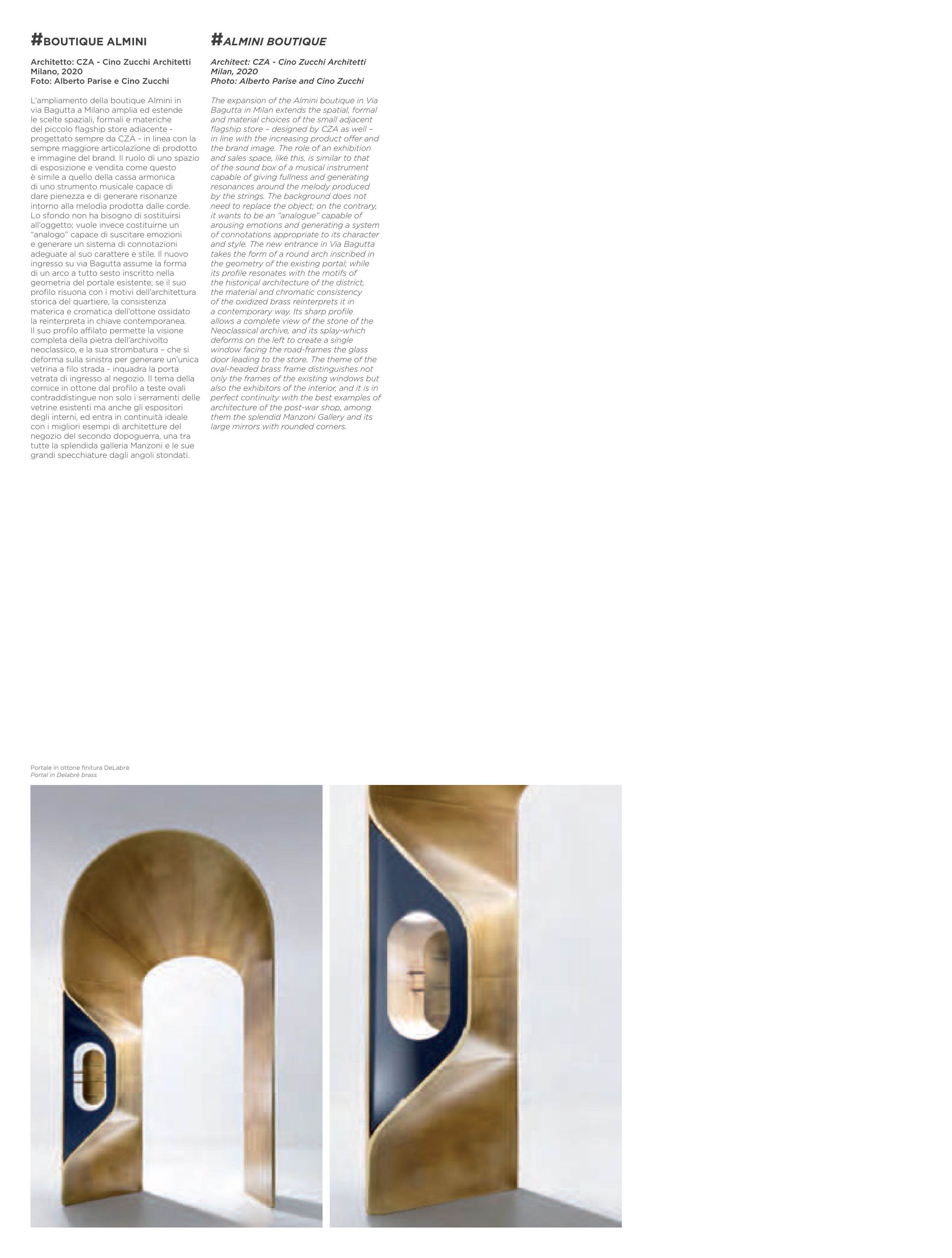
ingresso su via Bagutta assume la forma
di un arco a tutto sesto inscritto nella
geometria del portale esistente; se il suo
profilo risuona con i motivi dell’architettura
storica del quartiere, la consistenza
materica e cromatica dell’ottone ossidato
la reinterpreta in chiave contemporanea.
Il suo profilo affilato permette la visione
completa della pietra dell’archivolto
neoclassico, e la sua strombatura – che si
deforma sulla sinistra per generare un’unica
vetrina a filo strada - inquadra la porta
vetrata di ingresso al negozio. Il tema della
cornice in ottone dal profilo a teste ovali
contraddistingue non solo i serramenti delle
vetrine esistenti ma anche gli espositori
degli interni, ed entra in continuità ideale
con i migliori esempi di architetture del
negozio del secondo dopoguerra, una tra
tutte la splendida galleria Manzoni e le sue
grandi specchiature dagli angoli stondati.
#ALMINI BOUTIQUE
Architect: CZA - Cino Zucchi Architetti
Milan, 2020
Photo: Alberto Parise and Cino Zucchi
The expansion of the Almini boutique in Via
Bagutta in Milan extends the spatial, formal
and material choices of the small adjacent
flagship store – designed by CZA as well –
in line with the increasing product offer and
the brand image. The role of an exhibition
and sales space, like this, is similar to that
of the sound box of a musical instrument
capable of giving fullness and generating
resonances around the melody produced
by the strings. The background does not
need to replace the object; on the contrary,
it wants to be an “analogue” capable of
arousing emotions and generating a system
of connotations appropriate to its character
and style. The new entrance in Via Bagutta
takes the form of a round arch inscribed in
the geometry of the existing portal; while
its profile resonates with the motifs of
the historical architecture of the district,
the material and chromatic consistency
of the oxidized brass reinterprets it in
a contemporary way. Its sharp profile
allows a complete view of the stone of the
Neoclassical archive, and its splay-which
deforms on the left to create a single
window facing the road-frames the glass
door leading to the store. The theme of the
oval-headed brass frame distinguishes not
only the frames of the existing windows but
also the exhibitors of the interior, and it is in
perfect continuity with the best examples of
architecture of the post-war shop, among
them the splendid Manzoni Gallery and its
large mirrors with rounded corners.
Portale in ottone finitura DeLabré
Portal in Delabrè brass