C 04 51
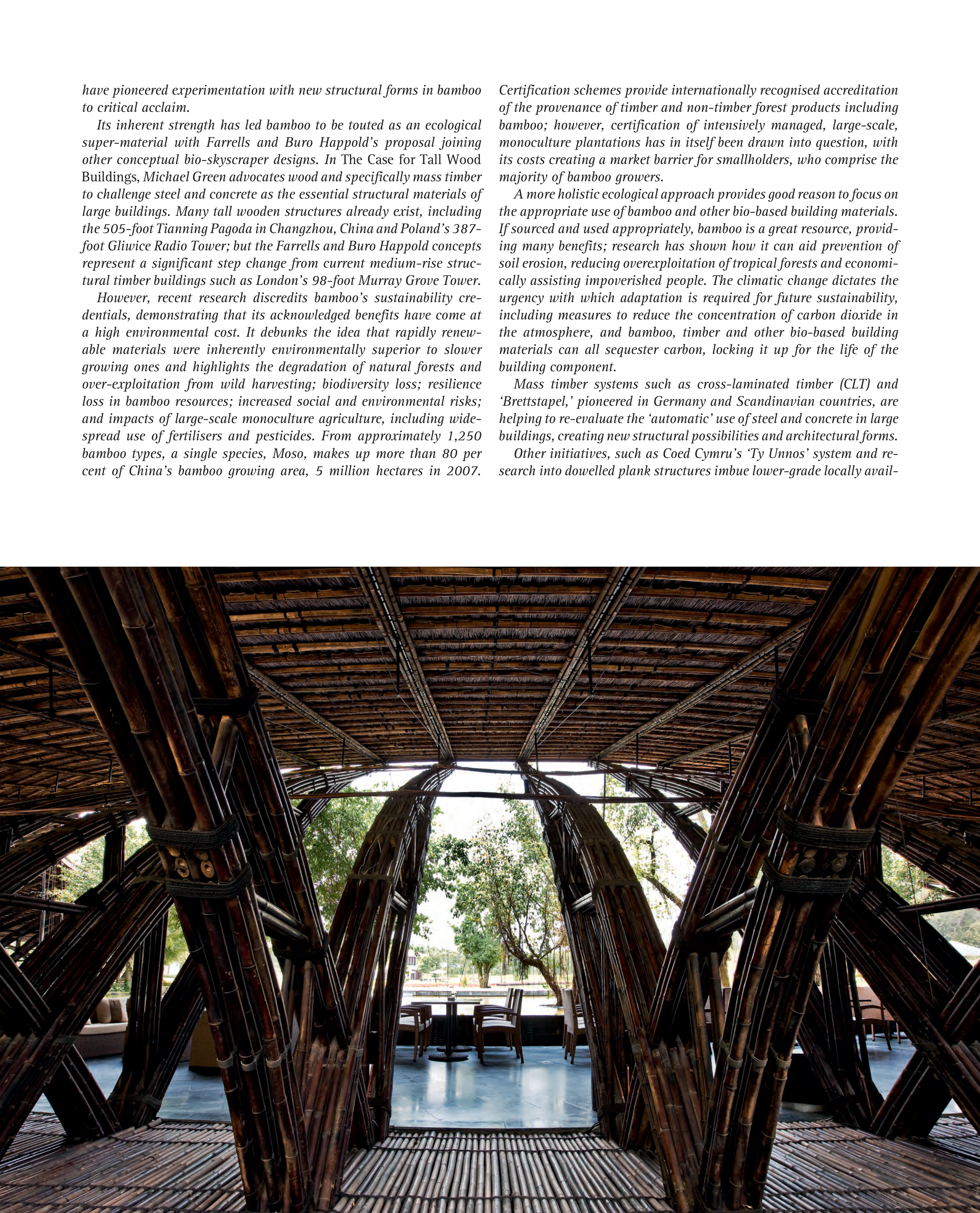
have pioneered experimentation with new structural forms in bamboo
to critical acclaim.
Its inherent strength has led bamboo to be touted as an ecological
super-material with Farrells and Buro Happold’s proposal joining
other conceptual bio-skyscraper designs. In The Case for Tall Wood
Buildings, Michael Green advocates wood and specifically mass timber
to challenge steel and concrete as the essential structural materials of
large buildings. Many tall wooden structures already exist, including
the 505-foot Tianning Pagoda in Changzhou, China and Poland’s 387-
foot Gliwice Radio Tower; but the Farrells and Buro Happold concepts
represent a significant step change from current medium-rise struc-
tural timber buildings such as London’s 98-foot Murray Grove Tower.
However, recent research discredits bamboo’s sustainability cre-
dentials, demonstrating that its acknowledged benefits have come at
a high environmental cost. It debunks the idea that rapidly renew-
able materials were inherently environmentally superior to slower
growing ones and highlights the degradation of natural forests and
over-exploitation from wild harvesting; biodiversity loss; resilience
loss in bamboo resources; increased social and environmental risks;
and impacts of large-scale monoculture agriculture, including wide-
spread use of fertilisers and pesticides. From approximately 1,250
bamboo types, a single species, Moso, makes up more than 80 per
cent of China’s bamboo growing area, 5 million hectares in 2007.
Certification schemes provide internationally recognised accreditation
of the provenance of timber and non-timber forest products including
bamboo; however, certification of intensively managed, large-scale,
monoculture plantations has in itself been drawn into question, with
its costs creating a market barrier for smallholders, who comprise the
majority of bamboo growers.
A more holistic ecological approach provides good reason to focus on
the appropriate use of bamboo and other bio-based building materials.
If sourced and used appropriately, bamboo is a great resource, provid-
ing many benefits; research has shown how it can aid prevention of
soil erosion, reducing overexploitation of tropical forests and economi-
cally assisting impoverished people. The climatic change dictates the
urgency with which adaptation is required for future sustainability,
including measures to reduce the concentration of carbon dioxide in
the atmosphere, and bamboo, timber and other bio-based building
materials can all sequester carbon, locking it up for the life of the
building component.
Mass timber systems such as cross-laminated timber (CLT) and
‘Brettstapel,’ pioneered in Germany and Scandinavian countries, are
helping to re-evaluate the ‘automatic’ use of steel and concrete in large
buildings, creating new structural possibilities and architectural forms.
Other initiatives, such as Coed Cymru’s ‘Ty Unnos’ system and re-
search into dowelled plank structures imbue lower-grade locally avail-