C 03 51
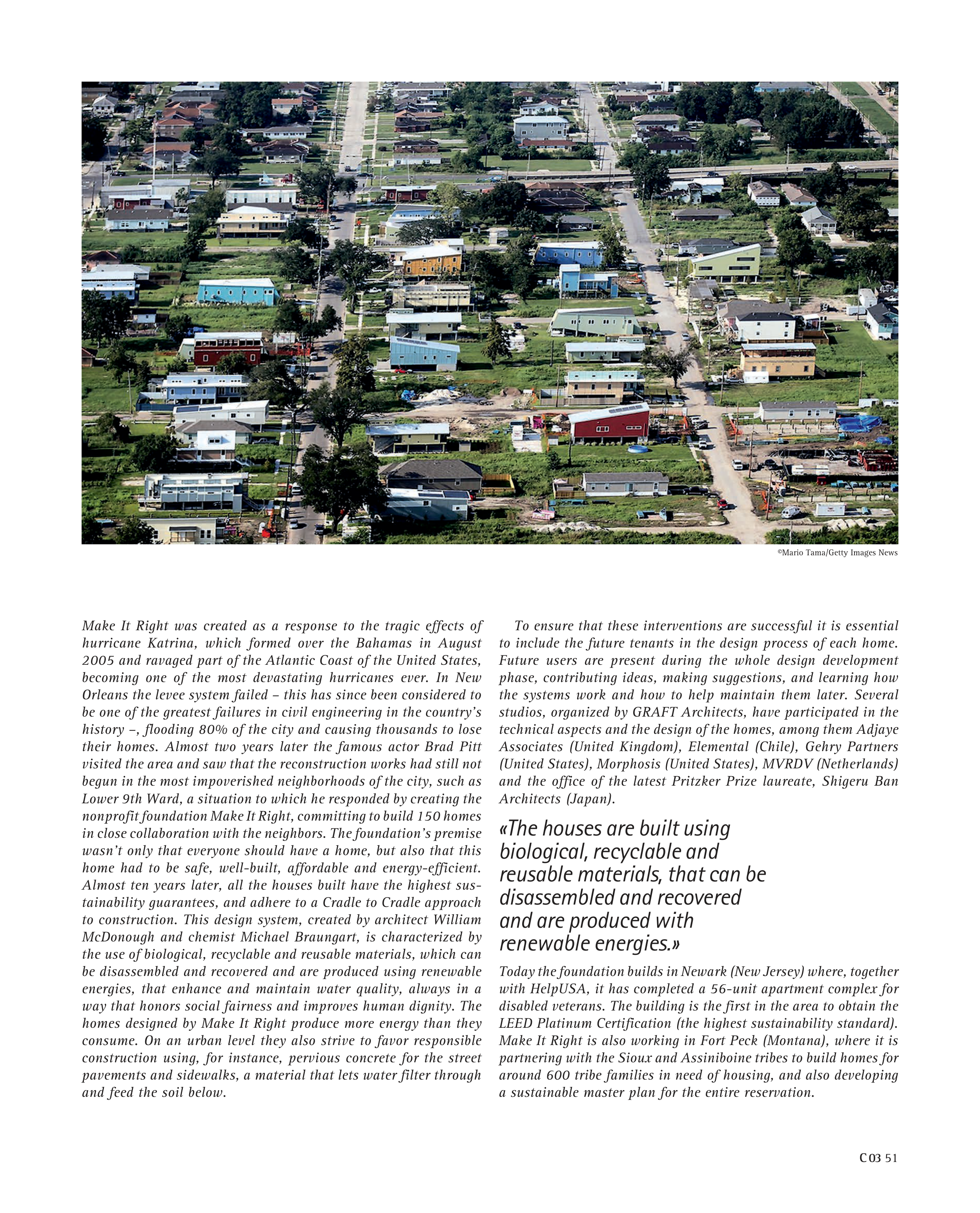
Make It Right was created as a response to the tragic effects of
hurricane Katrina, which formed over the Bahamas in August
2005 and ravaged part of the Atlantic Coast of the United States,
becoming one of the most devastating hurricanes ever. In New
Orleans the levee system failed – this has since been considered to
be one of the greatest failures in civil engineering in the country’s
history –, flooding 80% of the city and causing thousands to lose
their homes. Almost two years later the famous actor Brad Pitt
visited the area and saw that the reconstruction works had still not
begun in the most impoverished neighborhoods of the city, such as
Lower 9th Ward, a situation to which he responded by creating the
nonprofit foundation Make It Right, committing to build 150 homes
in close collaboration with the neighbors. The foundation’s premise
wasn’t only that everyone should have a home, but also that this
home had to be safe, well-built, affordable and energy-efficient.
Almost ten years later, all the houses built have the highest sus-
tainability guarantees, and adhere to a Cradle to Cradle approach
to construction. This design system, created by architect William
McDonough and chemist Michael Braungart, is characterized by
the use of biological, recyclable and reusable materials, which can
be disassembled and recovered and are produced using renewable
energies, that enhance and maintain water quality, always in a
way that honors social fairness and improves human dignity. The
homes designed by Make It Right produce more energy than they
consume. On an urban level they also strive to favor responsible
construction using, for instance, pervious concrete for the street
pavements and sidewalks, a material that lets water filter through
and feed the soil below.
To ensure that these interventions are successful it is essential
to include the future tenants in the design process of each home.
Future users are present during the whole design development
phase, contributing ideas, making suggestions, and learning how
the systems work and how to help maintain them later. Several
studios, organized by GRAFT Architects, have participated in the
technical aspects and the design of the homes, among them Adjaye
Associates (United Kingdom), Elemental (Chile), Gehry Partners
(United States), Morphosis (United States), MVRDV (Netherlands)
and the office of the latest Pritzker Prize laureate, Shigeru Ban
Architects (Japan).
Today the foundation builds in Newark (New Jersey) where, together
with HelpUSA, it has completed a 56-unit apartment complex for
disabled veterans. The building is the first in the area to obtain the
LEED Platinum Certification (the highest sustainability standard).
Make It Right is also working in Fort Peck (Montana), where it is
partnering with the Sioux and Assiniboine tribes to build homes for
around 600 tribe families in need of housing, and also developing
a sustainable master plan for the entire reservation.
«The houses are built using
biological, recyclable and
reusable materials, that can be
disassembled and recovered
and are produced with
renewable energies.»
©Mario Tama/Getty Images News