32 C 03
Doñana from the Air:
Natural Abstraction
A collection of landscapes
by Héctor Garrido
Arts
Photo
2
Cuenta el fotógrafo Héctor Garrido
(Huelva, 1969) en la memoria de esta
colección de paisajes que Cayetana de
Silva, Duquesa de Alba, era una mujer
excepcionalmente hermosa e inteligente
que vivió a finales del siglo XVII frente a
la desembocadura del río Guadalquivir,
y que el pintor Francisco de Goya
compartió con ella esos paisajes únicos
durante una intensa temporada, lo que
dio lugar a una estrecha relación entre
ambos. Ni Cayetana ni Goya volaron
nunca, pero en el Capricho nº 61 del
artista, denominado Volavérunt, se
representa a la duquesa volando, como en
una ensoñación. Volavérunt es también
el título de este compendio de fotografías
aéreas con las que Garrido no sólo ha
retratado la belleza de la emblemática
reserva natural andaluza, sino que además
ha servido para censar las aves de las
marismas de Doñana para la Estación
Biológica del parque. Es una importante
herramienta de gestión que ha desarrollado
durante años, junto a su piloto Hans
Nerlinger, que permite por un lado conocer
el estado de salud del espacio protegido
y su evolución en el tiempo, y por otro
imaginar, en cada viaje, cómo hubiera sido
la visión de la bella dama de Volavérunt
desde el cielo del grabado de Goya.
Photographer Héctor Garrido (Huelva,
1969) tells, in the description text of this
collection of landscapes, that Cayetana
de Silva, Duchess of Alba, was an
exceptionally beautiful and intelligent
woman who lived at the end of the 17th
century by the estuary of the Guadalquivir
River, and that painter Francisco de Goya
shared with her those unique landscapes
during an intense period, which prompted
a close relationship between both. Neither
Cayetana nor Goya ever had the chance
to fly, but in the artist’s Capricho no.
61, titled Volavérunt, the Duchess is
depicted in dreamlike flight. Volavérunt
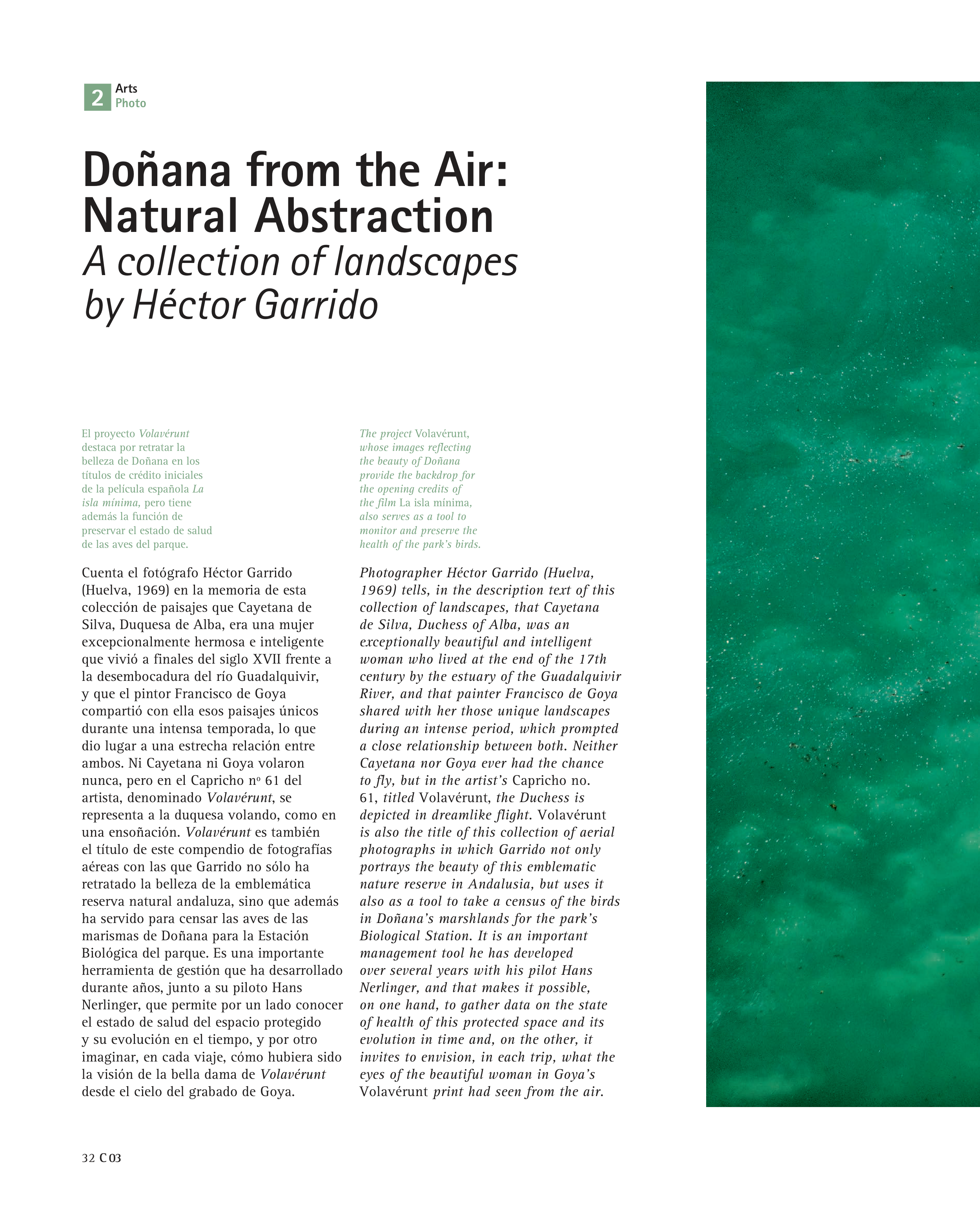
is also the title of this collection of aerial
photographs in which Garrido not only
portrays the beauty of this emblematic
nature reserve in Andalusia, but uses it
also as a tool to take a census of the birds
in Doñana’s marshlands for the park’s
Biological Station. It is an important
management tool he has developed
over several years with his pilot Hans
Nerlinger, and that makes it possible,
on one hand, to gather data on the state
of health of this protected space and its
evolution in time and, on the other, it
invites to envision, in each trip, what the
eyes of the beautiful woman in Goya’s
Volavérunt print had seen from the air.
El proyecto Volavérunt
destaca por retratar la
belleza de Doñana en los
títulos de crédito iniciales
de la película española La
isla mínima, pero tiene
además la función de
preservar el estado de salud
de las aves del parque.
The project Volavérunt,
whose images reflecting
the beauty of Doñana
provide the backdrop for
the opening credits of
the film La isla mínima,
also serves as a tool to
monitor and preserve the
health of the park’s birds.