C 02 55
already be implied within the term ‘digital fabrication.’ Conversely,
this means that architecture becomes the primary expression of its
fabrication process, separating itself from the traditional differentia-
tion between construction and fabrication. Even when the number
of functional requirements of a building element increases it is
possible to address them with simple material components. On that
scope, algorithmic design systems enable the selective manipulation
of fabrication data whereby material can be structured according
to its properties and functional requirements – a necessity when
assembling a large amount of small pieces to a greater whole. The
singular material elements are augmented with information that can
enhance their performance. This results in more complex design and
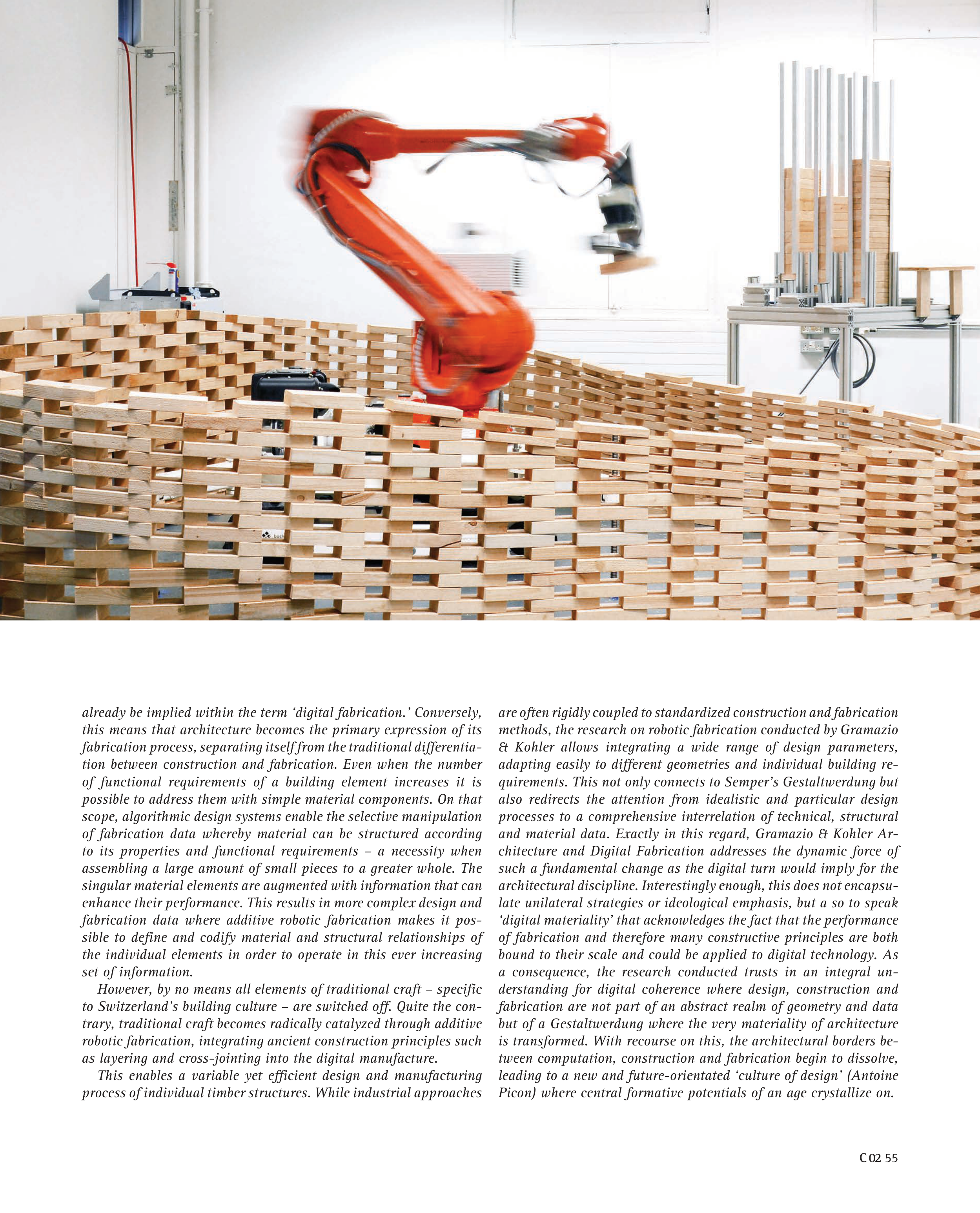
fabrication data where additive robotic fabrication makes it pos-
sible to define and codify material and structural relationships of
the individual elements in order to operate in this ever increasing
set of information.
However, by no means all elements of traditional craft – specific
to Switzerland’s building culture – are switched off. Quite the con-
trary, traditional craft becomes radically catalyzed through additive
robotic fabrication, integrating ancient construction principles such
as layering and cross-jointing into the digital manufacture.
This enables a variable yet efficient design and manufacturing
process of individual timber structures. While industrial approaches
are often rigidly coupled to standardized construction and fabrication
methods, the research on robotic fabrication conducted by Gramazio
& Kohler allows integrating a wide range of design parameters,
adapting easily to different geometries and individual building re-
quirements. This not only connects to Semper’s Gestaltwerdung but
also redirects the attention from idealistic and particular design
processes to a comprehensive interrelation of technical, structural
and material data. Exactly in this regard, Gramazio & Kohler Ar-
chitecture and Digital Fabrication addresses the dynamic force of
such a fundamental change as the digital turn would imply for the
architectural discipline. Interestingly enough, this does not encapsu-
late unilateral strategies or ideological emphasis, but a so to speak
‘digital materiality’ that acknowledges the fact that the performance
of fabrication and therefore many constructive principles are both
bound to their scale and could be applied to digital technology. As
a consequence, the research conducted trusts in an integral un-
derstanding for digital coherence where design, construction and
fabrication are not part of an abstract realm of geometry and data
but of a Gestaltwerdung where the very materiality of architecture
is transformed. With recourse on this, the architectural borders be-
tween computation, construction and fabrication begin to dissolve,
leading to a new and future-orientated ‘culture of design’ (Antoine
Picon) where central formative potentials of an age crystallize on.