C 25 65
He would say something like “One rainy
night…” and the class would have to draw
geometrical figures, ending up creating
absolutely abstract forms from figurative
phrases.
GM: These toys were instrumental in
forging our modernity and its artistic form.
JB: True, and it was also a time when in
architecture, no one was really sure what
style to build in, and precisely then, a great
many toys appeared in Gothic style, Ro-
manesque…
GM: Then the moderns adopted the aes-
thetic of the toys, but without stopping to
reflect on play. And after them came a pe-
riod, the 1960s and 1970s, that coincided
with the development of postmodernism,
where utopian thoughts were entertained
and toys became architectural models. Fig-
ures like Denise Scott Brown came into the
picture who caught on to the diversities of
play, not only of the toy. I can turn a piece
of paper into a toy. In fact, nowadays we
carry a huge number of toys right inside
our pockets.
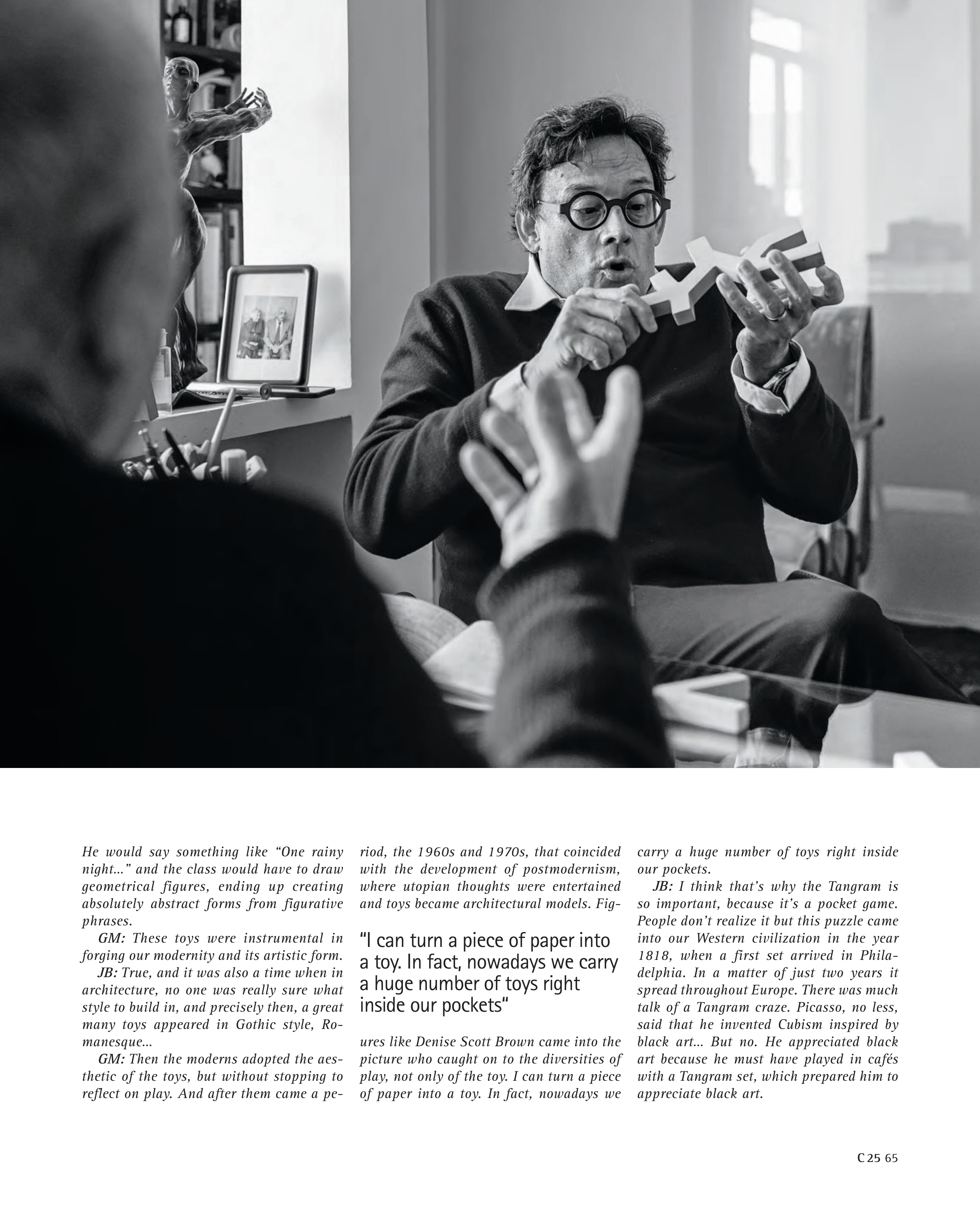
JB: I think that’s why the Tangram is
so important, because it’s a pocket game.
People don’t realize it but this puzzle came
into our Western civilization in the year
1818, when a first set arrived in Phila-
delphia. In a matter of just two years it
spread throughout Europe. There was much
talk of a Tangram craze. Picasso, no less,
said that he invented Cubism inspired by
black art… But no. He appreciated black
art because he must have played in cafés
with a Tangram set, which prepared him to
appreciate black art.
“I can turn a piece of paper into
a toy. In fact, nowadays we carry
a huge number of toys right
inside our pockets“